Making Senbei at Home
It is historically recognized that the provenance of sen-bei, 煎餅, is China, specifically introduced during the Heian era. Those early continental wafers were composed of wheat flour; however, owing to the Japanese preference for kome, 米, rice, became the primary ingredient for these sweets.
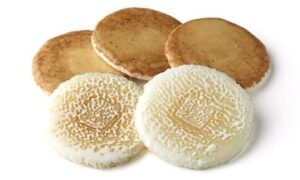
Sen-bei, 煎餅, toasted-mochi named ‘Matsu no Fū’, 松の風, Pine’s Wind, by Sue-tomi, 末富, Posterity-wealth, Kyōto. Showing both sides of the wafers. Note the outline of a square in the middle of the wafer, which is the silhouette of the small block of mochi flattened to create the senbei.
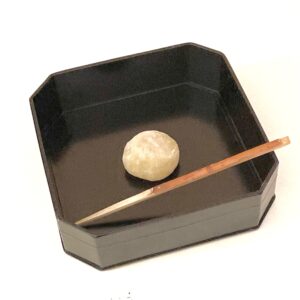
Left: fuchi-daka, 縁高, edge-high, black-lacquered octagonal box with dai-fuku, 大福, great-fortune, bean-jam wrapped in soft mochi with kuro-mo-ji, 黒文字, black-letter-character, pick.
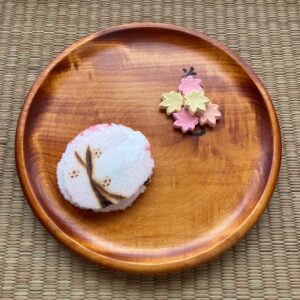
Right: hi-ga-shi bon, 干菓子盆, dry-sweet-of tray; round, wood tray with maple leaf raku-gan by Kan-shun-dō, 甘春堂, Sweet-spring-hall, Kyōto, and ‘Kiyo Sen-bei’, 清煎餅, Pure-toasted-mochi, by Palmer, Boston, Mass.
The round tray is made of wood salvaged from a restoration of Ja-kkō-in, 寂光院, Tranquil-light-sub-temple, Kyōto.
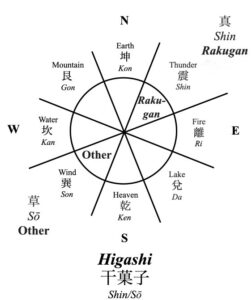
Trigram for Sōn, Tatsumi, 巽, (Southeast), ☴, is identified with the concept of Wind, in Japanese fu, fū, kaze, 風. The Kanji, 巽, is read as tatsu and mi, 辰 and 巳, (Asian zodiac) Dragon and Snake, which may be an example of the top two radicals of the tatsu Kanji being a duplication of the Kanji 已, as it is two mi together – 已已.
The higashi placed in this area is identified with the formality of Sō, 草, Grass. Borrowed from the three styles of calligraphy: Shin, 真, True, Gyō, 行, Transitional, Sō, 草, Grass. The rakugan molded sugar sweets from shrines and temples are Shin. The fresh omogashi served with koicha is Gyō.
Higashi are dry as the name indicates, because they are handled with the fingers, The omogashi is moist and is handled and eaten using a wooden pick – kuro-mo-ji, 黒文字, black-letter-character.
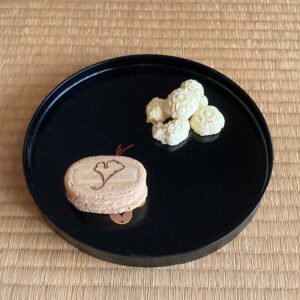
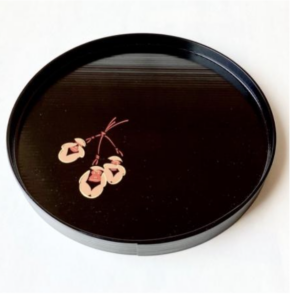
Maru-bon, 丸盆, round-tray; black lacquered throughout with design of bells modeled on ‘mi–zaru’, 三猿, three-monkey or, fu-yaki, 麩焼き, wheat gluten-toast, with scorched design of a gingko leaf, designed by Sen To-mi-ko, 千登三子, Thousand Ascend-three-child, made by Suetomi for Urasenke. One kind of sweet is randomly arranged, while the other is stacked. The sweets should be placed in the correct locations regardless of the design on the tray.
Five pieces of each kind of sweet for four guests. Each guest has both kinds of sweets, together with a bowl of usucha. One piece of each sweet is left on the tray for the host or for offerings. Note the oblong silhouette of the gluten fu, 麩, senbei that was pressed to form the oval.
It is believed that senbei were brought to Japan from China (Tang Dynasty) during the Heian period by Kū-kai, 空海, Empty-sea, Kō-bō Dai-shi, 弘法大師, Wide-law Great-master, the founder of the Shingon sect of Buddhism. A well-known theory suggests that the rice cracker was made using a recipe he learned while visiting China for Buddhist training, and that this became the origin of modern rice crackers.
Ko-kū-zō Bo-satsu, 虚空蔵菩薩, Empty-void-possess Grass-buddha, known in Sanskrit as Akasagarbha Bodhisattva, represents vast and boundless merit and wisdom, capable of fulfilling the desires of all beings. The Heart Sutra, Han-nya-kyō, 般若経, Carry-young-sutra, known in Sanskrit as the Prajnaparamita Sutra, Perfection of Wisdom Sutra, is a core scripture in Mahayana Buddhism that elucidates the wisdom of emptiness. Both are important practices for developing wisdom and purifying the mind.
Sen-bei, 煎餅, toast-mochi; Kanji, hei, 餅, rice-cake, is composed of shoku, 食, eat, food, and hei, 并, together.
For making mochi senbei:
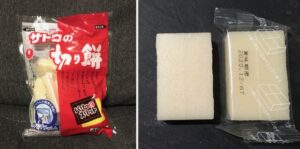
Bulk package of kiri-mochi, 切り餅, cut-mochi, by Satō Shoku-hin, サトウ食品, Satō Food-stuff, 新潟市, New-lagoon-city. Two blocks of mochi; one piece in cellophane wrapping.
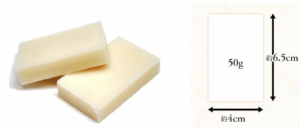
Making Senbei from a block of mochi;
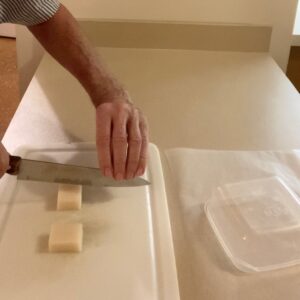
Cutting the mochi block in half – each subsequent piece is cut in half to be pressed into 16 flat, circular senbei.
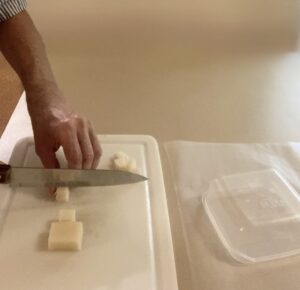
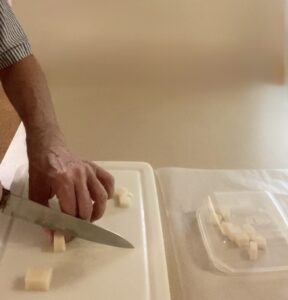
Cut mochi is temporarily kept covered to lessen drying.
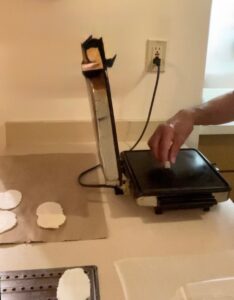
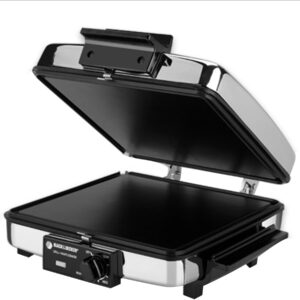
Placing a cube of mochi on the griddle surface of the waffle maker.
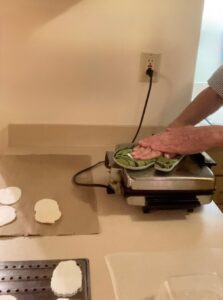
Pressing the cube of mochi until the mochi cube softens. As the mochi is hard, the top plate must be pressed evenly which may take a minute or so until it no longer rocks. Balancing the top plate makes the wafer round, otherwise the wafer would be misshapenned. The top plate is lifted to check the grilling process.
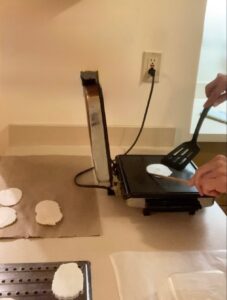
The pressed mochi is flipped periodically until its desired doneness.
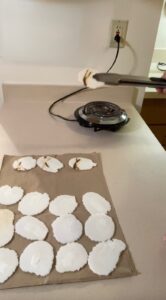
Scorching the mochi imparts a flavor that is enjoyed as the mochi on its own has little flavor. Scorch marks are achieved in many different ways. An electric coil burner is used here to make an abstract marking.
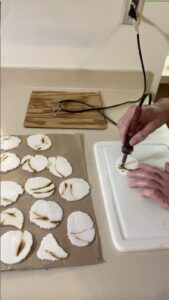
Additional scorching can be done with an electric wood-burning tool.
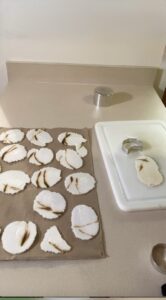
Trimming the senbei with a circular and crescent cutter.
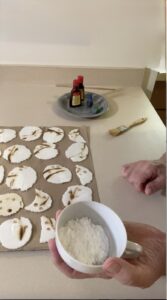
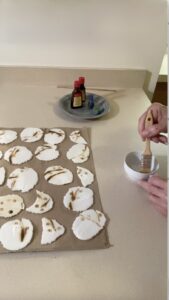
Confectioners’ sugar to be mixed with a small amount of water, and coloring. Domino Pure Cane Confectioners Sugar, 10-X powdered sugar.
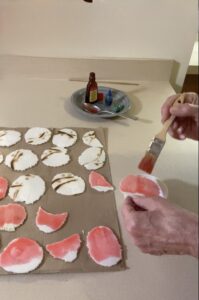
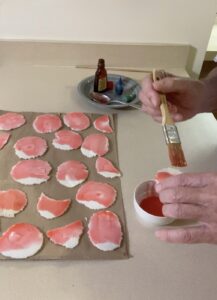
Brushing the senbei with icing. Brushing icing on the area where the senbei was held for the first application.
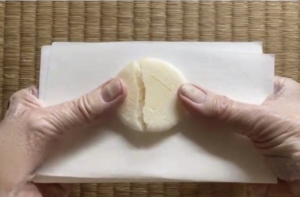
Finished senbei: diam. approximately 1.8 sun kane-jaku. The wafer is named ‘Kiyo Sen-bei’, 清煎餅, Pure Toasted-mochi – which is borrowed from my cha-mei, 茶名, tea-name: Sō-sei, 宗清, Sect-pure. The sweet is enjoyed by placing it on kai-shi, 懐折, heart-paper.
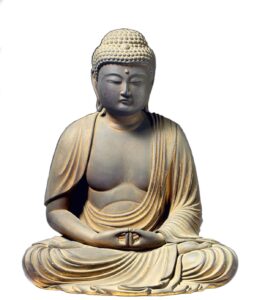
The hand movement briefly emulates the mudra of Amida Buddha, called the mi-da-jō-in, 陀弥定印, increase-steep establish-sign. It also serves a practical purpose, if the senbei is pushed downward, the wafer will be crushed, and there may be many crumbs. Pressing upward with the fingers the senbei is ‘opened’, an invitation to enter the spirit world, whereas pushing downward with the thumbs ‘closes’ the senbei. After breaking open the senbei one half may be broken again, or it may be bitten and chewed up in many small pieces. From the Tao De Ching, verse 42: ‘From one becomes two, from two becomes three, and from three all things arise’.
For further study see also: Sweets for Usucha and Kaishi: Heart of Paper