Sweets for Usucha
In Chanoyu, 茶の湯, Tea-’s hot water, there are many things that are in groups of three. They are predominantly identified with the three levels of formality: Shin, Gyō and Sō, 真行草, True (formal), Transitional (semi-formal), and Grass (informal). These three aspects have their origin in calligraphy, sho-dō, 書道, brush-way.
These dry sweets, known as hi-ga-shi, 干菓子, dry-sweet-of, are a foundational component served with thin tea. Their primary substance is a sugar base, often utilizing the high-quality wa-san-bon, 和三盆, Japanaese-three-tray. When starches such as rice flour or soybean flour are added, they are commonly referred to as raku-gan, 落雁, alighting-geese. After shaping the sweet in a wooden mold, the form is struck to release the sweets from the mold. This gives the sweet its name of uchi-mono, 打物, hit-thing.
To the touch, higashi are characteristically dry, yet they melt quickly upon the tongue, offering a delicate sweetness. Sweets such as rakugan that are served with usu-cha, 薄茶, thin-tea, can also be crunchy and make noise.
The sweets are pressed into forms kata-mono, 形物, shape-thing, and are generally of intricate shape, often representing the changing shiki, 四季, four-seasons, such as cherry blossoms or maple leaves. Additionally, they may take the form of nature’s emblems, or personas and gods familiar in Japanese culture. These small forms provide contemplation and delight for the eyes, anticipating the thin tea.
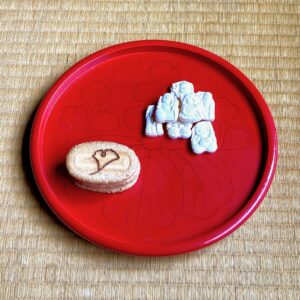
Two kinds of higashi are offered to guests before preparing usucha. As pictured above, a kind of rakugan is essential, and is placed in the upper right quadrant of the tray. In the opposite quadrant is a different type of higashi. One kind of sweet is organized as a single unit, while the other sweet can be in more clustered. The placement of the sweets ought not create a type of ‘scene’.
On the tray, pictured above, in the upper right quadrant is higashi, an uchi-mono, 打物, struck-thing, molded sugar in the form of ‘Shichi-fuku-jin’, 七福神, Seven-fortune-gods. In the lower left quadrant are several wheat fu-no-yaki, 麩の焼き, gluten-’s-toasted, with a branded ginkgo leaf motif.
The Shichi-fuku-jin, 七福神, Seven-fortune-gods are said to pilot through the heavens the Takara-bune, 宝船, Treasure-boat.
- Eb-i-su, 恵比寿, Joy-like-longevity (Deva) is the only one of the Seven Lucky Gods whose origins are thought to be purely Japanese. He is the god of prosperity and wealth in business, and of abundance in crops, grains, and food in general.
- Dai-koku-ten, 大黒天, Great-black-heaven (Deva) is the god of commerce and prosperity, and he is sometimes considered the patron of cooks, farmers and bankers, and is also a protector of crops.
- Bi-sha-mon-ten, 毘沙門天, Assist-san-gate (Deva) origins can be traced back to Hinduism, but he has been adopted into Japanese culture. He comes from the Hindu god Kubera and is also known by the name Vaisravana. He is the god of sucsess in war and battles, also associated with authority and dignity.
- Ben-zai-ten, 弁才天, or , 弁財天, origin is found in Hinduism, as she comes from the Hindu goddess Saraswati. She is the only female Fukujin in the modern grouping. She is the patron of artists, writers, dancers, and geisha, among other creatives.
- Ju–rō-jin, 寿老人, Longevity-elder-person, the god of the elderly and of longevity in Japanese Buddhist mythology. It is said that the legendary Jurōjin is based on a real person who lived in ancient times. Jurōjin enjoys rice and wine and is a very cheerful God.
- Ho-tei, 布袋, Cloth-bag,is the god of fortune, guardian of children, patron of diviners and barmen, and also the god of popularity.
- Fuku-roku-ju, 福禄寿, Fortune-wealth-longevity, also has his origins in China. It is believed that he used to be a hermit during the Chinese Song dynasty, and is said to be a reincarnation of the Taoist god Hsuan-wu. He is the god of wisdom, luck, longevity, wealth and happiness.
In Tea, there are two kinds of sweets, ka-shi, 菓子, sweet-of: nama-ga-shi, 生菓子, live-sweet-of, that are ideally made just before serving. The higashi may be made and kept for some time before offering them to guests. The higashi are dry because they are eaten using the fingers. Ideally, two types of higashi are presented, so that, collectively, throughout the serving of koi-cha, 濃茶, and usu-cha, 薄茶, thin-tea, there are three kinds of sweets that can be identified with Shin, Gyō and Sō.
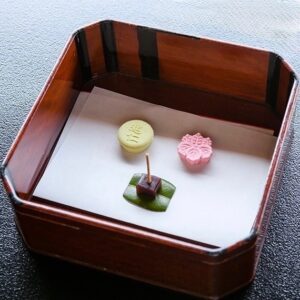
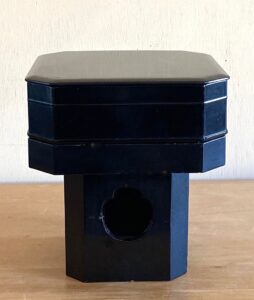
Left: three okashi placed in an octagonal box called a fuchi-daka, 縁高, edge-high, served at Ken-nin-ji, 建仁寺, Build-benevolence-temple. Right: one tier of a fuchi-daka is placed on a black-lacquered san-bō, 三宝, three-treasures; which happens to be the identical same width of 5.5 sun kane-jaku.
The dark cube, pictured in the lower portion of the fuchidaka, is ‘piri-kon’, ぴりコン, spicy-devil’s-plant, which is contracted from piripiri konjaku, It is pieces of konjac steeped in shō-yu, 醤油, miso-oil, flavored with chilies, sugar, sesame oil, and is sauteed in oil and thence eaten with a toothpick. It is identified as a style of konnyaku.
The piri piri is a very hot and spicy chili pepper, a cultivar of Capsicum frutescens.
The konnyaku is placed on a trimmed tsubaki no ha, 椿の葉, camelia ’s leaf, which is related to tea. A toothpick, commonly made from a willow, is the first of the eight things that a Buddhist may own. Willow helps to dispel headaches, and has other medical uses.
Because the ingredient konjac in the sweet is wet and or oily, the sweet is eaten with the toothpick. In Chanoyu, a pick made of kuro-mo-ji, 黒文字, black-character-letter, spice bush wood is substituted for the willow toothpick. The ideal length of the kuromoji pick is 6 sun kane-jaku; the number six, roku, 六, is symbolic of Infinity in Time.
After eating the primary sweet, the ko-haku, 紅白, red-white, sweets are wrapped in the paper lining of the box, and taken home. The kohaku sweets are in the forms of the temple’s name and mon-ka, 紋菓, crest-sweet, pink and white are kinds of rakugan. These sweets are served at the temple during the Yotsu-gashira, 四頭, Four-heads, tea drinking in memory of Eisai who introduced Zen and tea-drinking. Kenninji is the first Zen temple in Kyōto, founded in 1202, by Eisai upon his return from Buddhist studies in China.
The rites of Yotsugashira are accompanied with offerings of Tea to Eisai’s memory, The Japanese word for offerings is sonaeru, 供, and ku-motsu, 供物, offer-thing, is placed on a Butsu-dan, 仏壇, Buddha-altar. When offerings are made at Kenninji, the altar is raised, so that the priest carrying the objects intentionally stomps up the first part of the stairs. His tread becomes ever more gentle as he nears the offering area that is likened to heaven.
The nama-gashi, is generally called the omo-ga-shi, 主菓子, main-sweet-of, and is served with koi-cha, 濃茶, thick-tea. As it is fresh, it should be eaten ‘now’, and therefore represents the present and Gyō, transitional. In a formal Tea, the omogashi is usually served in the fuchi-daka.
The two different higashi should include rakugan, which is made of ultra-refined sugar called wa-san-bon-tō, 和三盆糖, harmony (Japan)-three-trays-sugar, and a special rice flour. These ingredients have their origins in Shin-tō, 神道, God-way, and Bu-kkyō, 仏教, Buddha-faith. As they are associated with faith, uchimono may be regarded as Shin, True. Of the other higashi, which, if the sweets are identified with three levels of formality, the third sweet should have some aspect identified with Sō, also read kusa, 草, grass, and that would suggest a grain such as rice, wheat, etc. A logical choice would be a sen-bei, 煎餅, toast-rice cake.
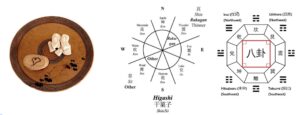
In the I Ching (Jpn. Eki-kyō), 易経, Change-sutra, Xun, Son, Wind, ☴, is one of the eight trigrams representing Wind or Wood with regards to the go-rin,五輪, five-rings, and the go-gyō,五行, Five-transitions respectively. Wind symbolizes gentleness, obedience, humility, and the ability to penetrate. In a context related to rice (grains), it is interpreted as a sign of a bountiful harvest, Wind bringing blessings to the grain (rice), or riding the trend.
The I Ching is consulted using various methods to cast hexagrams, most notably via fifty traditional sticks called zei-chiku, 筮竹, divine-bamboo, yarrow sticks, grains of rice can be used, or three coins.
The yarrow method, often used with yarrow stalks (or substitutes like bamboo sticks).The most common Japanese name for yarrow (Achillea millefolium) is sei-yō nokogiri-sō, 西洋鋸草, west-sea saw-grass, for its leaf shape: it is also known simply as nokogiri-sō, 鋸草, sawgrass.
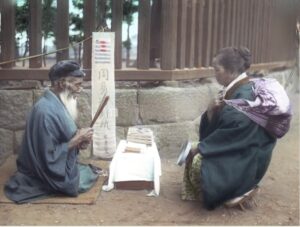
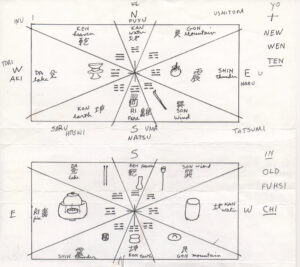
For reference, below are the eight trigrams of the Ekikyō. These are the same trigrams seen on the ha-kke bon, 八卦盆, eight-sign tray, used in some tea presentations.
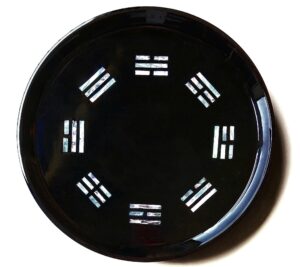
Ha-kke bon, 八卦盆, eight-sign tray, black-lacquered wood with ao-gai, 青貝, blue-shell, inlay of the eight trigrams of the Eki-kyō, 易経, Change-sutra. 8.8 sun kujira-jaku. The hakke bon trigrams, 三卦, three-sign, shown in the picture above from 12:00 clockwise are: Kan, 坎, Water, Gon, 艮, Mountain, Shin, 震, Thunder, Son, 巽, Wind, Ri, 離, Fire, Kon, 坤, Earth, Da, 兌, Lake, Ken, 乾, Heaven.
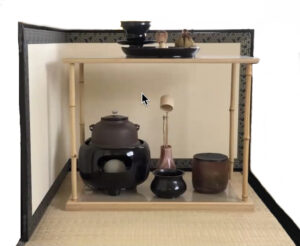
Left: take dai-su, 竹台子, bamboo support-of, with arrangement of utensils for Gyō presentation of Tea.
Right: drawing of the two trigram arrangements as they influence aspects of Rikyu’s take-dai-su, 竹台子, bamboo-support arrangement. The ji-ita, 地板, earth-board is influenced by the old arrangement with fire on the left in the furo, and ten-ita, 天板, heaven-board is influenced by the new arrangement.
There are two arrangements of the Ekikyō trigrams. One corresponds with the arrangement of Rikyū’s tenita of the take daisu, seen as pictured on the hakke bon, and the tenita diagram above, from 12:00 clockwise:
☵ ☶ ☳ ☴ ☲ ☷ ☱ ☰
- Kan, Kan, 坎, Water, ☵, Abyssal, Second Son, Water, North.
- Gen, Gon, 艮, Mountain, ☶, Stillness, Third Son, Earth, Northeast.
- Zhen, Shin, 震, Thunder, ☳, Arousing, First Son, Wood, East.
- Xun, Son, 巽,Wind, ☴, Gentle, First Daughter, Wood, Southeast.
- Li, Ri, 離, Fire, ☲, Clinging, Second Daughter, Fire, South.
- Kun, Kon, 坤, Earth, ☷, Receptive, Mother, Earth, Southwest.
- Dui, Da, 兌, Lake, ☱, Joyful, Third Daughter, Metal, West.
- Qian, Ken, 乾, Heaven, ☰, Creative, Father, Metal, Northwest.
The old arrangement corresponds with the jiita of Rikyū’s take daisu:
☰ ☷ ☳ ☴ ☵ ☲ ☶ ☱
- Qian, Ken, 乾, Heaven, ☰, Creative, Father, Metal, Northwest.
- Kun, Kon, 坤, Earth, ☷, Receptive, Mother, Earth, Southwest.
- Zhen, Shin, 震, Thunder, ☳, Arousing, First Son, Wood, East.
- Xun, Son, 巽,Wind, ☴, Gentle, First Daughter, Wood, Southeast.
- Kan, Kan坎, Water, ☵, Abyssal, Second Son, Water, North.
- Li, Ri, 離, Fire, ☲, Clinging, Second Daughter, Fire, South.
- Gen, Gon, 艮,Mountain, ☶, Stillness, Third Son, Earth, Northeast.
- Dui, Da, 兌,Lake, ☱, Joyful, Third Daughter, Metal, West.
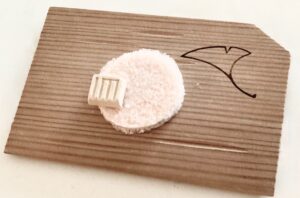
The raku-gan is in the shape of a Genji-kō no Zu, (Chapter 19, ‘Usu-gumo’, 薄雲, Thin-cloud), this sweet is eaten first, before the first bowl of usucha. This round sweet, named ‘Usu-beni’, 薄紅, Thin-rouge, is a rice senbei filled with sweetened ume boshi, by Sue-tomi, 末富, Posterity-wealth, Kyōto. The cedar board was made to present Urasenke sweets.
Note that the far right corner of the board has been cut away so that the board has five corners, which is more auspicious than four corners. The far right corner in Asian geomancy is identified as the ki-mon, 鬼門, demon-gate. It is believed that it requires protection from nor’easter storms that are more harsh emanating from that direction. It has been contended that the oni of the demon gate is a wrathful form of a benevolent protector against the wind, rather than an ‘evil’ spirit. In Buddhism, a pair of demons that guard the entrances to temples are called Ni-ō, 仁王, Benevolent-kings. It is a curious coincidence that the word nio is comprised of the same sounds as oni.
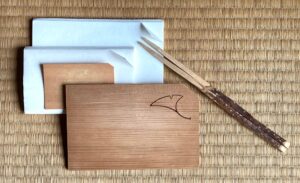
Note the far right corner of the board is mitered, which mimics the corner of the kai-shi, 懐紙, heart-paper, is used to wipe the tip of the kuro-mo-ji, 黒文字, black-character-letter.
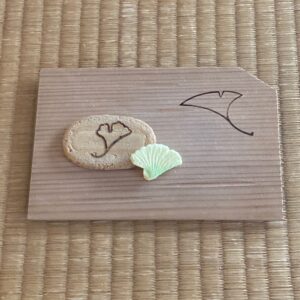
Single serving of both higashi: rakugan in the shape of a ginkgo leaf, and wheat fu-no-yaki, 麩の焼き, gluten-’s-toasted, with a branded ginkgo leaf motif, designed by Sen To-mi-ko, 千登三子, Thousand Ascend-three-child, wife of Hōunsai. The manner in which the single serving of sweets is presented on an usu-ita, 薄板, thin-board, as the rakugan is eaten first.
The i-chō, 銀杏, silver-apricot, (Ginkgo biloba), ginkgo leaf is a design motif as a symbol of Urasenke, and, particularly, of Sen Sō-tan, 千宗旦, Thousand Sect-dawn, Rikyū’s grandson, the founder of the three Sen families. Sōtan planted a ginkgo tree on the Sen property in Kyōto which rained sap that helped protect his Tea hut named Yū-in, 又隠, Again-retire, from the Great Tenmei Fire of 1788 (Ten-mei no Tai-ka, 天明の大火, Heaven-bright ’s Great-fire) which was the most devastating fire in Kyōto’s history, destroying over 80–90% of the city from March 6–8, 1788.
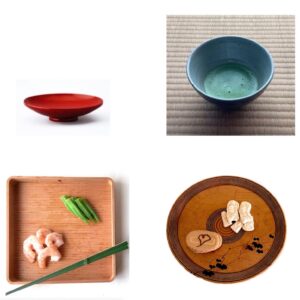
Upper left: red-lacquered sakazuki, 盃, sake cup. Upper right: cha-wan, 茶碗, tea-bowl, containing usu-cha, 薄茶, thin-tea.
Lower left: ha-ssun bon, 八寸盆, eight-sun (‘inch’) tray, sugi, 杉, cedar, made wet, containing okra representing yama-no-mono, 山の物, mountain-’s-thing, and e-bi, 海老, sea-elder, shrimp representing the umi-no-mono, 海の物, sea-’s-thing. These foods together with sake, hara-no-mono, 原の物, field-of-thing, made with rice from the field, represent the san-bō, 三方, three-directions – yama umi hara, 山海原, mountain sea field. The food is distributed by the host using the naka-bushi ao-dake hashi, 中節青竹箸, middle-node green-bamboo sticks. The foods are presented on the ha-ssun bon, 八寸盆, eight-‘inch’ tray, which has its origins in the san-bō, 三宝, three-treasures, of Kasuga Tai-sha, 春日大社, Spring-sun Great-shrine, Nara.
Lower right: maru-bon, 丸盆, round-tray, wood, containing hi-ga-shi, 干菓子, dry-sweet-of; raku-gan, 落雁, alighting-geese, and fu-no-yaki, 麩の焼き, gluten-’s-toasted.
The order of service of ‘hassun’ is: sip sake, eat (sakana) umi no mono, sip sake, eat (sakana) yama no mono – the accompanying mnemonic is ‘sake sakana’. There is also a correlation with the manner of enjoying thin tea which is ideally presented with each of the guests being offered two individual bowls of tea during the course of the presentation. Usucha: eat rakugan, Shin higashi, drink (ippuku); eat Sō higashi drink (ippuku) second bowl.
It is interesting to compare the aspects of the hassun bon and the standard higashi bon. The hassun bon is four-sided, plain cedar wood made wet before arranging the foods, whereas the higashi bon, which has a standard diameter of hassun, is usually round, lacquered black and/or red, dry.
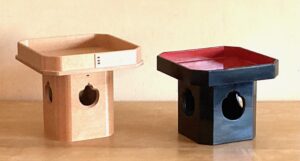
Two san-bō, 三方, three-directions, also called san-bō, 三宝, three-treasures (sea, plain, mountain): the plain hinoki, 檜, Japanese cypress, (Chamaecyparis obtusa), stand evokes Shintō, and the black and red lined stand evokes Buddhism, and its san-bō/san-pō, 三宝, three-treasures: Bu-ppō-sō, 仏法僧, Buddha, Dharma, Sangha, translated as Buddha, Principle, Community. The tray of the sanbō is called the o-shiki, 折敷, fold-spread, the supporting base is called the do, 胴, body. The ratio between the width and the diagonal of the tray is approximately 8 to 10, which is the profoundly symbolic number 18, and represents ‘life’. Both sanbō are made in a myriad of sizes.
Both stands are made of wood in the manner of mage-mono, 曲物, bend-thing, which is partially saw cut so that the wood will bend. The supporting body has openings in the shape of hō-ju, 宝珠, treasure-jewel, on three sides. The side without the opening is deemed the front, shō-men, 正面, correct-face, as it is an offering and therefore is facing deity in the north.
With magemono, there is usually a toji-me, 綴じ目, compose-space, seam, which has a mnemonic phrase: ‘maru-mae kaku-mukō’, 丸前角向, round-fore corner-opposite. A round object has the seam at the front, and a cornered object has the seam at the back. The shōmen determines the placement of the object. The plain wood mage sanbō tray shows the seam at the back according to the cornered form, as its shōmen is facing deity in the North.
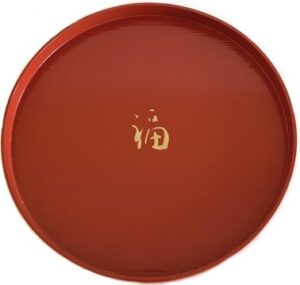
Maru bon, 丸盆, round tray: applied bentwood gallery on textured wood circle, covered with red lacquer, with gold Kanji character for ‘fuku’, 福, fortune; diam. 7.3 sun kane-jaku, by Tachi-kichi, 橘吉, Mandarin orange-luck, Kyōto.
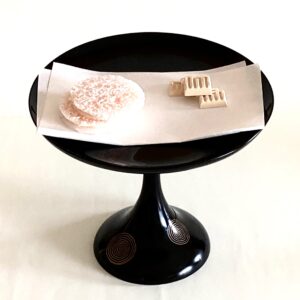
Higashi presented on a folded sheet of kai-shi, 懐紙, heart-paper: rakugan in the form of Genji Kō-no-zu, 源氏香の図, Genji Incense’s motif, and ‘Usu-beni’, 薄紅, Thin-rouge, rice rounds sandwiching sweet ume-boshi, 梅干, ‘plum’-dry, jam, by Suetomi.
Sweets pictured above are presented on a taka-tsuki, 高坏, tall-cup, maru-bon, 丸盆, round-tray, elevated on ‘trumpet’ pedestal; wood lacquered black throughout with gilt spiral design motif, for serving a deity or ki-nin, 貴人, noble-person. During certain Tea presentations, an abundance of sweets is offered to the nobility on a raised utensil.
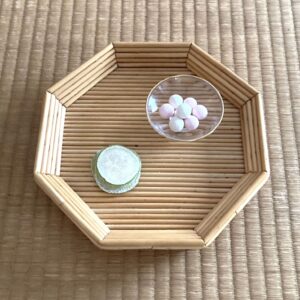
Higashi; raku-gan tama, 落雁玉, descending-geese balls, in gold-rimmed glass sakazuki, 盃, sake cup, which keeps the small balls from rolling around, and gelled rice wafer named ‘Natsu Yu-zu’, 夏柚子, Summer Citus-of, by Oi-matsu, 老松, Aged-pine, sweet shop in Kyōto. The sweets are presented on a ha-kkaku bon, 八角盆, eight-corner tray; constructed of dried reeds; 7.5 sun kane-jaku; Indonesia.
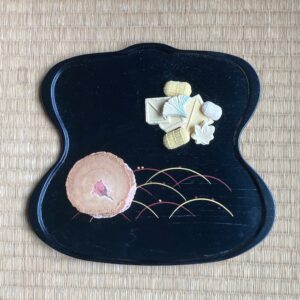
Higashi – ‘fuki yose’, 吹寄, blown-together, are the past years rakugan and round wheat senbei, including various plant parts, called ‘Ki-setsu’, 季節, season-division. The sweets are presented on a hisago bon, 瓢盆, gourd tray; black lacquered through with red and white ‘dewy grass’ motifs; width 9 sun kane-jaku, by Zō-hiko, 象彦, Elephant-boy.
Fukiyose sweets are the remainders of the higashi served that past year, nokori, 残, leftover, and are offered to the guests in October at the end of the season when using the furo. Most people purchase new fresh sweets in a variety of forms emblematic of the autumn season: colorful leaves, pine needles and cones, acorns, mushrooms, etc. which misses the point of fukiyose including the precept of not wasting that which is at hand.
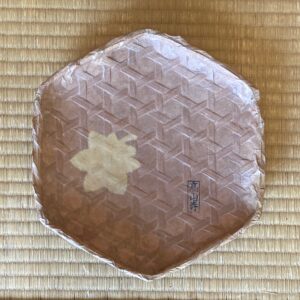
Hi-ga-shi bon, 干菓盆, dry-sweet-of tray; hexagonal, shallow, bamboo basket covered with persimmon juice-tanned paper throughout, with applied, tan paper stylized maple leaf, and stamped with the name of Kō-san-ji, 高山寺, High-mountain-temple; width 9 sun kane-jaku. The temple is in an area north of Kyōto, famed for its beautiful autumn colorful maple trees.
The somewhat eccentric Buddhist priest Myō-e, 明恵, Radiant-joy, of Kosan-ji, planted tea seeds given to him by Ei-sai, 栄西, Splendor-west, upon his return from Buddhist studies in China. This is considered the ‘first’ tea grown in Japan – the hon-cha, 本茶, origin-tea.
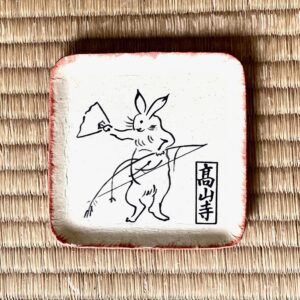
Small, square, paper tray with a printed image of a hare featured in the celebrated e-maki, 絵巻, picture-scroll, ‘Chō-jū Gi-ga’, 鳥獣戯画, Bird-beast Play-picture, which is the property of Kō-san-ji, 高山寺, High-mountain-temple. Width: 3.7 sun kane-jaku, one of a set of five trays with different images and edge colors.
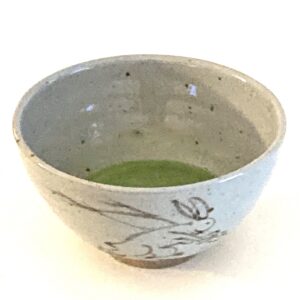
Cha-wan, 茶碗, tea-bowl, stoneware with design of an usagi, 兎, hare, carrying susuki, 芒, eulalia, Shiga-raki yaki, 信楽焼, Faith-pleasure fired, stamped katsu, 濶, wide; made by Kon-dō Hiroshi, 近藤濶, Near-wisteria Wide; diam. 4.7 sun kane-jaku. The bowl was made for the 750th anniversary of the founding of Kō-san-ji, 高山寺, High-mountain-temple. The design of the hare is taken from the temple’s great 13th century treasure of the ‘Chō-jū-gi-ga’, 鳥獣戯画, Bird-beast-frolic-picture, picture scroll of drawings of animals enacting and characterizing human behavior. The potter, Kondō, was a Living National Treasure. The chawan was a gift from the wife of abbot of Kōsanji.
The sweets served in Chanoyu can be highly symbolic elements that serve as a direct reflection of the presentation’s foundational structure, particularly the three levels of formality: Shin, Gyō, and Sō. When sweets are served with koicha and usucha in one complete presentation, they collectively express the full philosophical triad of Shin, Gyō, and Sō. Sweets for Tea, and their serving implements, are designed and arranged to embody profound cultural, religious, and philosophical concepts.
Foe further study, see also: Seasonal Higashi – Sweets for Thin Tea and Anatomy of Japanese Tea Ceremony: Five Elements and Ekikyō