Illumination in the Tokonoma
In traditional Japanese architecture, the toko-no-ma, 床の間, floor-’s-room, is a central feature and acts as the central artistic, and perhaps, spiritual focal point. It is raised slightly above the main tatami mat floor to show it is a special space.
The curated selection of the objects in the tokonoma are intentionally arranged to harmonize with the season, the overarching theme of the gathering, or the particular sensibilities of the guest, or the host, and first function as a type of silent greeting. Through this precise presentation, a unique sanctuary is created, honoring the singular nature of this encounter, ichi-go ichi-e, 一期一会, one-time one-meeting, which exists only within the present moment.
Beyond a greeting for the guests, the hanging scroll as well as the flowers that are displayed are each their own form of illumination. The words on the scroll are adaptable, often contain a warmth of spirit, and once spoken by the host they are, like the flowers, ephemeral.
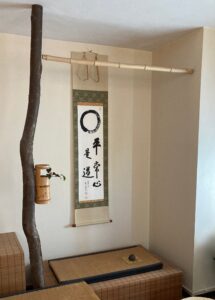
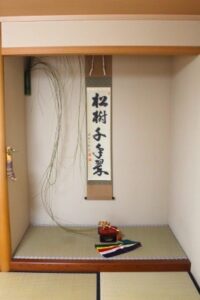
Kake-mono, 掛物, hang-thing; calligraphy, En–sō, 円相, Circle-aspect, ‘Byō-jō-shin Kore-dō’, 平常心是道, Level-ever-mind/heart is way: by Yama-da Hō-in, 山田法胤 Mountain-field Law-descendant, abbot of Yaku-shi-ji, 薬師寺, Medicine-master-temple, Na–ra, 奈良, What-good: L. 5.5 shaku kane-jaku. The Zen phrase on the scroll is derived from a teaching story of the monk, Jō-shū, 趙州, Hasten-state. Jōshū asked priest, Nan-sen, 南泉, South-spring, how to attain enlightenment, to which Nansen replied ‘Ordinary heart is the way’.
The architectural genesis of the tokonoma, is traced to the Muromachi Period from the 14th to the 16th centuries. During this time, the wide-spread influence of Zen Buddhism began to permeate the cultural fabric of Japan. Originally, these recessed alcoves served as sacred repositories for Buddhist icons, hon-zon, 本尊, original-revered, and sacred texts. Through the evolution of Chanoyu, the space transitioned into a realm that, while secular in function, remains deeply spiritual in its display of aesthetic objects.
Sen-no-Ri-kyū, 千利休, Thousand-’s-Rich-quit, advocated for the tokonoma as a sanctuary of austere elegance. The minimalist presentation of a single kake-jiku, 掛軸, hang-scroll, with thematic presence, and a soiltary hana-ire, 花入, with cha-bana, 茶花, tea-flower, which are seasonally placed, emerged as a definitive expression emphasizing the beauty found in transience, humility, and in the nature of existence.
In Chanoyu, one enters the tearoom and shows devotion with a bow in front of the tokonoma with the scroll and the flower. It is as though one is greeting the spirit associated with the scroll during the first portion of the gathering and the flower during the second portion. Both observances in front of the tokonoma can be approached as though one is at once appreciating the aesthetic presentation of the objects, as well as seeking illumination or guidance from their presence.
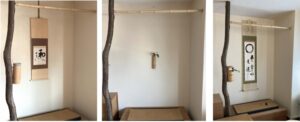
Tokonoma showing the aspects of displaying objects. Left: kakemono with Shiki-shi, 色紙, color-paper, pasteboard with calligraphy of ‘Wa wo motte shiro to nashi’, 和を以, Harmony is to be treasured, by Hō-un-sai, 鵬雲斎, ‘Phoenix’-cloud-abstain, XV Iemoto, Urasenke. The shikishi is temporarily mounted on a shikishi kake, 掛, hanger, with small oil lamp of bamboo hung on the toko-bashira, 床柱, floor-post, to illuminate the scroll.
Center; bamboo hanaire hung on the unseen mu-sō-kugi, 無双釘, no-pair-hook. Right: kake-mono, 掛物, hang-thing; calligraphy, En–sō, 円相, Circle-aspect, ‘Byō-jō-shin Kore-dō’, 平常心是道, Level-ever-mind/heart is way: by Yama-da Hō-in, 山田法胤 Mountain-field Law-descendant, abbot of Yaku-shi-ji, 薬師寺, Medicine-master-temple, Na–ra, 奈良, What-good: L. 5.5 shaku kane-jaku.
The Zen phrase on the scroll is derived from a teaching story of the monk, Jō-shū, 趙州, Hasten-state. Jōshū asked priest, Nan-sen, 南泉, South-spring, how to attain enlightenment, to which Nansen replied ‘Ordinary heart is the way’.
In a formal tea room or cha-shitsu,茶室, tea-hut, as preferred by Rikyū, there is no electric lightning in the tokonoma. There was no window in Rikyū’s tokonoma. This raises the question of whether the tokonoma is lit only for Tea at night. Some scholars identify the window that is in the wall of various tokonoma as Ori-be mado, 織部窓, Weave-guild window; research indicates this feature was created by Furuta Oribe who was a close follower of Sen Rikyū.
There is are also some people who believe it possible that Rikyū may have illuminated the tokonoma regardless of the time of day.
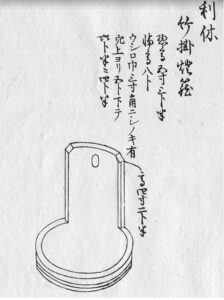
Illustration of Rikyū’s choice of a take-kake, 竹掛, bamboo-hanger, with notation and measurements. The bamboo retains the fushi to support an oil lamp, short wicks, and hole to hang the lamp. This perhaps was used in the Tea room on an ori-kugi, 折釘, fold-hook in the toko-bashira, 床柱, floor-post. Hanging takekake or tan-kei, 短檠, short-rack, were hung commonly under the eaves or in the mizu-ya, 水屋, water-house, preparation room. It is said that Rikyū preferred lanterns made of bamboo or wood to hang outside.
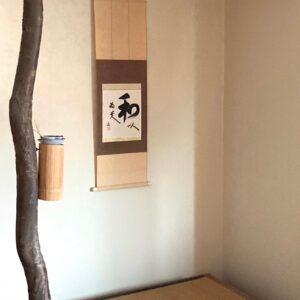
Example of a possible use of an oil lamp made of bamboo hung on the tokobashira to illuminate the scroll: ‘Wa wo motte shiro to nashi’, 和を以, Harmony is to be treasured, by Hō-un-sai, 鵬雲斎, ‘Phoenix’-cloud-abstain, XV Iemoto, Urasenke.
By many standards, during the first part of a Cha-ji, 茶事, Tea-matters, when the meal, kai-seki, 懐石, heart-stone, is served, only a kake-jiku, 掛軸, hang-scroll, is displayed in the tokonoma, except at night when a te-shoku, 手燭, hand-lamp, candle is needed to provide additional light. The teshoku is placed on the floor on the upper side, kami-za, 上座, upper-seat, of the tokonoma, opposite the toko-bashira, 床柱, floor-post. This side of the tokonoma is identified with the East and Fire.
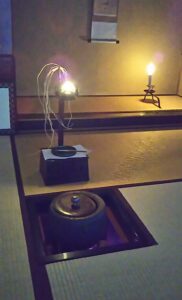
Yo-banashi, 夜咄, night-talk, Tea at night, is usually presented in cold weather using the sunken ro, 炉, hearth. The dark tea room needs light at night. A portable lamp that provides the needed illumination is the tan-kei, 短檠, short-rack, oil lamp stand. The tankei oil lamp is located ‘north’ of the ro.
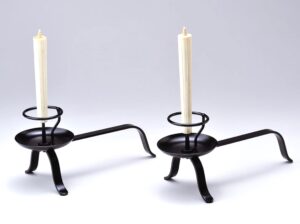
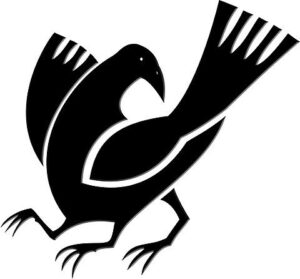
Pair of te-shoku, 手燭, hand-lamp. Stylized design of the Ya-ta-garasu, 八咫烏, Eight-span-crow who is believed to be the messenger of the gods of Kumano. This crow became the emblem of the sun and Ama-terasu, 天照, Heaven-brightener, the sun goddess. This mythical black bird has three legs and flies from East to West.
Teshoku Measurements:
Teshoku disk 3 sun kujira-jaku
Teshoku ring 2 sun kujira-jaku
Teshoku full length is 8 sun kujira-jaku
Candle length 5.5 kane -jaku
The form of teshoku preferred by Rikyū is made of blackened steel, with three legs and pricket for the rō-soku, 蝋燭, (plant) wax-light. The teshoku may evoke the Ya-ta-garasu, 八咫烏, Eight-span-crow, three-legged crow, that is symbolic of the Tai-Yō, 太陽, Grand-Yang, the sun and Ama-tersu Ō-kami, 天照大神, Heaven-brightener Great-goddess.
In Chanoyu, a pair of teshoku are used: one is for the tei-shu, 亭主, house-master, and one for the kyaku, 客, guest. When the two meet in the ro-ji, 露地, dew-ground, they trade teshoku, showing their equanimity. The teishu returns to the cha-shitsu, 茶室, tea-room, and places the teshoku in the tokonoma, which is identified with the east and thus likened to the rising sun. The last guest to enter the the Tearoom moves the teshoku from the tokonoma and places in front of the door of the cha-dō-guchi, 茶道口, tea-way-opening, informing the teishu that that all of the guests have entered the tearoom. The guest is identified with the East, and the host is identified with the West.
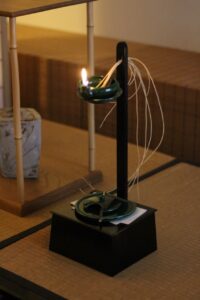
Tan-kei, 短檠, short-rack, oil lamp stand; black-lacquered wood box, with ceramic dish, abura-zara, 油皿, oil-dish, lid and kuro-mo-ji, 黒文字, black-letter-character, pick, with upright pole supporting a ceramic suzume-gawara, 雀瓦, sparrow-tile, with 7 tō-shin, 灯芯, lamp-wick, in oil, on a dish. A preferred oil used for lighting is na-tane-abura, 菜種油, rape-seed-oil. The wick is made of the pith of tatami reeds, and is not consumed in the flame, but acts as a syphon.
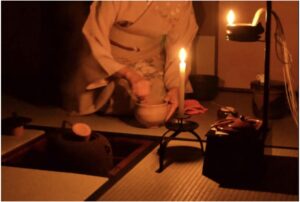
The lid of the suzume gawara is located on the oil bowl during the first part of the Chaji, and removed and placed on the abura-zara when preparing tea, both koi-cha, 濃茶 , thick-tea and usucha, 薄茶, thin-tea.
The teishu may carry a teshoku into the Tearoom together with the ken-sui, 建水, build-water, and place it next to the tankei near the hearth. The teshoku is offered to the guest together with the koicha cha-wan, 茶碗, tea-bowl, and also with the cha-ire, 茶入, tea-into. This allows the guest to handle fire, which is the priority of the tei-shu, 亭主; the Kanji for shu, nushi, 主, master; means ‘master of fire’.
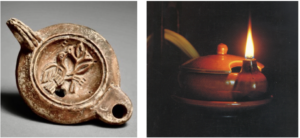
Left: ancient Roman, terra Cotta oil lamp with bird and olive branch design. Right: Japanese oil lamp named suzume gawara, 雀瓦, sparrow-tile, named after a fluffed-up bird.
The Roman birds are identified as ‘little bird’, which is like the Kanji 雀 composed of ‘little’ and ‘bird’. Although the oil burned in Roman lamps was primarily olive, mustard oil, 菜種油, was used in some regions.
Texts from roughly 4,000 years ago documented mustard use, and archaeologists discovered mustard seeds inside the tomb of King Tutankhamun for use in the afterlife. The Passer domesticus niloticus is a distinct house sparrow subspecies native to the Nile Delta and valley regions of Egypt, frequently interacting with local crops and wild plants. In ancient India, earthen lamps filled with mustard oil were lit for the observance of Diwali. The smoke from mustard oil lamps helped in preventing the outbreak of disease and kept germ-carrying pests away from the house. There is a well known teaching story in Buddhist texts referring to mustard seeds.
Birds are associated with illumination and enlightenment as they are able to transcend earthly bounds in flight and as a species are primarily active only during daylight hours (less than 5% of all birds are active at night). In numerous tales they act as divine messengers, and in many traditions around the world they symbolize one who is liberated.
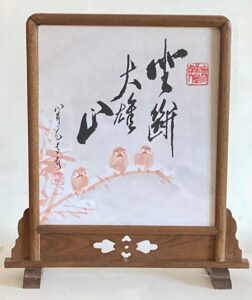
Shiki-shi, 色紙, color-paper; with brush-painting of three suzume, 雀, sparrows, sitting on bamboo, with calligraphy by Doku-za Dai-yū-yama, 坐斷大雄山,Sit-alone-Great-hero-mountain, by Deng Huibo [Tō Kei-haku], 鄧恵伯, City Bless-eldest brother, Sichuan, China: 9 x 8 sun kane-jaku. The sparrows have fluffed up their feathers to be warmer, and are affectionately called ‘fukura suzume’, 膨雀, fluffy-sparrow.
Standing frame, shiki-shi tate, 色紙立, color-paper stand, made of kuwa, 桑, mulberry.
The phrase ‘Za-dan Dai-yū-zan’, 坐斷大雄山, Sit-stop Great-male-mountain, refers to Bai-zhang (Hyaku-jō), 百丈, White-(10 shaku), Mountain in Fengxin County, Jiangxi Province, also known as Taxiong Peak.
‘Sitting upright on Mount Taixiong’ is a famous saying in Chan Zen Buddhism, meaning that a practitioner has achieved complete enlightenment, having let go of discrimination and delusions, transcending life and death and external constraints. This saying originates from the Zen master Baizhang Huaihai and is part of the Blue Cliff Records.
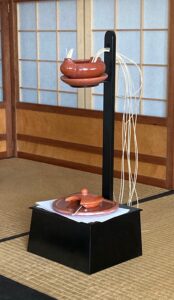
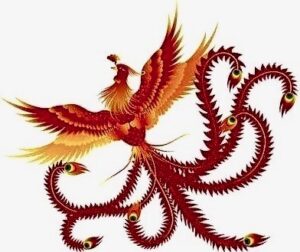
Left: tan-kei, 短檠, short-rack, with aka-raku, 赤楽, red-pleasure, cerammic pieces. Right: design of Su-zaku, 朱雀, Red-sparrow, one of the four mythical creatures who guard over the four quadrants of the sky, collectively known as the Shi-jin-jū, 四神獣, Four-god-creatures. Suzaku is emblematic of the southern quadrant of the sky.
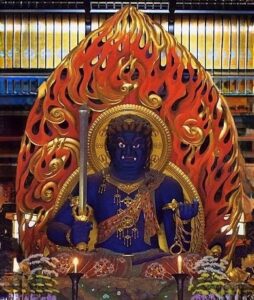
Restored copy of altar dedicated to Fu-dō Myō-ō, at Nari-ta-san Shin-shō-ji, Become-field-mountain New-victory-temple. Founded in 940 by by the high-ranking Shingon Buddhist monk Kan-chō Dai-sō-jō, 寛朝大僧正, Generous-dawn Great-priest-principle (and commissioned by Emperor Su-zaku, 朱雀, Red-sparro). Some of the flames surrounding Fudō Myōō have the appearance of stylized red birds with gold embellished heads and beaks.
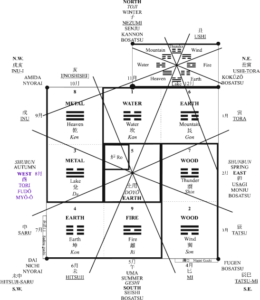
The Kanji, 酉, like the Tori of the 12 signs of the Asian Zodiac, is identified with the West. The Tori is the familiar vehicle of Fu-dō Myō-ō, 不動明王, No-move Bright-king, defender of the Buddha. Fudō, is located in the West, which, in Chanoyu, is the place where the host prepares Tea.
After building the charcoal fire in preparation for Tea, the floor of the ten-mae-za, 點前座, offer-fore-seat, during certain Tea presentations, the wing feathers of a swan, haku-chō, 白鳥, white-bird, are used as a za-bōki, 座箒, seat-broom.
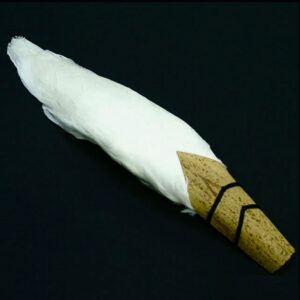
Za-bōki, 座箒, seat-broom, made of the wing of a haku-chō, 白鳥, white-bird, swan; handle wrapped in take-no-kawa, 竹の皮, bamboo’s-skin.
Within the narrative tradition of Buddhism, the youthful Prince Siddartha, before his enlightenment as the Buddha, and his cousin, Devadatta, were walking in a wooded grove. Devadatta struck a white swan, with a piercing arrow. In an act of compassion, Siddartha intervened to preserve the creature’s life, gently extracting the arrow and applying medicinal herbs, yaku-sō, 薬草, medicine-grass, to the wound. The white swan, hamsa, is the sacred seat of Saraswati, Goddess of Wisdom and Creativity, and the consort of Brahma.
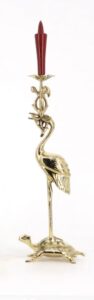
Japanese culture has many different birds associated with light, and cardinal directions. The bird that is likely the most emblematic of the north is the crane, tsuru, 鶴, especially that called tan-chō, 丹頂, red-crown (head) crane (Grus japonensis). It is known as a symbol of luck, longevity, and fidelity.
The crane is the subject of a rō-soku-tate, 蝋燭立, wax-lamp-stand, candlestick that is part of Buddhist offerings, which is located in the north. The crane is depicted standing on the back of the earth turtle that ‘lives ten thousand years’, and holding a lotus stem which has a pricket candle spike. The crane is often depicted eating a snake. Combining the The turtle and the snake is emblematic of Gen-bu, 玄武, Black-warrior, one of the four Shijujin, Genbu rules over the north quadrant of the sky.
A rōsokutate is commonly displayed when the tokonoma is set in the style of a Buddhist altar.
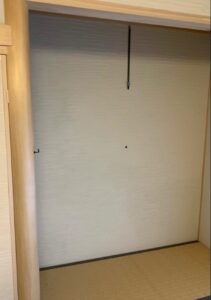
Tokonoma, showing various kugi, 釘, hooks, with opened blackened steel mu-sō kugi, 無双釘, no-pair hook, in the exact center of the back wall when measured top to bottom and side to side, the musōkugi is placed once and the hook is pushed in when not in use. The metal, long adjustable jiku-kake, 軸掛, scroll-hanger, is hanging in the center of the tokonoma. Ori-kugi, 折釘, fold-hook, in the side of the toko-bashira, 床柱, floor-post. The orikugi is driven into the toko-bashira at a height suggested by Rikyū: 3.35 shaku kane-jaku. It should be lower than the height of the musōkugi.
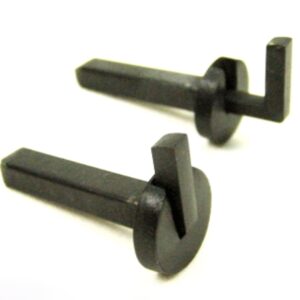
Musōkugi: front showing the retracted position and back showing the extended position. The musōkugi is pushed into the wall when hanging a scroll, and pulled out when hanging a hana-ire, 花入, flower-into. The hanging jizai also is at the center of the back wall of the tokonoma. The center of the hon-shi, 本紙, true-paper, of a hanging scroll, should align with the musōkugi. In a sense, due to the centered location of the musōkugi it could be considered to be the heso, 臍, navel, of the tokonoma. Another way to traslate musō, 無双, is unparalleled.
There is an important idiomatic expression for kugi, 釘, nail, somewhat well known in Japan as the phrase ‘kugi o nuku’, to pull a nail, sounds like ‘ku o nuku’, to remove suffering.
The musōkugi hook is inside of the socket when a scroll is displayed. When hanging a hanaire on the hook of the musōkugi, the hook is drawn out with the index finger of the right hand. This is the finger on which Vishnu holds the ever-spinning golden weapon Sudarshana Chakra.
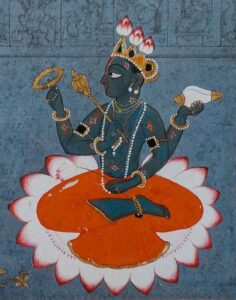
Vishnu sitting on a lotus. In three of his four hands, he holds a conch, a discus called the Sudarshana Chakra, and a mace. The Government Museum and Art Gallery, Chandigarh. Dated 1730.
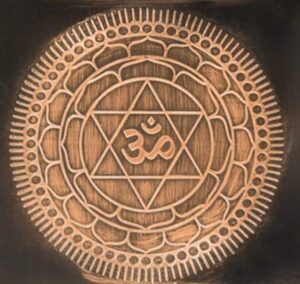
Sudarshan Chakra Yantra, a copper plate with a design of Vishnu’s golden disc with a central bija, seed sound. The Maha Sudarshan Yantra contains additional bija emblems. The Chakra is often depicted as possessing mesmerizing speed and precision, described as having 108 serrated edges used by the Hindu God Vishnu. The Sudarshana Chakra is Vishnu’s divine spinning discus, symbolizing cosmic order, protection, and the wheel of time. Its spinning motion represents the continuous cycle of creation and destruction. The six-sided star is symbolic of Infinity in Time, featured in the center is the Sanskrit character ‘Aum’, the seed sound of the Universe.
The sounds, a-un, 阿吽, a-hum, commonly referred to as Om. This is recognized as the seed sound of the Universe in Hindu and Vedic traditions; it is a syllable representing the primordial trinity of Vishnu, Shiva and Brahma. The opened and closed nature of creating the sound with the human voice also represents the aspects of In, 陰, receptive, and Yō, 陽, positive.
The reason for the musōkugi to be located in the exact center of the back wall of the tokonoma, may be associated with the energetic chakra system within the human body. If so, it is identified with Manipura chakra. Manipura in Sanskrit, is often translated into ‘Jeweled City’ in English. Known in Vajrayana and Tantric Buddhism as the center of manifestation, emanation, and transformation. Many Hindu, Vedic, Taoist, and Buddhist traditions contain meditation practices that focus on the navel region to kindle psychic heat and transform mental defilements.
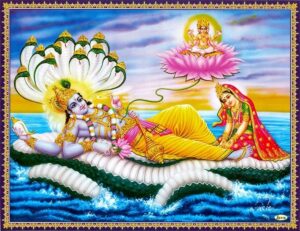
Image depicting Vishnu reclining on a great snake, Shesha (also known as Ananta) with a hasu no hana, 蓮の花, lotus-’s-flower, sprouting from his navel upon which is the creation of Brahma. Note Vishu has the gold disk of the Sudarshana Chakra on his finger. Vishu’s consort Lakshmi is anointing his feet.
In Vishnu-centered Purana tales, Brahma, the Creator, emerged on a lotus flower growing out of the navel of Vishnu, the preserver, with Lakshmi, Vishnu’s consort, by his side. The lotus and the navel evoke the flower in a vase hanging from the musōkugi in the center of the tokokoma, floating as though in Space.
The great serpent that provided protection for Vishnu had eleven heads, is named Ananta Shesha. The cosmic serpent is typically shown with a thousand heads or a canopy five, seven, or eleven hoods cradling Vishnu’s head. When shown with eleven heads, there may be a connection with with the Ju-ichi-men Kan-non, 十一面観音, Ten-one-face (Eleven) See-sound, Buddhist goddess of mercy.
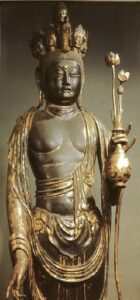
Jū-ichi-men Kan-non, 十一面観音, Ten-one-face See-sound, Eleven-headed Kannon. Detail; navel of Kannon, and sui-byō, 水瓶, water-bottle, container that may hold kan-ro, 甘露, sweet-dew, also called soma, elixir of life, as well as hasu, 蓮, lotus.
There are many statues and depictions of Jūichi-men Kannon that have a pronounced navel or heso. The Kanji for heso, 臍, navel, is composed of niku, 肉, flesh, and sai, hitoshi, 齊, center, body’s center, navel.
In Buddhism, the navel holds significant meaning as the source of life and the center of the energy of enlightenment. The navel, the center of the body, is a ‘traces of the passage of life’ that connected life and nourishment in the mother’s womb, and is positioned as follows from the perspective of the physical characteristics of Buddhist statues and meditation. This is considered the source of fire energy and the place that governs spirituality, vitality, confidence, and self-awareness.
In Buddhist dharma talks, the navel is often described as ‘the precious origin of life given by one’s parents’. Although we don’t usually think about it once we are born, the navel is cherished as a memory of the tube that connected mother and child, and can be a point of reflection for contemplating one’s own roots and the mystery of existence.
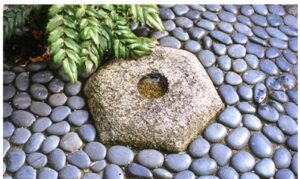
Heso-ishi, へそ石, Navel-stone, at Ro-kkaku-dō, 六角堂, Six-corner-hall, Kyōto. The hexagonal stone with round hole, which held a wooden dowel to stabilize the supporting stone column, was a foundation stone for the temple of Chō-hō-ji, 頂法寺, Summit-law-temple, the official name of Rokkakudō. Founded by Shō-toku Tai-shi, 聖德太子, Holy-virtue Grand-child, in 587, when he was seeking timber to build the Shi-ten-nō-ji, 四天王寺, Four-heaven-kings-temple. The temple was to venerate a statue of Nyo-i-rin Kan-non Bo-satsu, 如意輪観音, Like-will-ring See-sound Grass-buddha, Bodhisattva.
The hexagonal stone has been called the ‘Navel of Kyōto’ and is likened to its central location and heart of the city. The pictured leaves are of a plant called nan-ten, 南天, south-heaven, nandina; heavenly bamboo (Nandina domestica). Nanten is wordplay for ‘nan o tenzuru’, 難を転ずる; nan-ten, 難転, difficulty-change, and is believed to dispel evil and misfortune.
Rok-kaku-dō Kan-non, 六角堂観音, Six-angle-hall See-sound, pertains to the venerated icon of Nyō-i-rin Kan-non, 如意輪観音, Like-will-wheel See-sound, housed within Rokkakudō. The sanctuary is renowned for its hexagonal structure, its position as the eighteenth station of the Sai-goku Pilgrimage, and as the ancestral origin of i-ke-bana, 生け花, living-flowers.
The account of the golden Nyoirin Kannon arising from the waters of Iwaya Bay serves as a profound structural validation of the temple’s sacred lineage. By tracing the origin of the hon-zon, 本尊, main-image, to the era of Emperor Bidatsu and the past-life spiritual praxis of Prince Shō-toku, 聖徳, Holy-virtue, the narrative fulfills a specific metaphysical function. The temple’s faith is Jō-do Shin-shū, 浄土真宗, Pure-land True-sect.
Kannon Bosatsu is frequently depicted with light, a glowing aura, or a background of stylized flames, kō-hai, 光背, light-halo. In Buddhist art, these fiery or luminous elements represent purified wisdom, protective power, and the infinite radiance of compassion rather than destruction. Kannon is the watery nourishing manifestation of A-mi-da, 阿弥陀, Praise-increase-steep, Buddha of Mercy, whose name in Sanskrit, Amitabha, means ‘infinite light or boundless light.
The manifestation of the icon is a kie-shō, 帰生, return-arising, phenomenon – a recurrent theme in Japanese Buddhist veneration, where a divine object identifies its own sacred geography. The gold of the stature signifies absolute purity, distinguishing the sacred relic from the mundane silt of the shore.
By retroactively identifying the statue with the tutelage of Prince Shōtoku, the legend employs the Prince as a cosmic anchor. Within this traditional logic, if the Prince, the semi-divine progenerator of Japanese Buddhism, venerated the icon in a ‘previous life’, the image is effectively sanctified long before reaching the physical world.
This narrative structure collapses linear time. The mention of ‘training in China in a past life’, establishes a repetitious loop of merit. The statue was not discovered by chance; it is ‘called forth’ by Prince Shōtoku through his spiritual resonance of an earlier existence.
Ultimately, this account functions as a man-da-ra, 曼荼羅, Wide-weed-spread, of legitimization. It transforms a tangible artifact into an immutable, trans-historical relic, ensuring the temple’s authority is firmly fixed within the eternal framework of the Bodhisattva’s vow.
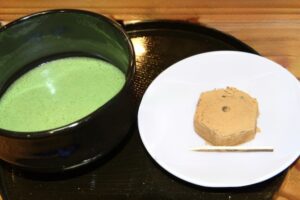
Bowl of usu-cha, 薄茶, thin-tea, presented with a serving of ‘Heso-ishi-mochi’, へそ石餅, (navel)-stone-mochi, on a dish with a small pick, kuromoji, served at exclusively at Ro-kkaku-dō, 六角堂, Six-corner-hall, Kyōto. The wa-ga-shi, 和菓子, harmony (Japan)-sweet-of, is an-filled mochi covered with kina-ko, 黄粉, yellow-flour, powder made from roasted dai-zu, 大豆, big-bean, soybeans. The hexagonal sweet is made by Kyō-A-zuki, 京阿月, Capital-Praise-moon, the preferred purveyor of Ikenobo which is the oldest and largest school of i-ke-bana,生け花, keep-alive-flowers, rooted in the Buddhist tradition at the Rokkakudō Temple in Kyoto.
The sweet’s iconic hexagonal shape and the ‘six-sided’ motif symbolize the purification of the six human senses (sight, hearing, smell, taste, touch, and thought/mind) to shed worldly desires and achieve spiritual purity. The six sided hexagon is also representative of Infinity in Time. It is a profound juxtaposition to note that Rokkaudō is home to the eternal nature of Kannon and the Bodhisattva vow as well as the is also the location of oldest school of ikebana which is in its 45th generation of the practice of appreciating that the ephemeral nature of flowers.
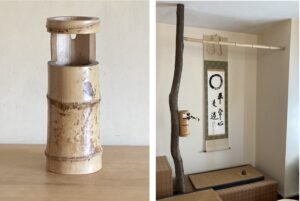
Left: hana-ire, 花入, flower-into, ichi-jū-giri, 一重切れ, one-tier-cut, take, 竹, bamboo, by Nishi-kawa Bai-gen, 西川楳玄, West-river Apricot-mystery, Kyōto. Right: tokonoma of Garandō with kake-jiku, 掛軸, hang-scroll, bamboo kake-hana-ire, 掛花入, hang-flower-into, and kō-gō, 香合, incense-gather, on the floor.
Kake-mono, 掛物, hang-thing; En–sō, 円相, Circle-aspect, with calligraphy, ‘Byō-jō-shin Kore-dō’, 平常心是道, Level-ever-mind/heart is way: by Yama-da Hō-in, 山田法胤 Mountain-field Law-descendant, abbot of Yaku-shi-ji, 薬師寺, Medicine-master-temple, Na–ra, 奈良, What-good.
The bamboo flower container was inspired by a similar hanaire created by Sen-no-Ri-kyū, 千利休, Thousand ’s Rich-quit. Note the hole in the back of the bamboo which is to hang the piece on a hook, either on the musōkugi or the orikugi on the tokobashira.
An important aspect of this style of hanaire is that no flowers are put into the top ring of the bamboo. It is remotely possible that the top was originally used to place an oil lamp that was meant to illuminate the hanging scroll and the flower.
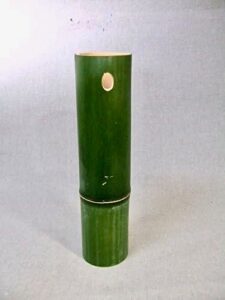
A yanagi-kake, 柳掛, willow-hanger, ao-dake, 青竹, green-bamboo, is a hanging flower vase used to decorate the alcove with ‘musubi-yanagi’, 結柳, tied-willow branches during New Year’s celebrations and other auspicious occasions. Dimensions vary depending on the intended use and school of flower arrangement. A standard is approximately one shaku kane-jaku. The opening at the back for hanging is called a mado, 窓, window.
The bamboo container is hung on a special yanagi-kugi, 柳釘, willow-hook, driven into a corner post near the ceiling, ten-jo, 天井, heaven-well, of the tokonoma. A curious aspect of the green willow holder is that it is not filled with water. The willow is not to be kept or planted, but is put into a river flows into the sea and eventually joins the ‘Milky Way’, Ama-no-gawa, 天の川, Heaven-’s-river.
The center of a burning flame, is called ka-shin, 火心, fire-heart, and is used as a metaphor for for the sacred fire that burns in the heart in Buddhism and the spiritual world.
Ka-shin is a homonym for 火心, fire-heart, which is ka-shin, 花心, or 花蕊, flower-heart. It is for this very reason that some Tea masters do not display flowers when having oil lamps or candles for Tea. Phonetically, kashin is a term referring to the center of a flame or the center of a flower.
The flower most clearly identified with Buddhism, is the hasu, 蓮, lotus, and is seen in Buddhist altar presentations. However, there are a number of other flowers that have a similar connection, and are more commonly used as flowers in the Tearoom.
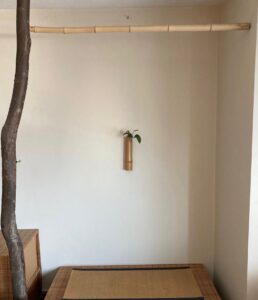
Tsubaki, 椿, camelia, in take hana-ire, 竹花入, bamboo flower-receptacle. Hanging from a musōkugi on the back wall of the tokonoma.
Flowers that are among the most often seen in Chanoyu in winter months are, tsubaki, 椿, camelia. Tsubaki abura, 椿油, camellia oil, in Japan and China, is extracted from Camellia japonica or Camellia oleifera) has been used for centuries as the traditional fuel for temple and household oil lamps (andon or shoku-dai). It burns cleanly with minimal smoke, making it ideal for indoor lighting and maintaining indoor air quality.
In summer months in Chanoyu, te-ssen, 鉄線, iron-wire, clematis, and bōtan, 牡丹, red-meat, tree peony, and many other flowers are available.
A preferred flower in summer and early autumn is mukuge, 木槿, tree-rose-of-Sharon, also mu-ku-ge, 無窮花, no-end-flower, Hibiscus syriacus (or Rose of Sharon), it is a representative flower of late summer and early autumn in Japan. Mukuge is notable for its legacy within ancestral medicinal traditions, attributed to its abundance of mucilage and anthocyanin antioxidants. In various practices, the flowers, leaves, and roots are utilized to reduce inflammatory conditions, lower blood pressure, heal the skin, nourish the digestive system, and soothe respiratory issues.
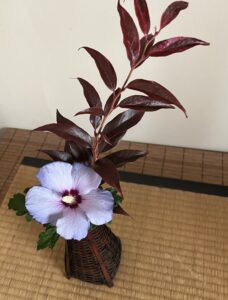
Mukuge placed with feathering branch in the tokonoma. The hana-ire, 花入, flower-receptacle; is a standing kago, 籠, basket, susu-dake, 煤竹, smoke-bamboo, with four corner base and round opening; H. 7 sun kane-jaku, Japan.
Mukuge flowers have five petals, which, for some, can bring to mind the Go-gyō, 五行, Five-transitions: five physical elements of Wood, Fire, Earth, Metal, and Water. The kashin of most mukuge are prominent. In the wild they are seen in a variety of colors ranging from white, to various shades of pink and light purple and are used to illuminate the impermanent nature of beauty and worldly existence.
For further study, see also: Tokonma and Imae and Tea in January and the Willow