Omogashi and Kaishi
Omo-ga-shi, 主菓子, main-sweet-of, is served and eaten before drinking koi-cha, 濃茶, thick-tea. Ideally, the sweet is made just prior to serving it, which gives it other name of nama-ga-shi, 生菓子, live-sweet-of. In life, such sweets are served at any time, accompanying a wide variety of teas and other beverages.
In Chanoyu omogashi is enjoyed from a special paper called kai-shi, 懐紙, heart-paper; the specific type of folded Japanese paper used as a plate for serving and eating o-ka-shi, お菓子, hon.-sweet-of, which refers to the traditional sweet or confectionery.
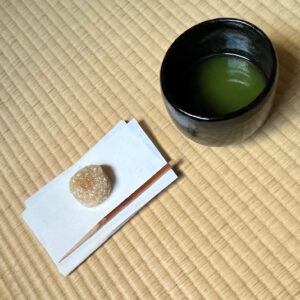
Kaishi supporting an omogashi and a kuromoji, a bowl of koicha served in a kuro raku cha-wan, 黒楽茶碗, black-Pleasure, made by the potter, Yoshi-mura Sō-raku, 吉村宗楽, Luck-town Sect-pleasure. The top sheaf of the kaishi is folded approximately one tatami me, 畳目, tatami-visual line, at an angle to the right.
An early method for presenting tea was developed by Myō-an Ei-sai, 明菴 栄西, Bright-hut Splendor-hut, who brought Zen Buddhist philosophy to Japan along with tea seeds. He is esteemed in Japan as the ‘grandfather’ of Tea. Upon his return from China to Japan, Eisai dedicated himself to the dissemination of Zen and the promotion of tea cultivation. In his 70’s, he authored Ki-ssa Yō-jō-ki, 喫茶養生記, Drink-tea Nourish-life-record, considered the earliest work on tea in Japan. Eisai established Japanese tea culture by documenting and promoting its practice. The text detailed the health benefits of tea, methods of cultivation, and preparation techniques. This initiated the reintroduction of tea culture in Japan, extending its reach to the lower classes. The serving of sweets and tea in this manner is considered to be highly formal and formerly was reserved only for aristocrats and high ranking priests.
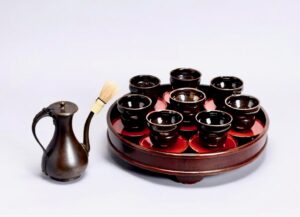
Round red-lacquered tray for transporting eight Dai-ten-moku cha-wan, 台天目茶碗, Support-heaven-eye tea-bowls, for the Buddhist rite of Yotsu-gashira, 四頭, Four-heads, when 32 participants are served sweets and tea. The practice was brought from China to Japan, along with Zen Buddhist philosophy by Eisai during the Song Dynasty. The ceremony is now presented every year to commemorate Eisai at the temple he founded, Ken-nin-ji, 建仁寺, Build-benevolence-temple. Hot water is poured by monks from a bronze sui-byō, 水瓶, water-bottle, with handle and spout, a cha-sen, 茶筅, tea-whisk, is carried on the spout.
While sweets and tea were enjoyed in presentations such as Yotsugashira during the Kamakura period and are still a part of Japanese culture, it was not until the Azuchi-Momoyama period that the formal presentation of Cha-ji, 茶事, Tea-matter, was codified by Sen no Rikyū. Many aspects of the Chaji including the meal presented before enjoying omogashi and koicha were borrowed from early Buddhist culture.
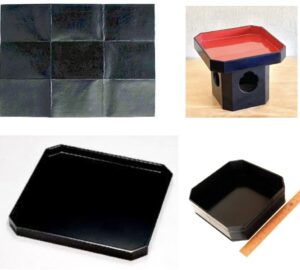
Upper left: ha-ttan, 鉢巣, bowl-nest; black-lacquered stiff paper placemat for Sō-tō-shū, 曹洞宗, Official-cave-sect, Buddhist meal called ō-ryō-ki, 応量器, accept-amount-container. ‘Ō-ryō-ki’ translates to ‘Just enough’, which refers to the efficiency and accuracy of the form. It is a meditative form of eating that originated in Japan that emphasizes mindfulness awareness practice by abiding to a strict order of precise movements. Ha-ttan, 鉢巣,bowl-’s-nest, is also read hachi no su, which is a metaphor for lotus, hasu, 蓮, which is likened to a hachi no su, 蜂の巣, bee-’s hive, which the lotus pod resembles.
Upper right: san-bō, 三宝, three-treasures, offering stand – black and red lacquered tray and support for Buddhist and Shintō offerings.
Lower left: o-shiki, 折敷, fold-spread, tray, kaku-giri, 角切, corner-cut, with mitered corners; measurement one kane-jaku square, or ha-ssun, 八寸, eight-‘inch’ kujira-jaku. Also known as a ha-kkaku sumi-giri zen, 八角隅切り膳, eight-angle corner-cut tray.
Lower right: fuchi-daka, 縁高, edge-high; measurement; 5.5 sun kane-jaku, diagonal 5.5 sun kujira-jaku. For the specific service of okashi, in Chanoyu, although it may contain other foods in other situations.
The prevalence of the number hachi, 八, eight, in all items pictured above could be thought to refer to sue-iro, 末広, ends-wide, and its symbolism of Infinity in Space.
In the formal progression of a Chaji, or tea gathering, the host presents omogashi to the guests following the conclusion of the kai-seki, 懐石, heart-stone, meal. A Chaji is structured into two primary segments:
Sho-iri, 初入り, first-entry, or sho-za, 初座, first-seating, during which the meal and main sweet is provided .
Go-iri, 後入り, latter-entry, and go-za, 後座り, latter-seating, where the tea service takes place.
The omogashi is typically offered at the end of meal, but before the sumi-de-mae, 炭手前, charcoal hand-fore, specifically during the fu-ro, 風炉, wind-hearth, season. These sweets are traditionally presented in a fuchi-daka, 縁高, a tiered stack of boxes, and are accompanied by individual kuro-mo-ji, 黒文字, black-letter-character, which are brushwood picks.
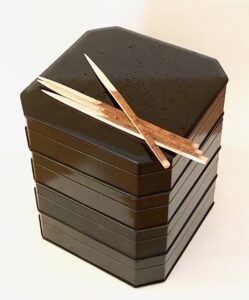
Each guest uses a kuromoji to transfer their portion from the fuchidaka onto their own kaishi, which acts as an individual plate for the sweet. The fuchidaka is restacked, and is generally returned to the host’s entrance once all guests have helped themselves to a sweet.
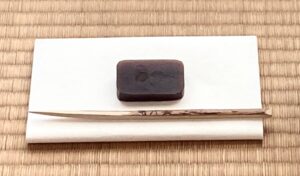
A slice of O-gura yō-kan, 小倉羊羹, Small-warehouse sheep-stew, sweetened red bean gel, by Minamoto Ki-tchō-an, 源吉兆庵, Origin Lucky-omen-hut, with a kuromoji; L. 6 sun kane-jaku, to eat the sweet, placed on a pack of kaishi.
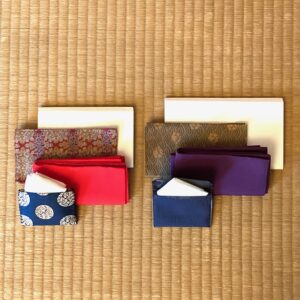
Each guest keeps kaishi along with a fuku-sa, 帛紗, cloth-gauze, cloth of purification, and a ko-buku-sa, 古帛紗, old-cloth-gauze, to protect the hand from the heat of the chawan and to honor a displayed object as well as a ko-ja-kin, 小茶巾, small-tea-cloth, in a small folder. Men’s kaishi measures 6.8 x 5.8 sun kane-jaku. Women’s kaishi measures 5.8 x 4.8 sun kane-jaku. Kaishi that is expressly made for Chanoyu is the Rikyū konomi, 好, choice, which is a pack of 30 sheets of paper, folded in half.
Another item carried by all guests is the sensu, 扇子, fan-of. The sensu is worn as the emblem of the guest, just as the fukusa is worn as the emblem of the host.
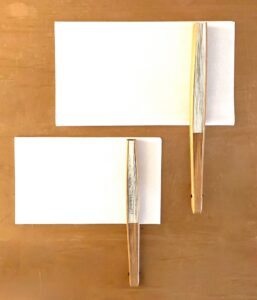
The full length of the men’s sensu is 6 sun kane-jaku, the women’s sensu is 5 sun. The width of the sensu paper is the same dimension as the width of the folded pack of kaishi. The sensu is essential for the guest as they move through the roji, 露地, dew-ground, upon entering and exiting for both first and second portions of the gathering as well as moving within the tearoom. It functions as an emblem of both gratitude and humility, and is also used to mark one’s space within the Tearoom.
Regarding both kaishi and sensu, six is an In/Yin number to complement his Yō/Yang, and five is a Yō number to complement her In. An important homonym for kai-shi is, 開始, open-begin; start; commencement; beginning; initiation. Kai is also read futokoro, 懐, which is composed of shin, 心, heart, and a group of Kanji that refer to clothing.
In Chaji, following the offering and enjoyment of the omogashi, the guests engage in the naka-dachi, 中立, middle-standing, leaving the Tearoom to allow the host to prepare for the subsequent serving of koicha. The host summons the guests back into the Tearoom, usually by striking a gong, do-ra, 銅鑼, copper-gong, Indonesian kem-pul, boss-gong. A Tea gathering at night the gong is replaced by a kan-shō, 喚鐘, call-bell, which is borrowed from Buddhism.
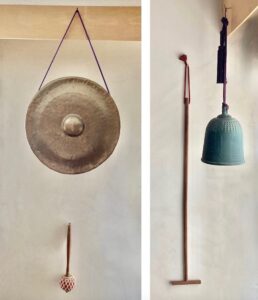
Left: do-ra, 銅鑼, copper-gong, polished brass, Jakarta, with striker. Right: kan-shō, 喚鐘, call-bell, patinated tetsu, 鉄, iron, Mi-i-dera, 三井寺, Three-wells-temple, with kuwa, 桑, mulberry wood striker, shu-moku, 撞木, strike-wood.
During the nakadachi, while the guests are outside, the kake-jiku, 掛軸, hang-scroll, is removed, the floor is swept, flowers in a hana-ire, 花入, flower-into, vase, are displayed in the tokonoma, the fire is checked, incense is put in the hearth, the various cha-dō-gu, 茶道具, tea-way-tools, arranged, the dora is struck during the day, and the kanshō at night. The nijiri-guchi, 躙口, crawl-opening, door is opened a little, and the host retreats into the mizu-ya, 水屋, water-room. The guests purify their hands and mouth with water from the chō-zu-bachi, 手水鉢, hand-water-bowl at the tsukubai, and individually re-enter the Tearoom.
Once the guests are settled, the host enters the Tearoom and prepares koi-cha, 濃茶, thick-tea. The critical aspect at this moment, is that the sweet omogashi has been eaten a while beforehand, and the mouth has been rinsed so that the tea is drunk completely on its own.
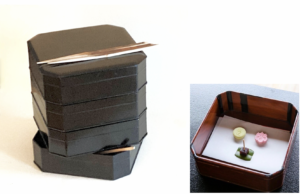
Fuchi-daka, 縁高, edge-high: stack of four individual boxes for four guests of a Chaji, with individual kuro-moji, picks. The bottom tier is designated for the shō-kyaku, 正客, main-guest, and supports the second, third, and fourth guest in succession. Generally, the stack of boxes is also called a jū-bako, 重箱, multi-box. The style of fuchidaka favored by Urasenke is borrowed from Ken-nin-ji, 建仁寺, Build-benevolence-temple, the first Zen Buddhist temple in Kyōto. Right: okashi served at Kenninji: cube of konjac with toothpick on a camellia leaf, and two molded sugar ‘rakugan’ served in a fuchidaka tier box.
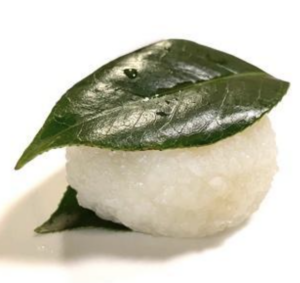
Tsubaki mochi, 椿餅, camellia-mochi, is a traditional Japanese confectionery with a long history, originating in the Heian period. It is one of the earliest confections in Japan and was mentioned in the classic literature ‘The Tale of Genji’. Its most distinctive feature is that a slightly sweet glutinous rice ball (usually made with Dō-myō-ji ko, 道明寺粉, Way-bright-temple flour), is wrapped around a red or a white paste and served between two fresh camellia leaves, because the rice ball is sticky to the fingers. The camellia leaves are related to the tea plant, and impart a hint of flavor, but are not eaten.
The intrinsic connection between the tsu-ba-ki, 椿, camellia, and the number hachi, 八, eight, is grounded in the flower’s botanical nature. Specifically, the wild tsubaki is characterized by its ‘single form’ blossom, which generally features no more than eight petals in a single layer. The spiral arrangement of petals and leaves follows the Fibonacci sequence (1, 1, 2, 3, 5, 8…), manifesting the mathematical order of nature. This prevalence of the number eight in the tsubaki could also be thought to refer to sue-iro, 末広, ends-wide, and its symbolism of Infinity in Space.
In Chaji the dimensions of the square tray, oshiki, 折敷, fold-spread, is one shaku kane-jaku. One shaku kane-jaku is equal to eight sun kujira-jaku. The oshiki is lacquer wood, and lacquer artists use kujira-jaku to measure things in their work. The traditional form of serving sweets in the eight-sided fuchidaka may have many references to the meal that preceded the offering of sweets to the guests.
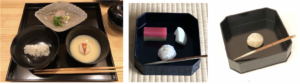
Left: o-shiki, 折敷, fold-spread, o-zen, お膳, hon.-tray, square, black-lacquered wood, set with meshi-wan, 飯碗, food-bowl, with a line of rice – representing the future, shiru-wan, 汁椀, soup-bowl, with miso shiru and daikon representing the past. At the far side of the tray is the mukō-zuke, 向付け, opposite-attach, a ceramic dish containing su-no-mono, 酢の物, vinegar-’s-thing, raw food ‘salad’ representing the present.
Middle: the fuchidaka pictured center contains three sweets that are also emblematic of time. Front, mochi, rice, representing the future. Upper left, yōkan, representing the past. Upper left fruit, representing the present.
Right: some tea presentations offer more than one sweet, at other times one sweet is offered. When there is a single sweet offered it is ideal that it is freshly made by the host.
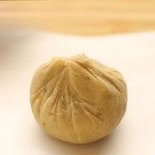
Cha-kin shibori, 茶巾絞り, tea-cloth wring; is a kind of sweet made of a variety of ingredients, such as bean an, and wrapped in a piece of cloth to create a ball form with wrinkles left on its surface. Although it is extremely easy to make, it gives the appearance of having been challenging to create. It also resembles the hō-ju, 宝珠, treasure-jewel, of Shintō and Buddhism. It is a popular sweet offered by a host who chooses to make their own omogashi.
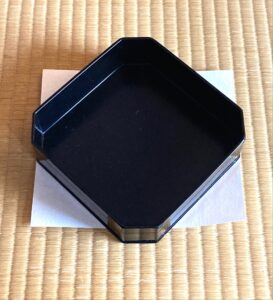
The diagonal measurement of the fuchidaka is equal to the length of a sheet of men’s kaishi which is 6.8 sun kane-jaku. The number 6 is symbolic of Infinity in Time, and 8 is symbolic of Infinity in Space.
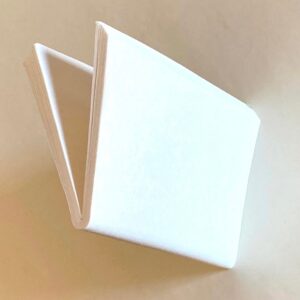
Packet of kaishi consisting of 30 sheets of paper, folded in half. Its folded form, when viewed upside down, is like the Kanji for eight, hachi, 八 , which is symbolic of Infinity in Space. Its basic form is like that of a folding sensu.
Regardless of the sweet that is served, the guest will use their kaishi on which to place the sweet prior to enjoying. Kai is also related to kai – ishi, in kai-seki, 懐石, heart-stone, which is a means to ward off hunger pangs. In Buddhist temples, a stone is heated wrapped in a towel and placed in the robe next to the stomach, kai, futokoro, 懐. This custom is given to the name of the meal served at a Chaji. Food is enough if it staves off hunger. The pack of kaishi is kept in the same location in the kimono along with a fuku-sa, 帛紗, cloth-gauze, and ko-buku-sa, 古帛紗, old-cloth-gauze, (called kai-chū kobukusa), and other necessary items. Because of the nature and design of women’s kimono and location of the obi, the ‘futokoro’ is in front of the chest, not belly. This is the location for women to keep the kaishi, fukusa and kobukusa. Thus, it is the futokoro in name only.
The kaishi is more than a means of transporting food. As the Japanese people enjoy ori-gami, 折り紙, fold-paper, the kaishi can be used in many different ways. When men’s kaishi is folded in half diagonally, the fold measures 8.9-9 sun kane-jaku.
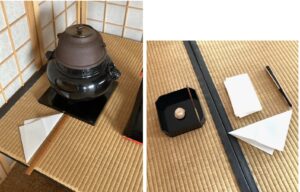
Left: a single sheet of men’s kaishi, when folded on a diagonal, has a measurement of 8.9-9 sun kane-jaku. This measurement is equal to the 16 tatami me, 目, visual line, of the adjoining tatami, and its heri, 縁, binding. This is the distance between the front edge of the shiki-ita, 敷板, spread-board, that supports the furo. The distance between the two corner points is three tatami me. The length of the diagonal fold is equal to 18 tatami me. The number eighteen in Japanese 十八 can be written as the Kanji moku, 木, tree, which is symbolic of life. The guest seated on tatami, should have 16 tatami me between the tatami heri , 縁, binding, and the front of their knees.
Right: in Chanoyu, the guest (represented in the picture by the folded sen-su, 扇子, fan-of,) sits with the knees 16 tatami me, 目, space, from the tatami heri The measurement from the knee line to and including the tatami heri, is equal to the diagonal fold of the guest’s kai-shi, 懐紙, heart-paper. The outer sheet of paper of the guest’s pack of kaishi is aligned so that the corner point is one tatami me to the right of the other, and the kaishi is where the sweet is placed. The distance between the two corner points is go-rin, 五厘, five-100th, (traditional mathematics is a decimal system: a shaku, 尺, is divided into ten sun, 寸, which is divided into ten bu, 分, which is divided into ten rin, 厘).
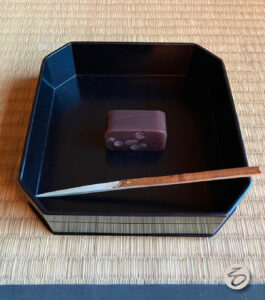
The host places the stack of fuchidaka before the main guests, about two tatami-me, 畳目, mat-interval, from the heri of the adjoining tatami. At the host’s entrance, the teishu bids the guests to have the sweet, and asks that afterward they leave to room so the preparations can be made to present the koicha presentation.
The main guest excuses for going ahead of the other guests and raises the fuchidaka in gratitude: kan-sha, 感謝, feeling-thanks. Then the guest places the pack of kaishi about two tatami me from the heri, or in approximately the same location if seated upon the kinin-tatami, which has a different orientation.
The guest removes the okashi with the kuromoji from the fuchidaka and places it on their kaishi.
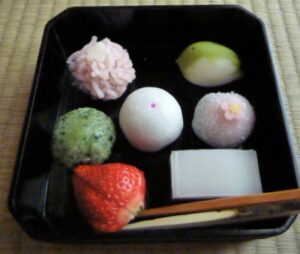
Wa-ga-shi, 和菓子, (Japanese) harmony-sweet-of, are an integral part of Chanoyu. Depending on the formality of the Tea presentation one, three, five, or seven types of sweets are served.
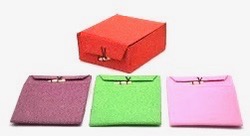
It is important to maintain the order of the boxes, because there are occasions when three, five, and seven kinds of sweets, and the guest may not eat all of them. After the conclusion of the Tea, the remainers are packed up and given to the proper owner/guest. There are guests who might bring with themself a small collapsible container, zan-sai-ire, 残菜入, leftover-leaves-container for that particular function on the off-chance it might be needed.
The sweets that are likely to be offered before the serving of koicha could include one or more of the following :
Kin-ton, 金団, gold-round
Mochi, 餅, rice cake
Man-ju, 饅頭, bean dumpling-head
Neri-keri, 練切, knead-cut
Mushi-mono, 蒸し物, steam-thing
Sao-mono, 棹物, block-thing
Mizu-ga-shi, 水菓子, water-sweet-of (fresh fruit)
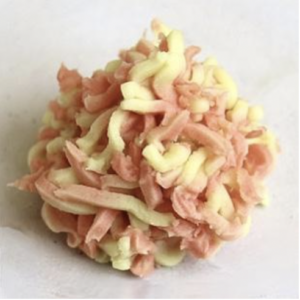
Kin-ton, 金団, gold-round; sweetened bean an, 餡, a kind of thick sweetened purée, pressed through a coarse sieve, inside is often sweetened bean paste that is made of either red beans or white beans. Kinton is included in foods for the new year, and is made of sweet potato and/or chestnut purée. Kinton is versatile and these sweets are made in a multitude of color and style variations, many of which are seasonally themed.
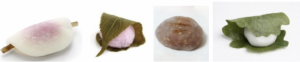
Mochi, 餅, rice cake; glutinous rice made into portions and wrapped in gyū-hi, 求肥, request-fertile, are made in a multitude of varieties, many of which are seasonally themed. Pictured from the left: hana-bira mochi, 花弁餅, flower-petal mochi; with sweetened white miso and candied gobo, 牛蒡, burdock; sakura mochi, 桜餅, cherry mochi; wrapped in preserved cherry leaf; i-no-ko mochi, 亥の子餅, boar-’s-child mochi, filled with sweetened red bean jam wrapped in gyūhi; kashiwa mochi, 柏餅, oak mochi, dense gyūhi filled with red bean jam.
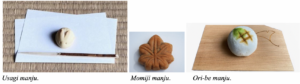
Man-jū, 饅頭, bean dumpling-head is also referred to as man-tō, 饅頭, bean-head. It is a steamed bun, of which there are an endless variety. Many of the foods in a Chinese Dim sum, 点心, point-heart, restaurant are a kind of steamed bun filled with savory as well as sweet. The Kanji 点 was originally written 點心, and may appear today.
Ten-shin, 點心, offer-heart. The kanji, 點, is also written, 点, and read tate, and is used to write ten-mae, 點前/点前, which is the procedure of making tea in Chanoyu. Ten-shin, 点心, is also a Zen monk’s early morning meal; refreshment; cakes, etc.
Left: Usagi man-ju, 兎饅頭, Hare bean-head, filled with white bean an, with kuromoji pick on a sheet of kaishi with top folded slightly to the right, creating sue-hiro, 末広, ends-wide. This folding creates the Kanji hachi, 八, eight, a symbol of Infinity in Space. Note the 6-sun kuromoji pick handle extends just beyond the edge of the kaishi.
Center: momiji man-ju, 紅葉, red leaf bean-head, filled with red bean an, is popular throughout the country, and has become a symbol of the great ‘floating’ Itsuku-shima Jin-ja, 厳島神社, Disciplin-island God-shrine.
Right: Ori-be manju, 織部饅頭, Weave-bureau bean head, filled with various kinds of an. With its green patch and branded motif it is indicative of ‘oribe’ which refers to Tea master Furu-ta Ori-be, 古田織部, Old-paddy Weave-bureau. It is served on an usu-ita, 薄板, thin-board, with its far-right corner cut-away, creating go-kaku, 五角, five-corners. In Buddhism, the pentagon, go-kaku, 五角, five-corner, represents the go-gyō, 五行, five-transitions, physical elements that make up all things (Earth, Water, Fire, Wind, and Void).
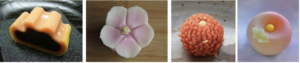
Neri-keri, 練切, knead-cut; kneaded mochi with sugar to make a kind of dough that holds its form. Because the dough holds its form, sweet makers are creative in the expression of seasonal themes. From left: ‘Yama-michi’, 山道, Mountain-path; ‘Sakura–bana’, 桜花, cherry-flower; ‘Kiku’, 菊, Chrysanthemum; ‘Kō-rin giku’, 光淋菊, Light-drench chrysanthemum.
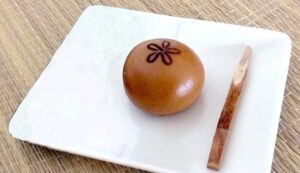
Mushimono are a group of various steamed buns filled with foods that are savory or sweet. An early and savory filled bun is niku-man, 肉頭, meat-bun, that could be curry. A very early treat is filled with sweetened bean, man-jū, 饅頭, bean-head. Another popular variety bears Rikyū’s name, Rikyū man-jū’, 利休饅頭, which is filled with tsubushi an, 潰し餡, mashed-bean paste, and covered with dough made with kuro-za-tō, 黒砂糖, black sand-sugar. This steamed bun is branded with various designs. Of the many different sizes of kuromoji, Urasenke prefers the 6-sun length for the Tearoom.
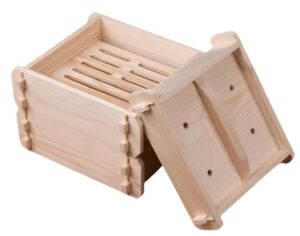
Sei-ro, 蒸籠, steam-basket, sugi, 杉, cedar; a stack of boxes approximately 6 sun kane-jaku square, which may cook mushi-mono, 蒸物, steamed-thing, sweets, and directly serve them in the Tearoom.
In cold weather, Urasenke may offer the guests a steamed bun. Rikyū served steamed buns in the tearoom in a fuchi-daka-like stack of boxes called a sei-ro, 蒸籠, steam-basket. The tiered boxes are made of hinoki, 檜, (Japanese) cypress (Chamaecyparis obtusa), and take, 竹, bamboo.
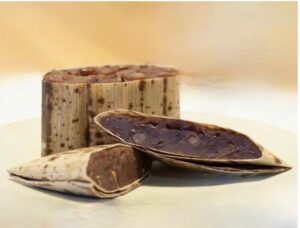
Sau-mono, 竿者, bar-thing: gelled an cut to length. Yō-kan, 羊羹, sheep-stew; Buddhism-inspired sweetened bean paste in log-form, molded and sliced. Pictured is traditional O-gura yō-kan, 小倉羊羹, Small-warehouse sheep-stew, named ‘Yoru-no-ume’, ‘夜の梅, Night-’s-apricot; wrapped and steamed in take-no-kawa, 竹の皮, bamboo-’s-sheathing, by Tora-ya, 虎屋, Tiger-house, Kyōto.
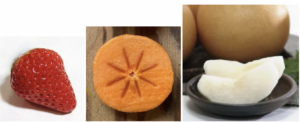
Mizu-ga-shi, 水菓子, water-sweet-of also called mizu-mono, 水物, water-thing, or kuda-mono, 果物, fruit-thing; natural fresh fruit.
Another form of offering sweets to the guests when not using a fuchidaka is in a large vessel with many sweets from which each guest selects their own single portion.
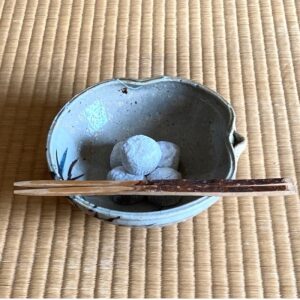
Ka-shi-bachi, 菓子鉢, sweet-of bowl, stoneware bowl with kata-kuchi, 片口, side-mouth, Shiga-raki–yaki, 信楽焼, Faith-pleasure-fired, containing five nama-ga-shi, 生菓子, fresh-sweet-of, with a pair of kuro-mo-ji hashi, 黒文字箸, black-letter-character sticks (points made wet before use); L. 8 sun kane-jaku. An important rule is ‘never take the last sweet from the kashi-bachi’. The pair of kuromoji manifest the the number hachi, 八, eight, and embody sue-hiro, 末広, ends-wide, which is emblematic of Infinity in Space.
Kansha ka-shi bachi, 菓子鉢, sweet-of bowl, is an important process of offering gratitude prior to serving oneself. The steps to this are to take out one’s own kaishi, fold the bottom half of the paper in half on the top of the pack slightly to the right. With kuromoji hashi move one sweet from the kashi-bachi and place it on the top of the kaishi. Wipe the tips of the kuromoji on the upper right corner of the top sheet of kaishi. Replace the kuromoji on the kashi-bachi, place the kashi-bachi halfway toward the next guests.
Further variation in sweet offering is an option, as the host may choose to place each sweet on an individual dish for each guest.
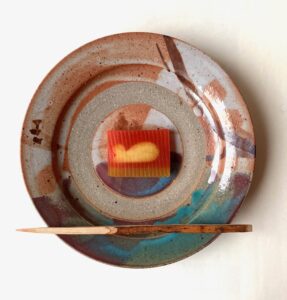
Sara, 皿, dish, round, stoneware plate with color glazes, diam. 6 sun kane-jaku, by Makoto Yabe, 誠矢部, Truth Arrow-guild, with a slice of yōkan, and a single kuromoji.
Mei-mei-zara, 銘々皿, name-name-dish, are individual dishes that are typically about 12-17 cm (4-5 sun) in diameter, small enough to fit in one hand. It is proper to transfer the sweet from the dish using the kuromoji, and place it onto one’s own kaishi.
Some sweets are offered at particular times of year or for particular reasons related to the theme of the gathering, while not always appropriate in a standard setting, they do play an important role in certain gatherings.
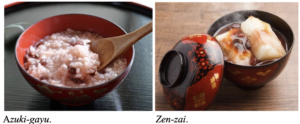
Both azuki-gayu, 小豆粥, small-bean porridge, and zen-zai, 善哉, good-(and)how, are traditional Japanese foods featuring red beans as the main ingredient. Azuki porridge is a soup cooked with rice to ward off evil spirits, while zenzai is a sweet red bean soup with mochi or shira-tama, 白玉, white-jewel, dumplings.
The foods offered in a Chaji should not have oil, butter, grease, etc. There are exceptional sweets such as miso Matsukaze, Castella, etc., which are greasy to the touch. This rule applies especially to higashi as they are eaten with the fingers. This holds for the foods served in ha-ssun, 八寸, eight-‘inch’, served during the Chaji, as they are eaten with the fingers, and called ‘tsumami’, 摘み, pinch.
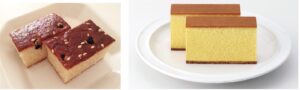
Miso Matsukaze is made by various bakers, but Matsu-ya Tō-bei, 松屋藤兵, Pine-house Wisteria-assist, that puts in the cake na-ttō, 納豆, fermented-bean, from nearby Dai-toku-ji, 大徳寺, Great-virtue-temple, Kyōto, 納豆.Castella, カステラ , is a type of sponge cake, from Portuguese ‘pão de Castella’, bread from Castile. The cake was introduced to Japan by the Portuguese in the 16th century, the sweet is from Castile, Spain. The word ‘castella’ is derived from the Portuguese Bolo de Castela, meaning ‘cake from Castile’ Its closest relative is pão-de-ló, a Portuguese cake.
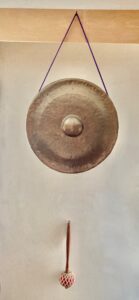
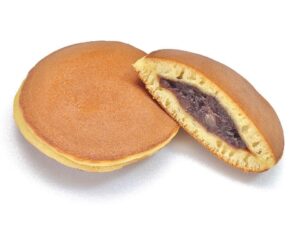
Dora yaki, どら焼, gong griddled; a sandwich-like sweet filled with red bean an, 潰し餡, mashed red bean jam: there are other fillings. The sweet is thought by some people to be a little too informal for a Chanoyu gathering.
Left: do-ra, 銅鑼, copper-gong, polished brass, Jakarta, with striker.
The etymology of the name for dora yaki includes a legend which states that during the late Edo period, a monk at Tō-ji, 東寺, East-temple, in Kyōto sought a confectionery to serve as a side dish. In response, the workshop Sasa-ya I-ori, 笹屋伊織, prepared a sweet by baking dough upon the surface of a heated bronze gong and filling it with red bean paste.
The use of objects originally related toBuddhism in the Tearoom is further exemplified by the creation of sweets that look like the kanshō, used to call guests back from the nakadachi in Chaji held in the evening.
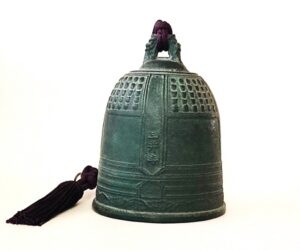
Iron kan-shō, 喚鐘, call-bell, modeled on a bon-shō, 梵鐘, buddhist-bell, from Mi-i-dera, 三井寺, Three-well-temple, Ō-tsu-shi, 大津市, Great-port-city. In the Tearoom, the Buddhist related bonshō is represented by the kanshō, which is rung at night to beckon guests from the nakadachi in the ro-ji garden back into the Tearoom.
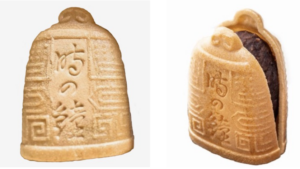
Toki no Kane Mo-naka, 時乃鐘最中, Time-of-bell -middle; a sweet of crisp dry to the touch wafer made of glutinous rice surrounding around red bean an. Made by Toki-no-kae Tanaka-ya, 時乃鐘田中屋, Time-of-bell Ricefeild-shop, in Saitama City, Saitama Prefecture. Monaka is a type of namagashi which, in some settings, would be served in the same manner as all omogashi and guests will continue to use their kaishi in the same way as for any other sweet, placing it on top of the paper packet as a type of personal ‘plate’.
Kaishi in Buddhism refers to shiki-gami, 敷紙, spread-paper, and is placed under altar offerings. There are many meanings of the word kaishi. In Chanoyu, kaishi, refers to the pack of papers, 懐紙, heart-paper, that is carried in the front of the kimono. Other homonyms for kaishi include 開始, open-begin; start; commencement; beginning; initiation; 回視, around-look; looking back (at the past), 海士, sea-gentleman; seaman. In Zen buddhism Kai-shi, 戒師, Commandment-master, can also refer to the Precept Teacher.
In Japanese Buddhism, particularly within Zen, a Kai-shi, 戒師, Precept-master, is the preceptor who guides practitioners through the rite of ju-kai, 受戒, receive-precept, to formally accept the Buddhist precepts. During this ceremony, the Kaishi provides instruction, transmits the spiritual lineage originating from Sha-ka-mu-ni, 釈迦牟尼, and bestows upon the student a kai-myō, 戒名, precept-name.
Special kaishi are used on Butsu-dan, 仏壇, Buddhist-altar, and kami-dana, 神棚, god-shelf, are available in various sizes and number of sheets in a package. A standard size is 6 sun kane-jaku = 18 cm square and often comes in reams of ten sheets.
There are correct ways to use kaishi for Buddhist altars. Placing a piece of kaishi underneath also serves to prevent the Buddhist altar or offering table from getting soiled. For Buddhist ceremonies (mourning), the paper should be folded so that the left side is on top. The basic rule is to place the paper with the fold facing the altar (back) and the open side facing the person offering prayers.
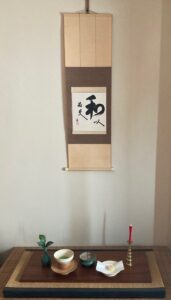
Shiki-shi, 色紙, color-paper, pasteboard with calligraphy of ‘Wa wo motte shiro to nashi’, 和を以, Harmony is to be treasured, by Hō-un-sai, 鵬雲斎, ‘Phoenix’-cloud-abstain,, XV Iemoto, Urasenke. The shikishi is temporarily mounted on a shikishi kake, 掛, hanger.
Altar offering utensils: cha-wan, 碗, tea-bowl, with tea, on a plain wooden dai, 台, support, with ka-shi-ki, 菓子器, sweet-of-container, white Raku ceramic, with manju on folded kaishi, (fold faces scroll), also presented is a ka-bin, 花瓶 flower-bottle, green-glazed ceramic, kō-ro, 香炉, incense-hearth, and rō-soku-tate, 蝋燭立, wax-light-stand, brass.
The writing on the shikishi is by Hōunsai and shows the first segment of the classic phrase attributed to Shō-toku Tai-shi, 聖徳太子, Holy-virtue Great-son (Prince Shōtoku):
和を以て貴しとなす
Wa wo motte tō-toshi to nasu .
Harmony is to be treasured.
The text was first written by Prince Shōtoku in 604 AD. The text dictates that the avoidance of conflict, through cooperation and the peaceful resolution of disputes, represents the highest virtue in society. It remains a foundational pillar of Japanese social norms and cultural aesthetics.
One may wish to have precise and exact models of utensils chosen by the various schools and faiths, however, one cannot possibly achieve this pursuit. The essential thing is to believe in your soul that you are thankful, and maintain the true deepest meanings of Chanoyu and your belief. Use what utensils you have. Improvise as well. Rikyū believed in the importance of Chanoyu and its significance in one’s life. He helped others to do the same.
For further study, see also: Kaishi: Heart of Paper, Kaishi and Kuromoji, and Tea Sweets and Offerings