
Tenmoku Chawan and Infinity
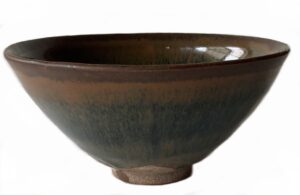
Ten-moku cha-wan, 天目茶碗, Heaven-eye tea-bowl; ceramic bowl with black to brown glaze, called o-gō-san, 兎毫盞, hare-hair-cup, also called nogi-me, 禾目, grain-eye, Diam. 4.1 x 2 sun kane-jaku, kō-dai, 高台, high-support, ring foot diam. 1.3 sun kane-jaku. Sō ji-dai, 宋時代, Dwell Time-generation, Song dynasty. 960-1127. The word tenmoku refers to the Tien-mu, 天目, area in China where such bowls originated in the Song dynasty.
Traditional tenmoku chawan possess a purposeful and geometric construction, meant to draw the meditative gaze of the person drinking tea toward a centralized point of Infinity, metaphorically contained within the bowl.
The three most well known types of glaze patterns of Tenmoku chawan are:
Yō-hen, 曜変, Glittering-change; is a bowl with a glaze that occurred as a rare and currently unknown kiln firing process with the glaze representing the pinnacle of the cosmic Void. These singular ceramics display iridescent maculae that fluctuate between deep indigo, electric blue, and violet as light shifts. Such pieces evoke the appearance of celestial nebulae or stars in the evening firmament. There are only three known flawless Yōhen vessels that survive today, each is honored as a National Treasure in Japan.
Yu-teki, 油滴, Oil-drop; are tenmoku chawan that are characterized by clusters of luminous, metallic silver or gold spots suspended against a profound, dark glaze. This visual quality simulates a vast expanse of oil droplets or a constellation of stars dispersed throughout the reaches of Space.
Nogi-me, 禾目, grain-eye; also called o-gō-san, 兎毫盞, hare-hair-cup. This glaze patterning features delicate, descending striations of ferruginous red, silver, or blue cascading along the vessel’s interior. It suggests the perpetual movement of falling rain or the passage of light through a cosmic stream.
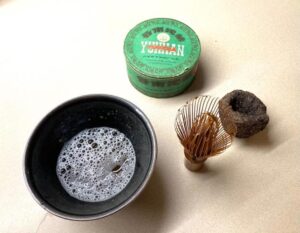
Tenmoku chawan with frothy tea made from Tuocha (毱茶) ball-tea; is compressed tea, made in Yunnan Province, China. While primarily using Pu-erh tea (dark tea), it can also be made with green tea or black tea. Tuo-cha, 沱茶, weep-tea, a brick tea, Songhe Brand, Yunnan, Xiaguan; a raw Pu-erh tea black tea. Bowl nest form. The choice of susu-dake cha-sen, 煤竹茶筅, smoke-bamboo tea-whisk, was made to help disguise the blackish tea bits retained on the whisk.
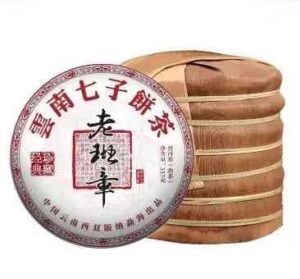
A popular Chinese cake-tea, chi-zi bing-cha, in Japanese, nana-ko-mochi-cha,七子餅茶, seven-sons cake-tea, is a traditional way of compressing Pu-erh tea; both fresh and fermented leaves into a round, flat shape. This method was developed centuries ago in Yunnan, China, to make the tea easier to store and transport along the ancient trade. The name originates in the custom of wrapping 7 pieces of cake tea in bamboo skin for storage.
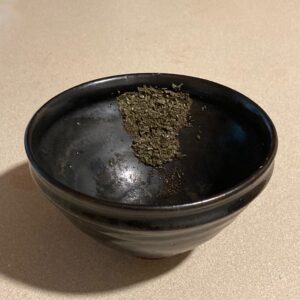
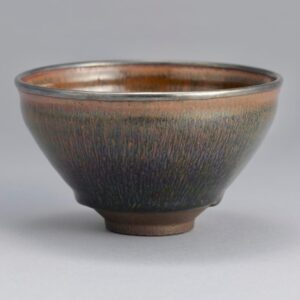
Left: residue of dancha tea particles impeded by the inner ridge of the tenmoku chawan. Stoneware ‘tenmoku’ bowl made by Makoto Yabe. Right: Song period tenmoku chawan, showing the inner ridge that blocks the tea particles from entering the mouth when drinking the tea.
This inner ridge is an essential aspect of early tenmoku chawan, because the tea leaves were infused with hot water seven or eight times. People would sit and sip tea for an extended period of time, interspersed with bits of food. With the advent of drinking powdered green tea, Zen Buddhists took only a few minutes to drink a single blend of matcha and hot water. The seven or eight infusions of brick tea interspersed with snacks may be the origin of serving seven sweets at a very formal Tea presentation.
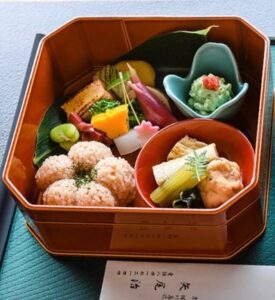
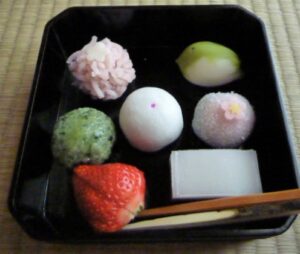
Left: ten-shin, 點心, offer-heart, a vegetarian meal with various foods served in a fuchi-daka, 縁高, edge-high, presented at Ken-nin-ji, 建仁寺, Build-benevolence-temple, Kyōto. Right: seven kinds of ka-shi, 菓子, sweet-of, served at a very formal Tea presentation. The Kanji, ten, 點, is composed of the Kanji for the Go-rin, 五輪, Five-rings, principles.
Shō-jin ryō-ri, 精進料理, Pure-process materials-process, vegetarian Buddhist foods and presentation, catered at Kenninji by various restaurants such as Ya-o-ji, 矢尾治, Arrow-tail-reign, Kyōto. [Pictured above.] Buddhist temples often serve mage fuchidaka and bowls with red, vermilion, or orange lacquer.
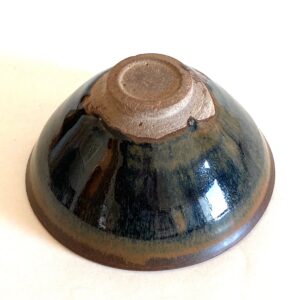
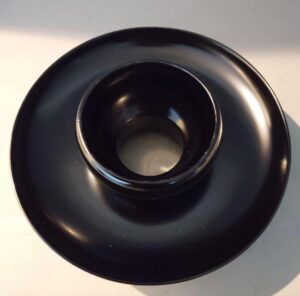
Tenmoku chawan: Ken-yō, 建窯, Build-kiln, Fu-jian, 福建, Fortune-build, area of China. Sō-ji-dai, 宋時代. Dwell-time-period, with glaze of Nogi-me also known as To-gō-san, 兎毫盞, hare-hair-cup, inverted, showing kō-dai, 高台, high-support; diam. 1.3 sun kane-jaku. The kōdai is rather short and narrow, rendering the bowl a little unstable. The tenmoku is intentionally made in this manner and, as it can be unstable, it is presented on a wooden support called a dai, 台 – and so the bowl and its stand together are identified as dai-ten-moku cha-wan, 台天目茶碗.
The wooden dai is traditionally lacquered throughout, and quite often black. However, of the vast variety of styles of tenmoku chawan, they have been categorized as nana-shu ten-moku-cha-wan, 七種天目茶碗, seven-types heaven-eye tea-bowl. In addition, the dai have also been identified as nana-shu ten-moku-dai, 七種天目台, 7-kinds heaven-eye-stand.
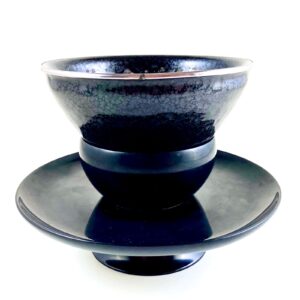

The tenmoku chawan, pictured above is a ceramic conical bowl with glaze in the style of yu-teki, 油滴, oil-drip. Japanese, this bowl is an adaptation of Chinese tea bowl, with silver fuku-rin, 覆輪, cover-ring, supported on a black-lacquered ten-moku dai, 天目台, heaven-support of.
In Japanese, a cone is identified as an en-sui, 円錐, round-cone. In profile, a cone appears as a triangle, san–kaku, 三角, three-corners, and is emblematic of the Kanji for the number eight; hachi, 八, Which is symbolic of Infinity in Space. Eight is an In number because it can be divided into two equal parts: 8 divided in half is 4 (In), divided in half is 2 (In), divided in half is 1(Yō). The Kanji, 八, is derived from one-eighth of a circle, and is symbolic of Infinity in Space. The wire cone holder exemplifies a salient feature of the Kanji 八 as though a cone is an inverted turning V, which is symbolic of the flowing nature of Infinity in Time.
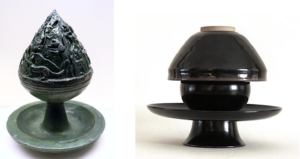
Left: kō-ro, 香炉, incense-hearth, green-glazed ceramic in the form of a mountain – ‘Bó-shan-lu’, 博山炉, Esteemed-mountain-hearth, in Japanese, ‘Haku-san-ro’. Right: The Daitenmoku may be likened to Mount Sumeru, the inverted chawan has the stylized profile of a mountain.
The Hakusanro is a type of incense burner that was popular during the Han and Jin dynasties. The saucer contained water that represented an ocean, and a precaution against fire. The bowl has a conical lid that is perforated to release the fragrant smoke.
The Myhtical Bó-shan, 博山, Esteemed-mountain, frequently depicted in Buddhist iconography, possesses a conical, overlapping form often intended to evoke the spiritual essence of Shumi-sen, 須弥山, Mt. Sumeru, the cosmic center of the world.
The conical form represents the mythical mountain at the center of the world, Shumisen, Mt. Sumeru; the legendary central pillar of the world within Buddhist and Hindu cosmology. Combined with the concept of Infinity, it illustrates the microcosm as a mirror of the macrocosm, wherein a singular, defined physical locus serves as a vessel for the limitless and boundless essence of existence within Infinity in Time and Infinity in Space.
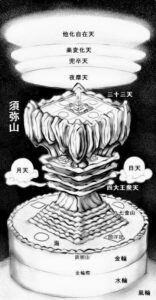
Illustration of a representation of Mount Sumeru/Shumisen, and its multitude of details with mountains, seas, and temples. This is a highly stylized image depicting the description of Mount Sumeru/Shumisen as in the ‘Ksitigarbha Bodhisattva Dharani Sutra’.
The daitenmoku can also be seen as a physical manifestation of the Go-gyō, 五行, Five-transitions, physical elements: Earth, Water, Fire, Metal, Wood.
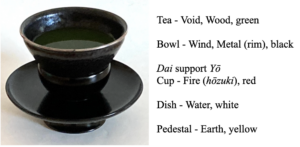
This view also has as a metaphysical correlate the Go-rin-tō, 五輪, Five-ring, five principles: Earth, Water, Fire, Wind, Void.
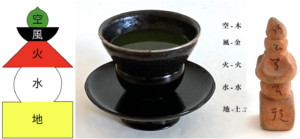
Left:Gorintō. Center: tenmoku and dai, Kanji from left are the principles which are Chi, 地, Earth, Sui, 水, Water, Ka, 火, Fire, Fū, 風, Wind, Kū, 空, Void and on right are the five elements the Go-gyō, 五行, Five-transitions: mo, ka, don, sui, indicating the relationship to the Gorintō. Ceramic Go-rin-tō, 五輪塔, Five-principle-tower, inscribed with the Sanskrit characters, by Henry Mittwer, Kyōto
In the relationship of the daitenmoku as a metaphor for the gorintō, the tea is a representation of the Void. The Kanji for cha, 茶, tea, has a deeper meaning other than identifying the tea plant, camellia sinensis. The Kanji is composed of Kanji four numbers. The main part of the Kanji is a variant of kome, 米, rice, and that represents the numbers 八十八, 8 10 8, or 88, which is symbolic of the center of Infinity in Space. It is topped with the Kanji kusa-kanmuri, 艹, grass-crown, which represents two number tens, 十十, or twenty. Collectively, the Kanji ‘total’ is hyaku-hachi, 百八, or, 108, which can imply ‘Hyaku-hachi Bon-nō, 百八煩悩, 100-8 Worry-pain, unwholesome desires that must be expunged before one can be enlightened.
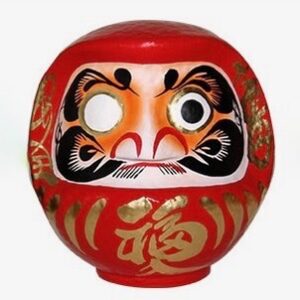
Buddhist enlightenment, satori, 悟り, and tea-drinking are united concepts exemplified by the Indian monk, Daru-ma Dai-shi, 達磨大師, Attain-polish Great-master. It has been said that during his nine years of meditating, facing the wall of a cave, he became annoyed by his eyelids that were continuing to close causing him to fall asleep, so he cut them off. Where they fell to the ground, tea plants grew up. Dolls representing Daruma were created without eyes, and traditionally one acquires a doll each year, and when making a wish, one eye would be painted in. If the wish comes through, the other eye is painted in and returned to the temple where it was purchased. At year’s end, the many dolls are consumed in a ritual fire. The legend of Daruma is a metaphor of attaining enlightenment. Open-eyedness, awakening and tea-drinking are inseparable.
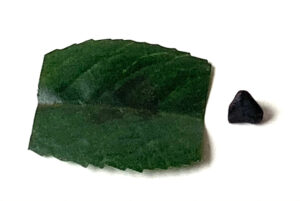
Depictions of Daruma with wide-open eyes suggest his enlightenment. There may be some connection between Daruma’s tea leaf eyes, and the camellia leaf that has its pointed ends cut off to support the piece of neri-kō, 練香, kneaded-incense, held in a kō-go, 香合, tea-gather, that is sensitive to moisture.
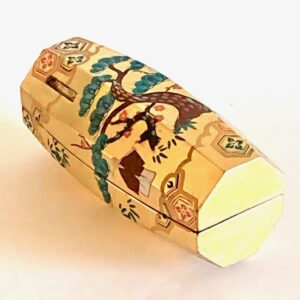
Buri-buri kō-go, ぶりぶり香合, ‘plump’ incense-gather; gilt-lacquered, octagonal, wooden mallet-head, split and adorned with colorful auspicious designs for the New Year. Holds neri-kō, 練香, kneaded-incense, that is placed on a camellia leaf to protect the kōgo from its moisture. However, the choice of a camellia leaf may be its identification with the Kanji for tsubaki, 椿, which means the tree (木) of spring (春), and, ideologically, the New Year is also the beginning of the spring season.
Nerikō is a mixture of aromatics in powdered form blended with honey and water. Matcha is only tea in powdered form that is blended with water, and varies between thick tea and thin tea. Nerikō dries to a solid, whereas tea is drunk in liquid form. Incense and tea are examples of the Change, as espoused in the I Ching. Incense smoke is visible but fragrance is invisible. Tea, being drunk, is no longer present.
Incense, kō, 香, fragrance, has a vital and intrinsic place in Chanoyu, and in daily life. Its origins have roots in Buddhism, where it is the scent of divinity, and is symbolic of eternity. In the world of Chanoyu, there are essentially two kinds of incense: byaku-dan, 白檀, white-sandalwood, and neri-kō, 練香, knead-incense, which is a varied blending of aromatics including the option of sandalwood. Byakudan is burned in the portable fu-ro, 風炉, wind-hearth, whereas nerikō is burned in the sunken ro, 炉, hearth. This is part of the tradition of Urasenke.
Outside of Chanoyu, people in Japan love incense and enjoy its various forms and acknowledge its seasonality. Sen-kō, 線香, thread-incense, stick incense is perhaps the most familiar form. It is present for offerings at Buddhist temples. It is made of nerikō extruded like noodles and dried, or shaped into various forms including spirals and small cones, en-sui-gata, 円錐形, round-cone-form.
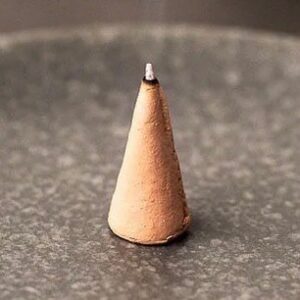
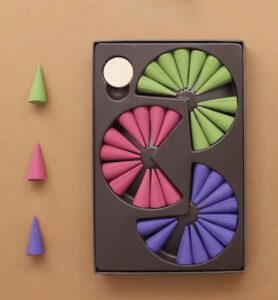
Three varieties of incense fragrance; en-sui-gata, 円錐形, round-cone-shape; available from Shō-yei-dō, 松栄堂, Kyōto.
The form of the cone incense is maintained after burning, which has its parallel in the powdered black tea leaves after seven or eight infusions.
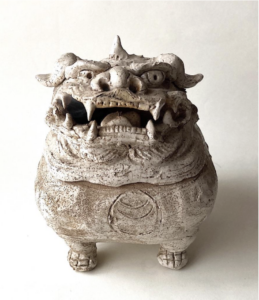
Kō-ro, 香炉, incense-hearth, covered, ceramic container in the form of a ‘Kara ji-shi’, 唐獅子, Tang lion-of, Shi-no-yaki, 志野焼, Aspire-field-fired, by Mae-kawa Den-kō, 前川電光, Fore-river Electric-light, lightning. In the Tea realm, offerings of tea and sweets and other foods are presented on an altar-like arrangement in a tokonoma, with a central incense burner, flower vase and candlestick. This provides a time when other types of incense are offered or burned in the Tearoom.
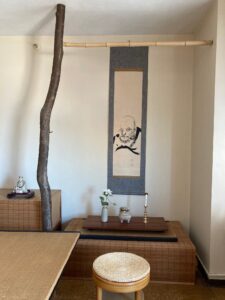
Display of utensils in a tokonoma adapted from a Buddhist altar. From left: hana-ire, 花入, flower-receptacle, kō-ro, 香炉, incense-hearth, rō-soku-tate, 蝋燭立, wax-light-stand, candlestick.
Formal offerings of Chanoyu, Ken-cha-shiki, 献茶式, Offer-tea-rituals, are also presented throughout Japan at shrines, temples, and other places of worship. This offering generally includes a tenmoku chawan on a dai.
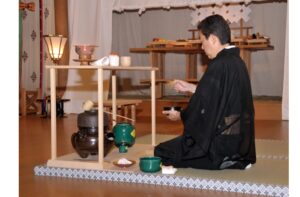
Urasenke Oiemoto offering Kencha at Itsukushima Jinja. The da-isu, 台子, support-of, display stand presentation includes the offering and a charcoal fire, thick and thin tea. Koi-cha, 濃茶, thick-tea, is kept in a plain wooden natsume, 棗, jujube, lined in gold, and wrapped in a white silk shi-fuku, 仕服, serve-cover, tied with a purple cord, and usu-cha, 薄茶, thin-tea is in a separate natsume lined in silver and wrapped in a white silk shifuku tied with a red cord. The Kencha is typical of Tea offerings.
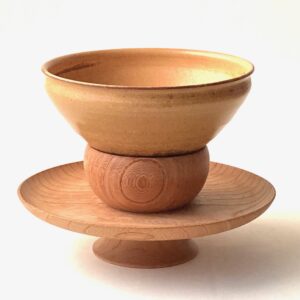
Tea bowl, cha-wan, 茶碗, tea-bowl; ceramic Ten-moku-gata, 天目型, Heaven-eye-shape, with wheat color glaze, Ki-kkō yaki, 吉向焼, Good luck-beyond-fired; diam. 4.4 x 2.3 sun kane-jaku. Ki-nin dai, 貴人台, noble-person stand, zelkova. The chawan was made in 1963 for the 700th anniversary of the birth (May, 21) of Shin-ran, 親鸞, Parent-mythic bird, (1173-1263), founder of the Jō-do Shin-shū, 浄土真宗, Pure-land New-sect, given at Higashi-Hon-gan-ji, 東本願寺, East-True-vow-temple, Kyōto.
Whether the offering is presented in the formal kencha tradition at a temple or shrine, or if it is presented in a more standard Tearoom setting, the tea offering is generally placed on a dai.
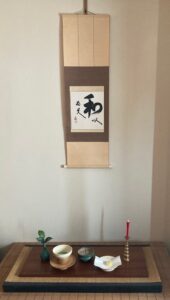
Hanging scroll with shiki-shi, 色紙, color-paper, bearing the Kanji, Wa, 和, Harmony, written by Hōunsai, XV, Oiemoto Urasenke. Altar offerings of Tea (in a tenmoku chawan place on a dai) and sweets, together with incense burner, candlestick, and vase.
Within the Buddhist tradition, ku-motsu, 供物, offer-thing, are not viewed merely as sacrificial tributes to a divine presence, but serve as pragmatic manifestations of mindfulness. These acts are crafted to dissolve earthly attachments, foster a spirit of generosity, and accumulate spiritual merit. The concept of Infinity is intrinsically linked to these customs, as they transmute finite, localized gestures into vast and boundless metaphysical intentions.
Mu-hen no eko, 無辺の回向, No-boundary-of-merit-transference, have been practiced in various ways over millennia. Through the completion of such acts, ideally, each practitioner has directed the accumulated merit toward the enlightenment of every sentient being existent throughout the passage of Infinity in Time and the vast reaches of Infinity in Space.
For further study, see also: Furo Ro:Three Forms, Kami Kamashiki and Kaishi, and Tea Utensils: Roots in Heaven