
Sounds in Tea: Part 1
Attending a Tea presentation, or special event such as a cha-ji, 茶事, tea-matter, or a cha-kai, 茶会, tea-gathering, provides an opportunity to be present with all the senses, and while many associate Tea with a quiet and contemplative experience there are a wide variety of sounds, both in the external environment as well as in the internal forms of mental and emotional participation.
One of the first sounds that is present in a gathering is the knock of a ban-gi, 板木, board-wood, that is hung outside near an entrance, and is struck once by a guest arriving for a Tea gathering. The bangi may be present within the gen-kan, 玄関, profound-gateway, the main entryway to the that leads to the yori-tsuki, 寄り付き, gather-attach, changing room where guests prepare to enter the machi-ai shitsu, 待合室, wait-gather room.
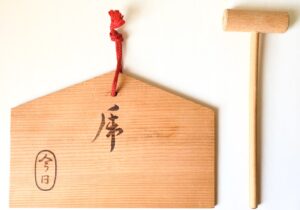
Left: usu-ita, 薄板, thin-board, sugi, 杉, cedar, in the pentagonal shape of an e-ma, 絵馬, horse-picture, 5.5 x 8 sun kane-jaku. The branded Kanji for tora, 乕, tiger, after calligraphy by Hōunsai VX, with the branded stamp from Kanji also written by Hōunsai VX for Kon-nichi, 今日, Now-day, from the name of Sōtan’s Kon-nichi-an, 今日庵, Now-day-hut. Konnichian is synonymous with Urasenke. Right: wooden mallet.
This single strike of the bangi is derived from Buddhism in which a thick board is struck to alert others of time and occasions. The sound of striking the board may be likened to the roar of a lion that awakens one to spiritual realms.
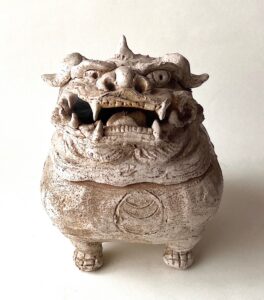
Incense burner, kō-ro, 香炉, incense-hearth; ceramic Kara Ji-shi, 唐獅子, Tang Lion-of, Shi-no yaki, 志野焼, Aspire-field fired, by Mae-kawa Den-kō, 前川電光, Fore-river Lightning-light, Se-to Shi, 瀬戸市, Rapids-gate City.
The sound of the Buddha’s teachings has been equated with the lion’s roar. This is, in part, because there is an important distinction between hearing and listening. In order to move along the path from disturbance to peace, or chaos to quietude, knowing and attending to the difference between hearing a teaching and listening to a teaching is essential. This is true even within a conversation with another person, or a tea lesson.
Hearing is passive, involuntary, requires no effort, and is a mere physiologic perception of sound.
Listening is active, voluntary, requires effort, and an intentional integration and interpretation of sound.
When the bangi is stuck in the genkan, it is the first sound one can actively engage with as they prepare to enter the extra-ordinary space of the gathering. The genkan may lead to the yori-tsuki,寄り付き, changing room, where guests prepare to enter the machi-ai shitsu, 待合室, wait-gather room. All three locations generally will have decorative elements that are fitting for the theme of the gathering.
Many items and/or motifs may evoke qualities of other senses beyond visual. A particular sense often present in a Tea gathering, in one form or another, is the sense of sound that can be metaphorically ‘heard’ through a felt sense, even within the visual or other sensorial experiences of the tea room, as well as within the objects, elements, and people present at the gathering. The sense presence of sound is readily apparent in many objects as they are used by either host or guest, as sound can only exist through movement.
All five senses, sight, smell, taste, touch, and sound are present and within that presence, ideally, the sense of consciousness is felt, or awakens. These senses are known as the six sense doors in Buddhism, and comprise one of the ways in which En-gi, 縁起, Connection-wake up, also referred to as known as Pratityasamutpada, is realized. This is a core Buddhist concept of interdependent arising of phenomena that occurs for human beings. For example, nothing is just one thing – because this exists, that also exists.
This mode of understanding co-dependent arising, particularly through two or more sense modes simultaneously, is illuminated in the following poem by Rikyu’s grandson, Sen Sō-tan, 千宗旦, Thousand Sect-dawn, (1578-1658), with modern translation:
Chanoyu to wa ikanara koto to hito toeba sumi-e ni kakishi matsukaze no oto.
If asked, the nature of Chanoyu, one may say it is the sound of windblown pines in an ink painting.
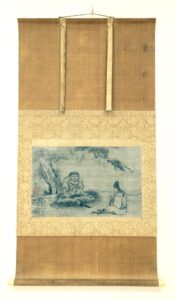
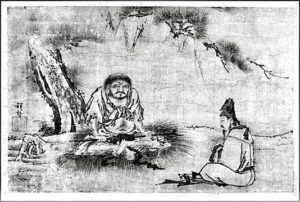
Kake-jiku, 掛軸, hang-scroll, with painting of two men and a pine tree. Attributed to Ken-kō Shō-kei, 賢江祥啓, Wise-bay Auspicious-disclosure, (Japanese, active ca. 1478–ca. 1523) Muromachi period (1392–1573). MET Metropolitan Museum of Art. Previously thought to depict Bodhidharma and a follower. Bodhidharma is known as Daruma, ダルマ, in Japanese.
The painting illustrates a ‘Zen-ki’, 禅機, Zen-encounter, a meeting between and master and a disciple.
In China, Dao-lin Chan-shi, (Dō-rin Zen-shi), 道林禪師, Way-grove Zen-master, asked Fu-li Fa-shi, (Fuku-rei Hō-shi), 復禮法師, Return-rite Law-master, “How should one contemplate at first? How should one use one’s mind?” Master Fuli remained silent for a long time, and Daolin bowed three times, san-rei, 三礼, three-bows, before leaving. Later, Daolin received Dharma transmission.
In the painting, Fuli, his robe tied in a knot on his chest, sits on a mat of long grasses, on the roots of an ancient pine tree, with his legs crossed in front. He holds a long stick, horizontally, on his lap. Daolin sits on the ground in front of Fuli. The presence of the pine tree is like the toko-bashira, 床柱, the distinctive pole of the tokonoma. The Kanji for 床 is composed of side, ⽙, and tree, 木, meaning by the side of a tree.
Objects or scrolls with images and/or calligraphy may be present in the genkan, yoritsuki, and/or maichai.
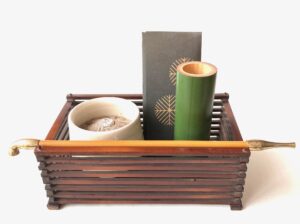
When the guests arrive in the machiai, a tabako bon, 煙草盆, smoke-plant tray, identifies the location for the main guest, sho-kyaku, 正客, first-guest.
The tabako bon, pictured above, is made of narrow strips of susu-dake, 煤竹, smoked-bamboo, that is suited to summer, as the open construction technique gives a cool breeze feeling. The basic utensils are tobacco in a paper folder, tabako ire, 煙草入, smoke-plant-into, a pipe, kiseru, 煙管, smoke-pipe, a lighter, hi-ire, 火入,fire-into, and a burnt ash receptacle made of green bamboo, hai-fuki, 灰吹, ash-blow. The design on the black paper tabako-ire is Kara-matsu, 唐松, Tang-pine, larch, which alludes to matsukaze. The gilt motif of the Karamatsu is the choice of Tantansai, XIV.
After smoking, the kiseru pipe bowl is tapped on the rim of the bamboo, making a sound. While smoking from the tabako-bon is rarely actively used as an aspect of current Tea gatherings, there is an element within the practice of seeing the tray that can be utilized as a sign to help pay attention to the breath, a movement of air into the body and out of the body, somewhat similar to a meditative breathing. Formally, and for some currently, the use of tobacco can be thought of as a way to encourage a more meditative form of breathing. This focus on the breath, whether through the visual presence or actual use of tobacco, is utilized to help guests transition from the ordinary space of the outer world to prepare to enter the extra-ordinary space of the Tea gathering. Whether it is used visually or in actuality can be of little consequence as its ultimate purpose is to show encouragement of the guests to be relaxed and fully present as participants in the gathering. If and when used, the movement of breathing smoke and air in and out reduces the contents of the kiseru to ash, which is then tapped into the haifuki, the tapping does make sound, as does the breath if one is attending to it.
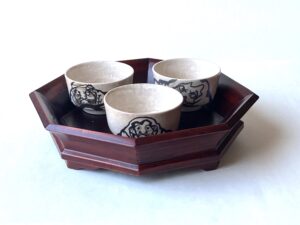
Kumi-dashi ja-wan, 汲出茶碗, ladle-out tea-bowl; three ceramic cups with different depictions of Daruma, with calligraphy: Marked, hi-gumo, 日雲, sun-cloud. Bon, 盆, tray, octagonal, wood tray with maroon lacquer over incised floral motifs, Korea. Legend connects Daruma with the phrase “Cha Zen Ichi Mi”, 茶禅一味, or “Tea and Zen are One Taste”, as he is recognized as the founder of Zen, whose eyelids allegedly became the first tea plants. One may look at the image of Daruma and, perhaps, listen to the phrase within.
Once the guests are assembled, the han-tō, 半東, half-east, an assistant of the tei-shu, 亭主, house-master, serves o-sa-yu,お白湯, honarable-white-hot water, in kumidashi jawan, on a bon, 盆, tray. The hot water served is ideally the same water that is being used to prepare much of the meal, as well as the tea presented during the event. Some people have taken to flavoring the water, in part due to the phrase, kō-zen, 香前, fragrant-before, however the fragrance is not in the water, rather it is the scent of the incense present as host places the first three pieces charcoal in the ash bed present, either in the furo or ro, in the tearoom.
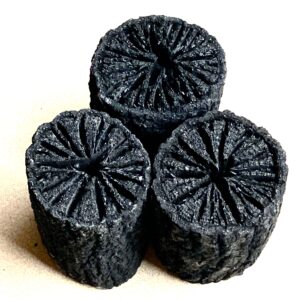
Three shita-bi, 下火, down-fire, called chrysanthemum charcoal. Shitabi form the base of the full sumi, 炭, charcoal, procedure to heat water for making tea, and charcoal is naturally black with a natural and visible chrysanthemum pattern. The natural pattern of flower-like radiating wood grain lines gives this kind of charcoal the name of kiku-zumi, 菊炭, chrysanthemum-charcoal.
The first thing that is put into the hearth is three pieces of incense called shiki-kō, 敷香, spread-incense. These are placed in the hearth before the ignited gitchō, which, when burning, are called shita-bi, 下火, down-fire. The fire causes the charcoal and the incense to be useful, and causes action in the Tearoom. These are the coals that have been lit to allow the faint scent of incense to linger in the room prior to the serving of the meal, if it is a full chaji, or the during enjoyment of the sweets if the gathering is a chakai event.
An aspect of placing the main charcoal for the kettle to heat water for tea involves placing incense, which in Tea culture indicates being able to ‘listen’ to scent. According to custom, one does not ‘smell’ incense, but ‘listens’ to it, which is called kō wo kiku, 香を聞く, incense to listen, and mon-kō, 聞香, listen-incense. There is, in Japanese, a profound wordplay on ‘kiku’, which means both listen, 聞, and chrysanthemum, 菊.
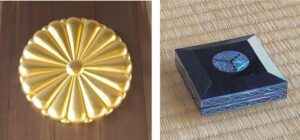
Left: Japan’s Imperial Kiku-ka-mon-yō, 菊花紋章, Chrysanthemum-flower-crest-crest, gilt wood. Right: kō-gō, 香合, incense-gather, black-lacquered covered wood box with a design of three partial chrysanthemum flowers and geometric banding in inlay of ao-gai, 青貝, blue-shell, mother-of-pearl, used with the fu-ro, 風炉, wind-hearth, Japan.
In Japanese traditional design, the kiku has special significance and symbolism, and is the imperial crest of the emperor. It is depicted in different forms, especially with 16 or 32 petals. A familiar family crest is the mitsu-wari-giku, 三つ割り菊, three-divide-chrysanthemum.
The placing of incense in the charcoal fire is an implicit offering to use the five senses in ways that can develop the mind state to include the idea that everything is interconnected, nothing is only one thing.
Both the tabako bon, if used, the kōzen, and the incense are aspects of sound introduced in the maichai, regardless of the decorative object(s) present. To encourage relaxation, the host, tei-shu, 亭主, house-master, ensures the guests are provided with water, scent, and a tabako bon. Whether or not the guest chooses to partake of tobacco, the presence of the lit charcoal in the hiire places the guest in the role of handling fire, an act that places him or her in the role of the true teishu of the gathering.
At the same time, if the machiai is located close enough to the tearoom, the guests are also ‘listening’ to the scent of incense, the first fragrance, while partaking in the tasting of hot water and, perhaps, tobacco or intentional breathing.
Once the experience of the machiai is complete, the guests move to the koshi-kake machi-ai, 腰掛待合, hip-put wait-gather, an outdoor waiting area near the entrance to the inner ro-ji 露地, dew-ground (露 means enlightenment in Buddhism). Again, a tabako bon is provided in this area as well, and the incense from the tearoom may continue to be perceptible as well, depending on the layout of the area.
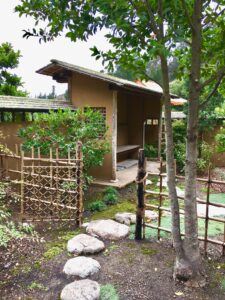
Koshikae machiai as seen from the inner roji. Essential to the roji garden is the chū-mon, 中門, middle-gate, which is borrowed almost directly from the Buddhist temple complex. A popular and humble gate for the chūmon is a wari-ao-dake shi-ori-do, 割青竹枝折戸, split-green-bamboo branch-fold-door, (pictured). The gate separates, in a symbolic manner, the soto-roji, 外露地, outer-roji, and the uchi-roji, 内露地, inner-roji, where the tsukubai, 蹲踞, crouch-down, and the Teahouse are located.
In the koshikae machiai, located in the soto roji, the guests arrange their seating and sit on the bench, taking in the experience thus far, and preparing to be present, both for the journey through the uchi-roji, as well as that of the meal (if the gathering is a chaji), and tea inside the chashitsu. It is while seated in the at the koshikae machiai that the guests may receive the first evidence of the host as they listen to the host generating sound of water at the the chō-zu-bachi,手水鉢, hand-water-bowl, or tsukubai being replenished from the te-oke, 手桶, handle-bucket.
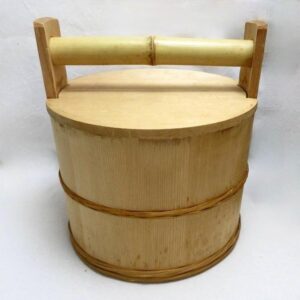
Te-oke, 手桶, hand-bucket, with divided lid; cedar and bamboo, used to replenish the water in the chōzubachi, at the tsukubai in the uchi ro-ji.
The teishu empties the basin with a ladle, and replenishes it with water from a wooden teoke. The teishu holds the bucket above the empty basin, and pours the water from the bucket so that it refills the basin, which makes a refreshing sound heard by the guests who are seated nearby.
When in the roji garden, the guest must carry the closed sen-su, 扇子, fan-of, in the right hand. The standard length of a man’s sensu is roku sun, 六寸. There may be a correlation of this standard with either a walking stick called a called a ro-ji zue, 路地杖, dew-ground staff, which was often carried by Sen no Rikyū, or perhaps even the shaku-jō, 錫杖, tin-staff, carried by Ji-zō Bo-satsu, 地蔵菩薩, Earth-keep Grass-buddha.
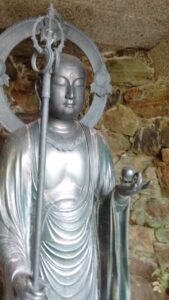
Bronze figure of Jizō Bosatsu, at Hō-nen-in, 法然院, Law-as such-temple, Kyōto. He is depicted holding in his right hand the shakujō and on his left hand he holds the hō-ju, 宝珠, treasure-jewel, that grants all wishes.
Rikyū’s staff was made of bamboo that had nana fushi, 七節, seven nodes, which created six chambers, roku kan, 六間. There is a correlation between the six rings of the shakujō and the six chambers of the bamboo staff and the six sun of the sensu. If such connections are made, the guest holding the fan is emulating Rikyū’s bamboo staff and Jizō’s shakujō. If Jizō, the guardian of travelers, is seen as guiding the guest through the roji to the Tea room, a realm of Buddhist heaven, the six rings of the shakujō would be creating sound.
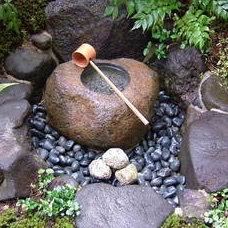
Chozūbachi with freshly replenished water and purification ladle.
Purification at the chōzubachi follows a concept of the importance of the number three; the single ladle of water is poured three times: left hand, right hand, mouth, spit – do not drink the water. Attending to the sound, the feeling, and the purificatory essence of water prior to entering the tea room is part of engaging with washing away the ordinary trappings of the outer world and entering the tearoom with humility and openness of mind.
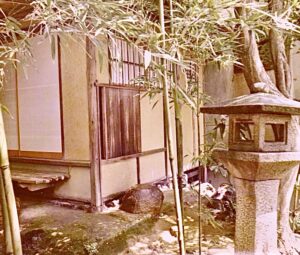
The sliding wooden door of the nijiri-guchi should not be opened completely. As shown in the photograph above, a small part of the sliding door should be available to grasp to open as well as close the door. The last person to enter the Tearoom, called tsume, 詰め, closer, is designated to shut the sliding door with an audible thud, which informs the host that all of the guests have entered the Tearoom.
Once the guests are inside the tearoom, they move to observe the toko-no-ma, 床の間, floor-’s-room.
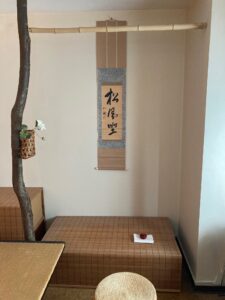
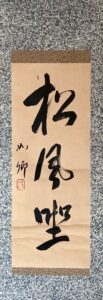
Tokonoma, kake-jiku, 掛軸, hang-scroll, calligraphy, Shō-fu-za, 松風坐, Pine-wind-sit, signed, Jo-kyō, 如郷, Like-home; kō-gō, 香合, incense-gather, red-lacquered, round, covered container with gold design of kiku, 菊, chrysanthemum, displayed on kami-kama-shiki, 紙釜敷, paper kettle-spread. The choice of these items has been selected by the host to subtly continue the theme of engaging all the senses, in order to pay particular attention to the essence of sound. Only the kakemono is displayed in the tokonoma during the first part of a chaji when a meal is presented. Flowers, cha-bana, 茶花, tea-flower, are displayed in the tokonoma during the second part of a chaji when Tea is presented.
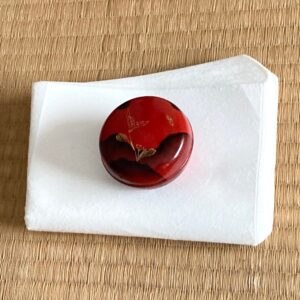
Kōgō, red-lacquered, round, covered container with gold design of kiku, displayed on kami kama-shiki, 紙釜敷, paper kettle-spread.
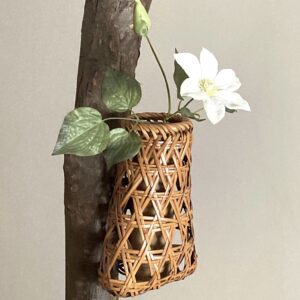
Kake-hana-ire, 掛花入, hang-flower-enter, bamboo kago, 籠, basket. In a chaji, flowers in a hana-ire, 花入, flower-receptacle, are the only things displayed in the tokonoma.
With regards to the jiku, because of the wide use of the word ‘matsukaze’ which is also read ‘shōfu’, there is the possibility of a homonym with profound significanc in Buddhism. E-shō Fu-ni, 依正不二, Rely-correct Not-two, which is the Buddhist concept of co-arising phenomena – Pratityasamutpada, En-gi, 縁起, Connection-wake up. For a Buddhist, this concept of shōfu may evoke the homonym shō-fu, 松風, pine-wind, as another form of referring to matsukaze. In the context of the phrase, ‘Sho fu za’, there is a suggestion to sit under the pine with a gentle wind, awakening to the sound of the wind that exists within the phrase begins only internally for the guests by first observing the jiku upon entering the tearoom. The awakening to the experience through sound then continues when the first guest utters the first spoken phrase to the host – will you please read the scroll – “jiku wo yonde kudasai”.
It is within the host speaking of the words on the scroll, while guided by the movement of the breath and the vocal cords, that the written words themselves come fully into existence within the gathering, via sound.
Sho fu, is the on-yomi reading of the same Kanji that could also be pronounced matsukaze. Matsukaze is a word often used to describe the sound of the water that is well heated in a kama prior to serving tea.
When at a chaji, a meal called kai-seki, 懐石, heart-stone, is served. Once the meal is complete the first charcoal arrangement called sho-zumi, 初炭, first-charcoal takes place. Utilizing intentional movement, the hearth is brushed with a ha-bōki, 羽箒, feather-brush, charcoal is placed, and the hearth is again brushed with the feather. Both the visible and the audible aspects of the process are observed by the guests. The kōgō is placed for the guests to observe up close and there is a discussion regarding both kōgō as well as the the incense. During a full chaji one, or possibly two, charcoal procedures occur with the guests present.
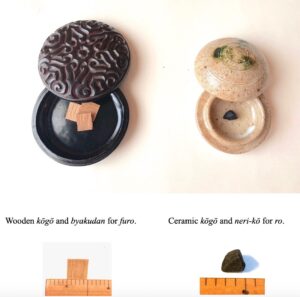 Left: square of byaku-dan, 白檀, white-sandalwood, incense used with furo; 5 bu kane-jaku. Right: a piece of nerikō made into the form of a shi-men-tai, 四面体, four-face-body, a tetrahedron, burned in the ro, and a section of a bamboo kujira-jaku ruler measuring .25 bu. Depending on the season different incense is placed into the charcoal bed. Traditionally, sandalwood is used during furo season. Sandalwood has at least 25 different species. Being attuned to the scent of the incense requires connecting the perception of scent along with the ability to ‘listen’ to the inner experience of the heart. The experience is one in which the various types of aromatic wood incense contain not only scent, they also have a quality described as a ‘voice’ or ‘whisper’ that speaks to the listener, bringing wisdom from nature, awakening memories, references to teachings, presence, and openness to ‘listen’ to the sound that the incense generates within one’s heart.
After the charcoal is set and the kettle begins heating, a moist sweet is served.
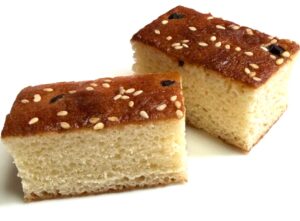
O-ka-shi, お菓子, hon.-sweet-of, ‘Mi-so Matsu-kaze’, 味噌松風, taste-sour pine-wind, is a baked, wheat cake flavored with miso and Dai-toku-ji na-ttō, 大徳寺納豆, Great-virtue-temple preserved-bean, sprinkled with go-ma, 胡麻, foreign-flax. The nattō came from China with Zen monks during the 12th century, and were conserved at Daitokuji.
Once the sweets are served to the guests, the teishu lets the guests know that there will break called nakadachi , 中立 , and that they can return to the waiting area. The main guest thanks the host and lets the host know that the guests will wait for the sound for them to return.
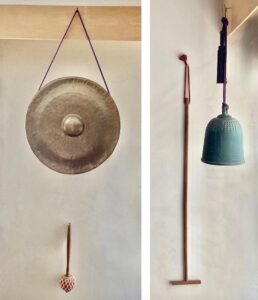
Left: do-ra, 銅鑼, copper-gong, polished brass, Jakarta, with striker. Right: kan-shō, 喚鐘, call-bell, patinated tetsu, 鉄, iron, Mi-i-dera, 三井寺, Three-wells-temple, with kuwa, 桑, mulberry wood striker, shu-moku, 撞木, strike-wood.
The kanshō was used to summon guests to have Tea, until Hideyoshi gave Rikyū a dora from Indonesia. Rikyū used the kanshō at night and the dora during the day. The high note of the kanshō is Yō/Yang, in contrast to the night which is In/Yin. The reverse is true with the dora note is In/Yin contrasting with the Yō/Yang day.
The dora and the kanshō are struck in a specific manner. The standard sequence is seven strikes: dai shō dai shō chū chū dai, 大 小大 小 中中 大, big small big small medium medium big. When there are four or fewer guests the sequence is five strikes: dai shō chū chū dai, 大 小 中中 大, big small middle middle big. The sound of each strike varies in duration before the following strike.
Once the sound of either the dora or kanshō is heard the guests again travel through the roji to re-enter the tearoom and ready themselves for the presentation of Tea.
As the kettle comes to a temperature that is appropriate for tea, the guests can hear the crackling sounds of the charcoal used to heat the ro, 炉, hearth, or fu-ro, 風炉, wind-hearth, as well as the simmering of the water that is referred to as matsukaze. The sound of the wind in the pines has been described as the sound of longing, for loss and desire, and yet also has a calming reassurance. The murmuring of the hot water in the kama can soothe one’s spirit, and in a practical way, the sound indicates that the temperature of the water is appropriate for making a bowl of Tea.
When presenting koi-cha, 濃茶, thick-tea, or usu-cha, 薄茶, thin-tea, the host and guests exchange conversation regarding the phrase and the feelings of the scroll, the flower, the sweets and tea, as well as discussion of the various items selected for the gathering. The conversation is held in quiet tones, and, includes both breath and sound. Conversation is is meant to encourage one another in being fully present with each other and cultivating the qualities of harmony, purity, peace, and tranquility as individuals and as a collective.
During the thin tea preparation, another presentation of sweets are served for the guests enjoyment. These sweets are generally dry in nature and there is a wide variety and range of options, though O-hi-ga-shi, 御干菓子, hon.-dry-sweet-of, is generally one of the offerings.
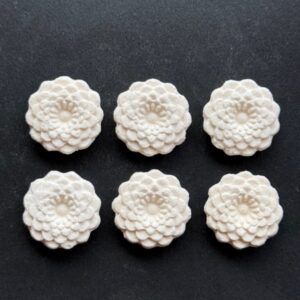
Ohigashi, uchi-mono, 打物, strike-thing, molded sweets in the form of kiku no hana, 菊の花, chrysanthemum ’s flower. Such confections of which there are countless numbers, are generally made of wa-san-bon-tō, 和三盆糖, harmony (Japan)-three-tray-sugar, and rice flour. Collectively, this style of sweet is called ‘raku-gan’, 落雁, alight-goose, which is thought to be one of the first impressed designs on the sweet.
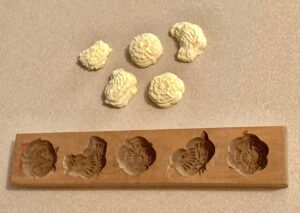
Hi-gashi, 干菓子, dry-sweets, and the wooden mold with carved images of flowers and birds to make uchi–mono, 打物, strike-thing. The word, uchi, strike, is taken from the manner in which the forms are removed by striking the mold to knock them out.
When the tea is prepared, some of the first utensils to be placed are the futa-oki, 蓋置, lid-place, and the hi-shaku, 柄杓, handle-ladle.
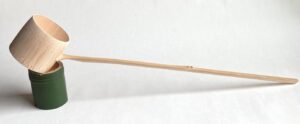
In certain tea presentations the hishaku is tapped on take futaoki. The tapping sound is referred to as kotsun, コツン, clack. The word kostsun is an onomatopoeic expression representing a light, soft tapping sound, such as something small and hard knocking against a hard surface. During very formal Tea presentations, the hishaku is placed on the futaoki without making a sound; oto–nashi, 音無し, sound-less.
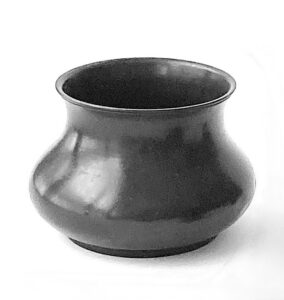
Ken-sui, 建水, build-water, waste water vessel, in the form called e-fugo, 餌畚, feed-bag, black-patinated bronze, signed Naka-gawa Jō-eki, 中川浄益, Middle-river Pure-benefit, Kyōto. Also called a koboshi, 零, spiller, that may be wordplay on ko-bō-shi, 小法師, small-law-master, a black-robed Buddhist. The name efugo is derived from a falconer’s pouch containing morsels of food as rewards for the bird when returning with prey. In addition to the sound of the water as it is discarded, the kensui often makes a ringing sound when water is poured into it.
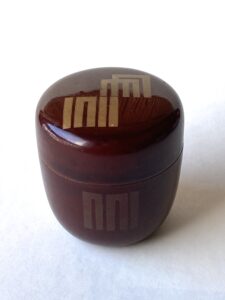
Chū-natsume, 中棗, middle-jujube, maroon-lacquered, covered tea container with various motifs of Genji Kō no Zu, 源氏香の図, Genji incense’s designs. The motif on the front of the container is identified with the Matsukaze chapter of the Genji Monogatari. There are 54 total rectilinear emblems representing chapters of The Tale of Genji and are based on Heian-period incense practices. The Gen-ji mon, 源氏紋, Genji-clan crest, motifs are all used as an aspect of incense appreciation and ‘listening’.
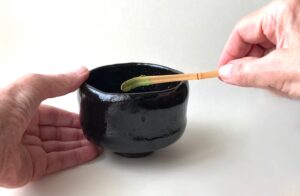
After scooping tea in the chawan, the cha-shaku, 茶杓, tea-scoop, is tapped lightly on rim of the bowl, making a nearly silent tap to remove some of the tea from the scoop. An exception is to not make a sound tapping a teabowl that is Raku-yaki, 楽焼き, Pleasure-fired.
When scooping koi-cha,濃茶, thick-tea, into a chawan, three scoops per guest are placed in the bowl, the tap on the rim of the bowl adds the final traces of tea. Just as when drinking tea, one takes three sips, and a final bit of tea. Adding the matcha, then taking in the matcha. In and Yō. No-sound and sound.
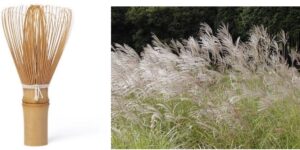
Cha–sen, 茶筅, tea-whisk, bamboo with white thread to separate the outer from the inner tines. The sound of the whisk rinsing in the water in the cha-wan, 茶碗, tea-bowl, should make a swishing sound, sarasara, which is likened to the sound of the wind rustling through ashi, 芦, reeds, susuki, 芒, Pampas grass, alongside a river.

A final sip of tea creates an abrupt sipping sound, which informs the teishu that the guest has finished drinking the tea.
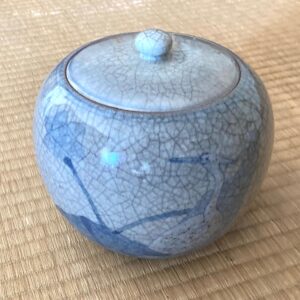
Mizu-sashi, 水指, water-indicate, spherical, stoneware, covered vessel with self-lid, and some-tsuke, 染付, dye-attach, blue under-glaze design of hasu, 蓮, lotus, and shira-sagi, 白鷺, white-egret; H. 5 sun kane-jaku, undecipherable potter’s stamp, Korea.
When the lid is placed onto the mizusashi this sound and movement are the signal for the first guest to ask the host if they may look at the utensils used to serve tea. Movement and sound are involved in both the careful observation of the objects by each guest, as well as the conversation about the objects used. The host sharing thoughts on questions asked by the first guest, and the guests listening to the names and origins of the objects gives further meaning to the theme of the gathering as a whole.
For further study, see also: Jizō Bon, Nakaoki: Kama and Incense, and Salt in Chanoyu and Chaji