Light and a Bamboo Tale in the Tearoom
Choices for adding natural forms of light in the Tearoom are both circumscribed and, with historic understanding and some imagination, they can also be somewhat unlimited. Illumination comes in many forms. The most automatic thought may be the light of a flame, yet illumination arrives through perceptions beyond the visual flickering of light.
Tori-awase, 取り合わせ, take-gather, plays a large role in the experience of illumination that is possible for both host and guest. In the most standard of formats a clear choice for providing light in a darkened Tearoom, particularly during an evening gathering, is by using a te-shoku, 手燭, hand-lamp.
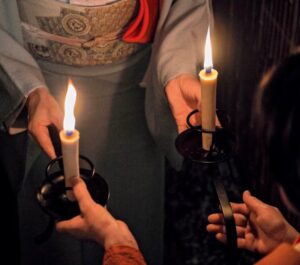
Yo-banashi Cha-ji, 夜咄茶事, Night-talk Tea-matters, tei-shu, 亭主, house-master, and shō-kyaku, 正客, main-guest, exchange te-shoku, 手燭, hand-lamp, when they meet for the first time in the ro-ji, 露地, dew-ground, garden. By this simple act of trading an-don, 行灯, transition-lamp, and candle, the tei-shu, 亭主, house-master, bestows upon the guest the handling of fire, which elevates the stature of the guest to shu, 主 , ‘master of fire’. The same transformation occurs when the guest handles the ki-seru, 煙管, smoke-pipe, pipe and hi-ire, 火入, fire-into, of the tabako bon, 煙草盆, smoke-plant tray.
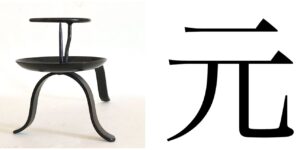
Left: teshoku; hand lamp, with a pricket used as a candle spike. Right: Kanji for gen, 元, origin/source.
The first time indoor illumination is said to have been introduced in Japan coincides with the arrival of Buddhism in 538. In the ancestral home of Buddhism, India, monks used simple oil lamps consisting of a small dish or bowl filled with oil with a short wick sustaining the flame of light. In Japanese temples these vessels, fueled by a variety of oils derived from plants, transformed indoor spaces into earthly manifestations of the Jō-do, 浄土, Pure-land. Over time, within these sacred spaces the generous use of gold leaf in imagery and painting captured the flickering light, creating numinous and ethereal reflections throughout the space.
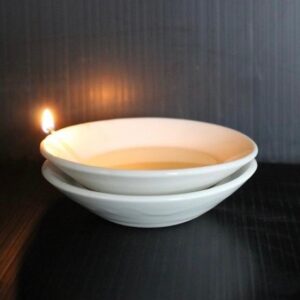
Abura-zara, 油皿, oil-dish; two stacked, shallow, white porcelain bowls, with a single burning wick is part of Shintō or Buddhist offerings.
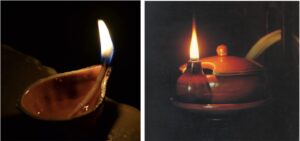
Left: a diya also known as a deepa which is typically made of clay, brass, or silver and uses a cotton wick immersed in ghee or vegetable oil to create a sacred, glowing flame that welcomes light.
Right: Abura-zara, 油皿, oil-dish, aka-Raku-yaki, 赤楽焼, red-Pleasure-fired, called a ‘suzume gawara’, 雀瓦, sparrow tile, with seven burning tō-shin, 灯芯, lamp-wick. The bowl’s rounded form is likened to a fukura-suzume, 脹雀, full-sparrow.
In both Hindu mythology and Vedic astrology, it is believed that feeding sparrows grains and water represents compassion, humility, and supports cosmic unity. Through Vedic astrology sparrows are linked as intermediaries with Mercury and the Moon. The care for and feeding of sparrows is thought to improve communication, remove challenges that block personal growth, increase prosperity in all areas of life both material and spiritual, and stabilize the quality of nurturing energy. It is also believed that sparrows carry messages to the ancestors and feeding sparrows on can reduce ancestral karmic debt, particularly when this selfless act is carried out on Mondays, the day associated with the Moon.
In the classic style of Sen no Rikyū’s Tan-kei, 短檠 short-rack, the suzume gawara sits on an abura-zara, 油皿, oil-dish, that catches any drips from the wicks. The abura-zara and its accompanying utensils are part of a portable lamp or lantern called andon. There are countless styles of andon, many are used in traditional Chanoyu.
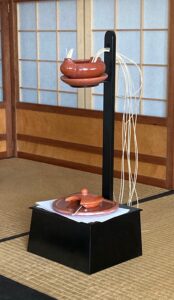
Tan-kei, 短檠 short-rack, with suzume-gawara, 雀瓦, sparrow-tile, ceramic, oil lamp, aka-Raku-yaki, by Wa-Raku, 和楽, Harmony (Japan)-Pleasure, Kyōto. The potter may be Kawa-saki Moto-ki, 川嵜基生, River-promontory Fundamental-life.
This is a kind of portable lamp, an-don, 行灯, transitional-portable, lamp.
The lamp consists of a rectangular lidded wooden box with an upright stick that has a metal ring to support the suzume gawara and has long wicks that transfer the oil to the flame. The stick has an oval hole through which the pithy wicks, tō-shin, 灯芯, lamp-wick, pass – and are left long with a loop that unites them. The length of the natural wick is approximately 2 shaku kujira-jaku.
The oil lamp has seven tō-shin, 灯芯, lamp-wick, with long wicks that can be said to represent either a su-zaku, 朱雀, vermilion-sparrow, or the ku-jaku, 孔雀, great-sparrow, otherwise known as a peacock.
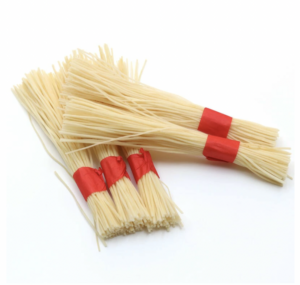
The standard length of ‘short’ tō-shin, 灯芯, lamp-wick, is 21 cm. or 7 sun kane, or 5.6 sun kujira. The wicks are made of the natural pith of tatamai i-gusa, 藺草, rush-grass. Commercially, the wicks are available in various lengths and in bundles – a standard is a bundle of 60 pieces. Although the number varies, in a yo-jō-han, 四畳半, four-mat-half, rooms, seven wicks, tōshin, burning in the tankei lamp. 7×7 equals 49 which may evoke the seven periods of seven days for mourning.
The total height of the tankei is 18 sun kane-jaku. The number 18 in Japanese is jū-hachi, 十八, ten-eight, and is symbolic of ‘life’ when written to form the Kanji moku, 木, wood.
The supporting metal ring is 14 sun kane-jaku from the floor. Which is the standard measurement of the sunken hearth, ro, and the width allowed for a person sitting on the tatami in the tearoom.
The tankei is traditionally used at night and in conjunction with the ro. It is placed on the kinin-tatami between the ro and the toko-bashira. There is a hook, ori-kugi, 折釘, fold-hook, driven into the tokobashira to hang a flower container. Rikyū suggested the height of the ori-kugi from the floor is placed at ‘san jaku san zun go bu’, or 3.35 shaku kane-jaku. It is possible that the tankei was originally a hanging lamp.
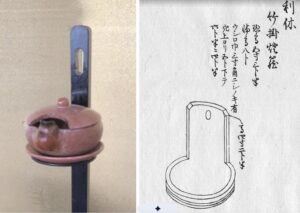
Left: an-don, 行灯, transition-lamp, portable oil lamp, Right: design for Rikyū’s hanging bamboo lamp holder.
The andon is comprised of a covered, shallow, ceramic bowl and saucer that is traditionally made of Raku-yaki, 楽焼, Pleasure-fired. It is thought that it resembles a fluffed-up sparrow, which gives it that name suzume kawarake, 雀土器, sparrow-earth-container. If the oil lamp were to be hung by the opening in the upright pole, long wicks would be replaced by short 7 sun kane wicks, the brightness is increased by adding two or three wicks. The measurements for the andon, pictured left, are:
Bowl, abura-tsuki, 油盞, oil-cup, with futa, 蓋, lid; diam. 3 sun kujira-jaku.
Saucer, shita-kawarake, 下土器, down-earth-container, to catch drips; diam. 3 sun kujira-jaku.
Metal ring, wa, 輪, ring, that is attached to an upright wooden post; diam 1.8 sun kujira-jaku.
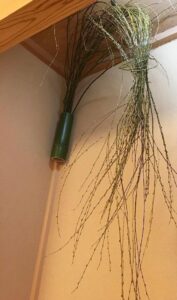
The long-trailing tō-shin wicks of the tankei lamp form also resemble the New Year’s display of musubi-yanagi, 結び柳, tie-willow. The willow is held in a green bamboo container without water. The bamboo tube hangs from a ‘yanagai kugi’, 柳釘, willow-hook, driven into the back left corner of the tokonoma. The post, hashira, 柱, of the willow complements the adjacent toko-bashira, 床柱, floor-post, which has a hook, ori-kugi, 折釘, fold-hook, driven like a nail into the wood. The word musubi, 結, means tie, unite. An important homonym is musubi, 産霊, create-spirit; divine spirit of creation; god who gives birth to all things.
In Buddhism, the word for willow tree, yanagi, 柳, may be interpreted as the main connection between ‘yana’ and ‘tree’ (plant)” is that ‘yana’ meaning ‘vehicle/teaching’ (Mahayana) in Sanskrit and Pali. This is discussed in connection with various sacred trees that appear in Buddhist scriptures, or it may refer to the Japanese word yana-gi – yana/willow/teach and gi or ki meaning tree. The Buddha, like many spirit guides, teaches sitting under a tree. One of the early places that Buddha taught in a community was a bamboo grove, chiku-rin, 竹林, given by King Bimasara. Many tools used in Chanoyu, such as the ladle and tea scoop, are made of bamboo.
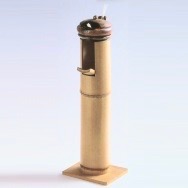
Bamboo was used by Rikyū to create a variation of the wooden tankei for a chiku-kei, 竹檠, bamboo-lamp It is used for light in small Tearooms for a feeling of wabi. The lamp has a detachable base for security, and an opening at the back to hang on a hook, such as on the tokobashira or the hook in the middle of the back was of the tokonoma. Na-tane abura, 菜種油, rape-seed oil, may be used in the oil lamp. It should be remembered that Rikyū’s final flower for Tea was na-no-hana, 菜の花, rapeseed-’s-flower.
When hosting a gathering, thought given to the type of light used can have a profound effect on the experience. For instance, if a bamboo lamp is used in the machi-ai shitsu, 待合室, wait-gather room, it may evoke for some, the classical Japanese literature story of “The Tale of the Bamboo Cutter”, Taketori Monogatari, 竹取物語. The light emanating from bamboo might conjure thoughts of the light of the Moon Princess first found inside a piece of bamboo.
The Heian period tale of Taketori Monogatari begins with a Bamboo Cutter who, while harvesting bamboo, finds a small baby that he brings home to raise with his wife. They named her Nayo-take-no-Kagu-ya-hime, 弱竹の赫映姫, Thin-Bamboo-of-Illuminate-Projection Princess, also written Ka-gu-ya–hime, 輝夜姫, Shine-night-princess.
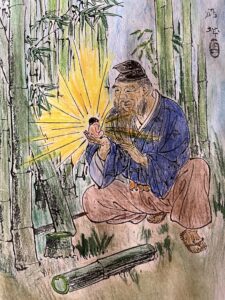
In summary, the Taketori Monogatari details that Kaguya was 3 sun kane when the bamboo cutter found her glowing from inside a bamboo stalk. As Kaguya continued to grow, whenever the Bamboo Cutter harvests a stalk of bamboo, he finds a small nugget of gold inside and the family soon grows rich. Kaguya grew unnaturally fast, and within three months she was a beautiful, grown woman. Before long, she is courted by five noble suitors. Each suitor was given an impossible task in order to receive her hand in marriage. The list of tasks were individually assigned to each suitor.
The first noble was tasked with obtaining the stone Hō-hatsu, 奉鉢, the sacred begging bowl used by the Buddha in India. A second suitor was sent to get the Hō-rai no tama no eda, 蓬莱の玉の枝, a jeweled branch of precious metals from the legendary mountain island of Hōrai. Another required the hi-nezumi no kawagoromo, 火鼠の裘, a robe woven from the fire-proof fur of the Chinese fire-rat. A fourth suitor was to acquire a shimmering, multi-colored jewel taken from the neck of a dragon. The fifth was commanded to procure the takara-gai, 宝貝, a mystical cowry shell said to be guarded and nurtured by swallows.
Each man was so desperate to fulfill the request assigned to them that they resorted to trickery or met with calamity in their pursuit of both the object, as well as Kaguya herself.
Following the suitors unfortunate attempts at achieving their tasks ending in trickery and disaster, the Emperor of Japan travels to meet Kaguya-hime. Captivated by her spirit, he requests her hand in marriage, yet even without the burden of an impossible trial, Kaguya declines the royal union. She explains that she is not a resident of the Emperor’s land and she cannot serve within the imperial palace. Despite this refusal, a deep bond persists, and the Emperor and Kaguya remain in constant contact through poetic letters for three years.
During her final summer, the sight of the mangu-tsu, 満月, full-moon, causes Kaguya’s eyes to well with tears. Her foster parents, overcome with concern, attempt to understand her deepening melancholy, yet she initially remains silent. As her distress intensifies, she finally confesses the celestial truth: she is not a being of this world, and her lunar family will soon descend to guide her back to her home on the Moon.
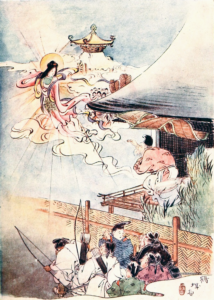
On the 15th evening of the 8th lunar month, when the full moon illuminates the sky, a celestial procession arrives at the residence of the bamboo cutter. A numinous and piercing radiance overwhelms all present, including the thousands of imperial guardsmen. Kaguya declares that despite her profound affection for her companions on Earth, she must depart with her lunar kin for her primordial dwelling. She prepares notes of grief for her foster parents and the Emperor, bestowing her own garment upon her parents as a kata-mi, 形見, memento. She attches a small portion of the fu-shi no kusuri, 不死の薬, elixir of immortality, to her note to the Emperor. At the moment a mantle of feathers, ha-goromo, 羽衣, is draped over her shoulders, her earthly grief and empathy vanish as if never known. The heavenly retinue ascends to the heavens, escorting Kaguya-hime back to the Tsuki no Miyako, 月の都, Moon of Capital, leaving her mortal guardians in a state of profound sorrow.
The Taketori Monogatari is widely considered to be the oldest surviving work of Japanese prose fiction. Within the five impossible tasks the story emphasizes five distinct, and yet also syncretic, wisdom traditions all of which were held beliefs, to one degree or another, in Japan:
Buddhism – The stone begging-bowl of the Buddha:
Within the traditions of Buddhism, the alms-bowl of a monk serves as a manifestation of profound humility and a heart of spiritual detachment.
Taoism – The jeweled branch from Mount Hōrai:
Ho-rai-san, 蓬来山, known in Chinese as Penglai, is a mythical island mountain where the immortal Taoist sages dwell in eternal paradise.
Chinese Mythology and Five Element Theory- The robe of the Fire-Rat:
The hi-nezumi, described in ancient Chinese texts, represents a numinous beast born of the pure, concentrated essence of the fire element, a core pillar of Eastern natural philosophy.
Shintō and Buddhist Syncretism – The five-colored hō-ju, 宝珠, jewel from the dragon’s neck:
Japanese dragons, Ryū, represent a blending of indigenous Shintō sea deities and Buddhist Nāga water spirits. The jewel they guard signifies a union of absolute spiritual wisdom and earthly mastership.
Folk Magic and Shintō Animism – The cowry shell born of a swallow:
Anchored in ancient Japanese beliefs concerning fertility and creation, cowry shells are often utilized as sacred mamori, 守, protection, or amulets to stabilize and ensure the safety of childbirth.
Within the history and the artistry of Chanoyu both the Tearoom, as well as the toriawase selected for a gathering, can highlight the combining or bringing together different wisdom traditions, cultural, or philosophical beliefs, ideas, or well known poems, plays, stories, and styles into a new and unified whole.
A toriawase to honor aspects of Taketori Monogatari:
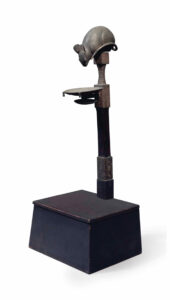
Portable tan-kei, 短檠, short-rack, with the figure of a rat made of textured bronze, called a hi-nezumi, 火鼠, fire-rat.
A famously known tankei that could be used in a creative Tea gathering which is referencing the fire-rat task in Taketori Monogatari is mechanical in nature. The flame is sustained by a central wick immersed in the oil dish; as the fuel is consumed, replenishment occurs through a steady drip from the mouth of the hi-nezumi, 火鼠, fire-rat. This tankei utilizes the principles of atmospheric pressure to ensure a continuous flow of oil, allowing for an extended experience of illumination.
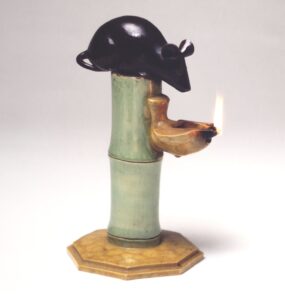
Ceramic Awaji ware tankei; showing the rat atop a stalk of green bamboo, with a Sparrow shaped reservoir lamp. Although not nearly as mechanical as the original tankei pictured above, the lamp can be used to burn oil for light. This lamp blends practical utility with a playful spirit. Oil is poured into the lower dish, and a wick is inserted to light it. It is designed so that as the oil in the dish depletes during use, oil stored in the mouse’s belly naturally drips from its mouth, continuously replenishing the supply. Ceramic versions are particularly rare.
While unusual in a classic setting of the machai, the host could use such lamps or the bamboo lamp created by Rikyū (pictured previously) not only to provide light for the waiting guest, but also to allude to the theme of the gathering. Particularly if the machai is located some distance from the Tearoom, an incense burner may also be present.
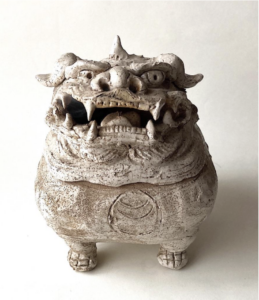
‘Lion’ kō-ro, 香炉, incense-hearth. The lion incense burner, kō-ro, 香炉, incense-hearth is a ceramic, covered container in the form of a Kara Ji-shi, 唐獅子, Tang Lion-of, Shi-no yaki, 志野焼, Aspire-field fired, by Mae-kawa Den-kō, 前川電光, Fore-river Lightning-light, Se-to Shi, 瀬戸市, Rapids-gate City. The familiar lion incense burner may not simply represent a lion, but one of the nine sons of the Dragon King. The Dragon King is said to live in an undersea mansion called the Crystal Palace.
Having been adopted from artistry from China, the Kara Jishi is commonly recognized as one of the Ryū-sei-kyū-shi, 竜生九子, Dragon (King)-born-nine-child, a lion-like creature known for his calm and quiet nature. Because he enjoys sitting still and relishes the scent of burning incense, his image is traditionally used to decorate incense burners. Note the line depiction of a hō-ju, 宝珠, treasure-jewel, on the chest, which represents the nyo-i-ju, 如意珠, equal-heart-jewel, also called the chintamani, or flaming jewel.
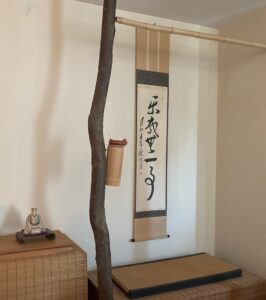
Garandō, tokonoma with hanging scroll ‘Hon rai mu ichi butsu’, 本来無一物, Origin-from not one thing, or in modern translation, ‘Fundamentally, there is not a single thing’ with bamboo kake-tan-kei, 掛短檠, hanging short-rack, oil lamp suzume gawara, 雀瓦, sparrow-tile, red Raku yaki, 楽焼, Pleasure-fired.
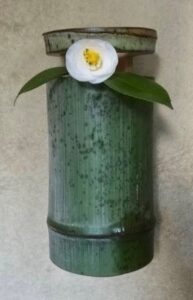
Ichi-ju-giri, 一重切, one-tier-cut, ao-dake, 青竹, green-bamboo, with tsubaki, 椿, camellia, white flower is preferred in Chanoyu. A white flower such as a tsubaki in the winter or a mukuge,木槿, Wood-rose of Sharon, in the summer, placed in a green bamboo container may be seen as representing the light of the full moon, creating synchronicity between Kaguya’s Earthly discovery and her true home of the Moon. In this gathering, the kakejiku and the lamp are removed after the serving of koi-cha, 濃茶, thick-tea, and the flower container is hung on the back wall of the tokonoma.
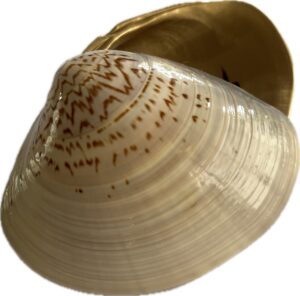
Hamaguri kō-gō, 蛤香合, clam incense-gather with gold interior. The shell is part of a collection of 180 clamshells that have matching designs, used in a game of kai-awase, 貝合わせ, shell-gather, and are part of a girl’s wedding trousseau, yo-mei-dō-gu, 嫁入り道具, marry-enter way-tool. The shell may be a reference to the cowrie shell and the gold inside can evoke the feeling of the golden light Kaguya was surround by after being found in the bamboo, as well as the gold retrieved by the Bamboo Cutter after taking Kaguya into the care of his family.
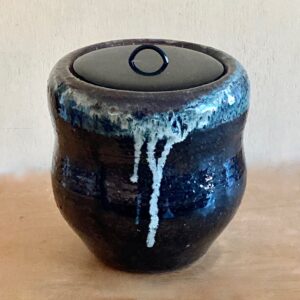
Mizu-sashi, 水指, water-indicate; stoneware vessel in the form called tan–pyō, 箪瓢, basket-gourd, inverted hyō-tan, 瓢箪, gourd-basket, with varied black glaze and white glaze on shoulder by Yōko Itō Messersmith, Kyōto. With black-lacquered wooden lid. The semi-circular tsumami, 摘み, pinch, of the lid is intended to become a complete circle being reflected in the lacquer’s mirror surface. The pictured water container, made by Ms. Messersmith, is the first mizusashi I acquired. It has the form of an inverted gourd with a distinct glaze pattern indicating the vessel has been at least somewhat emptied of its contents, which in the classical sense could be the Elixir of Life. It is also known as the Elixir of Immortality, it is called by various names in different traditions: Vedic soma, Hindu amrita, Buddhist kan-ro, 甘露, sweet-dew, Taoist jin-dan, 金丹, gold-elixir (cinnabar), etc.
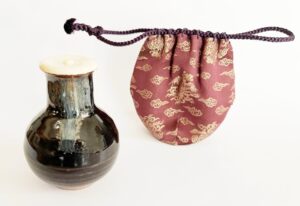
Cha-ire, 茶入, tea-receptacle, ceramic jar in the form called tsuru-kubi, 鶴首, crane-neck, with black glaze and muti-colored run, Kyō-yaki, 京焼, Capital-fired, made by Man-dai Sō-zan, 万代草山, Ten thousand-generations Grass-mountain, personal name, Ki-mi-ko, 喜美子, Joyous-beauty-child. Ms. Mandai is one of the leading potters in a field usually lead by men. The jar has an ivory lid and drawstring silk pouch, shi-fuku, 仕覆, serve-cover, with pattern of ‘Hō-un gire’, 鵬雲切, Phoenix-cloud cut, choice of Hōunsai, XV Iemoto, Urasenke. The Phoenix is part of the crown of the Empress of Japan. She is the earthly representative of the heavenly Phoenix and the Emperor is the earthly representative of the heavenly Dragon.
The chaire is a container for powdered koi-cha, 濃茶, thick-tea. Tea itself has been known to symbolize the Elixir of Life.
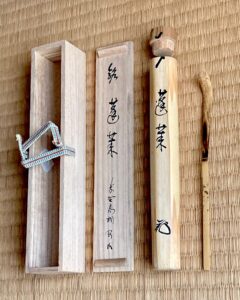
Cha-shaku, 茶杓, tea-scoop; bamboo naka-bushi, 中節, middle-node, by Kage-bayashi Sō-toku, 影林宗篤, Shadow-grove Sect-kind.
The chashaku is named ‘Hō-rai’, 蓬莱, Mugwort-goosefoot, Matsu-naga Gō-zan, 松長剛山, Pine-long Strong-mountain, abbot of Kō-tō-in, 高桐院, High-paulownia-sub temple, Dai-toku-ji, 大徳寺, Great-virtue-temple, Kyōto. Hōrai, is also the name of the eight-mat cha-shitsu, 茶室, tea-room, in the temple, which is derived from the mythical island of Horai-san, 蓬来山, Mugwort-goosefoot, where the Taoist immortal sages live.
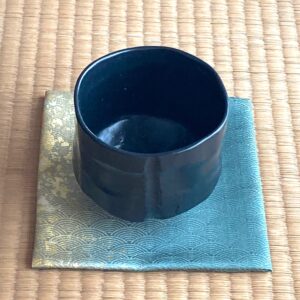
Cha-wan, 茶碗, tea-bowl, cylindrical, white ceramic bowl with vertical groove, and with black glaze, by Shio-tsuki Ya-e-ko, 塩月弥栄子, Salt-moon Increase-splendor-child, older sister of Hō-un-sai, 鵬雲斎, ‘Phoenix’-cloud-abstain, XV Iemoto, Urasenke. When Shiotsuki Sama presented me with her chawan, she said its name was ‘Wa-shin’, 和心, Peaceful Heart. Because this type of bowl is considered to be a humble ceramic, it is presented with a ko-buku-sa, 古帛紗, old-cloth-gauze, blue silk and gold thread fabric square with pattern of ‘sei-gai-ha’, 青海波, blue-sea-wave, with spattered gold; 4.3 x 4.4 sun kujira-jaku: designed by Shio-tsuki Ya-e-ko, 塩月弥栄子, Salt-moon Increase-splendor-child.
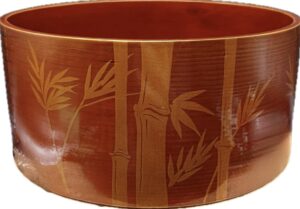
Mage ken-sui, 曲建水, bent build-water, waste water vessel, cedar wood with tame-nu-ri,溜塗り, collect-paint, and gold maki-e,蒔絵, embed-picture, of bamboo. Regarding the seam of wooden objects, the rule is ‘maru mae kaku muko,’ 丸前角向, round fore corner opposite. As the host prepares to present Tea, the kensui is turned so that the woven seam (seen here at the left side of the kensui) faces the guests.
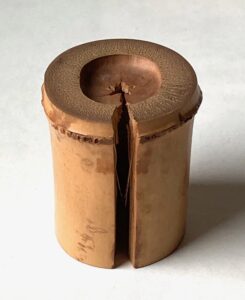
Aged bamboo take futa-oki, 竹蓋置, lid-place, moto-bushi, 元節, origin-node, of, ten-bushi, 天節, heaven-node, by Nishi-kawa Bai-gen, 西川煤玄, West-river Prunus-mystery, Taka-ga-mine, 鷹峯, Hawk’s-peak, Kyōto. If a bamboo futaoki cracks, as did the one in the photograph, the ware-me, 割れ目, separate-eye, becomes shō-men, 正面, correct-face. The split in the bamboo creates In, 陰, Receptive, and therefore is like a toji-me, 綴じ目, compose-eye, a seam, which becomes shōmen. Most tojime are shōmen for round objects.
The top of the futaoki is opposite the direction of the growth of the bamboo, the fushi is comprised of the roots of the bamboo. The shōmen of the fuatoki is at the lowest level of the fushi. The measurement from the bottom of the futaoki to the lowest point of the fushi is eight tenths the total height of the fuaoki. This creates a reference to the number 18, which is symbolic of Life.
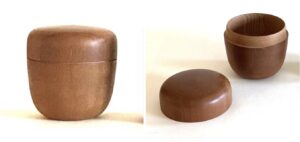
Chū-natsume, 中棗, middle-jujube: Ichi-i, 一位, one-grade, yew wood: full height – 1.8, body height – 1.44, join eight – 1.15, diameter – 1.7 sun kane-jaku.
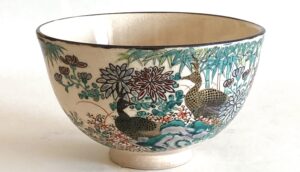
Cha-wan, 茶碗, tea-bowl, fine ceramic bowl with color enamel painting of a pair of peacocks, ku-jaku, 孔雀, great-sparrow, amidst a bamboo grove, colorful flowers and clouds, by Sei-ko-zan, 精巧山, Excel-adroit-mountain, Satsu-ma-yaki, 薩摩焼, Buddha-polish-fired, Kyū-shū, 九州, Nine-states. The presence of the peacock alludes to the coming transformation of Kaguya as she prepares to don the hagoromo.
The definitive moment in Kagyu’s journey to return to the Moon is the placement of the hagoromo. Reflecting the ancient lore that the peacock consumes venom to create its radiant plumage, the ku-jaku, 孔雀, great-sparrow/peacock feathers represent the spiritual alchemy of transmuting adversity into luminescent protection and insight. Within syncretic arrangements of wisdom traditions and talismanic arts, peacock feathers, or their protective energetic equivalents, are used to repel malevolence and enhance the vibrant Yō, 陽, positive-energy. In donning the hagoromo Kaguya herself transmutes from human, In, form into a celestial being taking on a Yō form. In the lexicon of symbols, the peacock serves as a terrestrial relative of the celestial hō-ō, 鳳凰, Phoenix, embodying the virtues of nobility, auspicious grace.
The kujaku, great sparrow/ peacock, is also related to su-jaku, 朱雀, vermilion-sparrow, which is identified with the southern quadrant of the heavens. It is the name of the great Su-jaku-Mon, 朱雀門, Vermilion-sparrow-gate, of the Imperial Palace, and the great avenue that divides the imperial city in Japan.
Garandō, tokonoma with hanging scroll ‘Hon rai mu ichi butsu’, 本来無一物, Origin-from not one thing, or in modern translation, ‘Fundamentally, there is not a single thing’ with bamboo kake-tan-kei, 掛短檠, hanging short-rack, oil lamp suzume gawara, 雀瓦, sparrow-tile, red Raku yaki, 楽焼, Pleasure-fired. Illumination comes in many forms. A thing is not just one thing.
For further study, see also: Illumination in the Tokonoma