Kagami Mochi and Wisdom Traditions
Kagami mochi, 鏡餅, mirror mochi, is often seen displayed as an offering for the solar New Year in many settings around Japan, as well as in the Tearoom. It is important to remember that mochi offerings are present in Japan throughout the year, as a result of the close connections with various wisdom traditions throughout the country. For those who celebrate the lunar New Year, kagami mochi displays play an important part in the start of the Lunar New Year offerings.
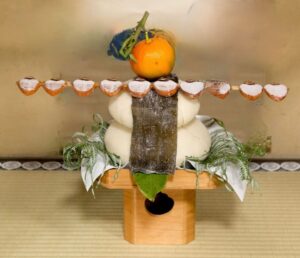
Kagami mochi, 鏡餅, mirror mochi, offerings displayed on a sanbō, 三宝, three-treasures: two rounds of mochi, placed on folded paper, with ura-jiro, 裏白, back-white, fern; sheet of kon-bu, 昆布, descendant-cloth, kelp, ten hoshi-gaki, 干し柿, dried-persimmon, on a bamboo skewer, and a leafy daidai, 橙, bitter orange. Each of the offerings represent and symbolize hope for a happy family and a long life filled with good fortune. It is imperative to have a leaf or more still attached to the daidai fruit, as green is essential to life and regeneration.
In some areas of Japan, the start of the new year is observed on Kyū-shō-gatsu, 旧正月, Old-true-month, which is the first day of the first month of the year, according to the lunar calendar. As with the solar New Year celebration, kagami mochi, is displayed for the Lunar New Year, as a Shintō offering to Ō-toshi-gami, 大歳神, Great-year-god, also called Toshi-toku-gami, 歳徳神, Year-virtue-god.
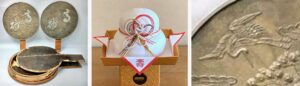
Left: pair of bronze kagami,鏡, mirrors, and storage box; possibly Meiji period. The backs of both mirrors have auspicious relief designs of a pine tree, cranes, and silver calligraphy of Taka-sago, 高砂, High-sand. The obverse is polished, un-adorned bronze.
Center: kagami mochi adorned with mizu-hiki, 水引,water-pull, with the form of a tsuru, 鶴, crane, incorporated into the adornment of kagami mochi, the mizuhiki also includes go-shiki, 五色, five-colors, seen on the right side of the cranes and on the lower left side of the design.
Right: closer view of the crane relief on the bronze mirror. The crane is believed to live a thousand years.
Many mirrors bear the imagery of the crane. Hand-held mirrors were available as individual objects and were also available in pairs – when provided as a set one mirror may have been larger than the other. When not being used, the two flat, mirrored surfaces face each other, and are kept in a form-fitting box. The storage box may be highly decorative.
The history of mirrors in Japan can be harkened back to the tale of Ama-terasu Ō-kami, 天照大神, Heaven-brighten Great-god. According to legend, the sun was deified, as Amaterasu Ōkami. In this legend, the sun is personified by Amaterasu who is the supreme deity of Shintō. In the legend, many events occurred that caused Amaterasu to remove herself from the world by moving into a cave covered by a stone, as a result the world was plunged into darkness. Once she decided to emerge from the cave, light returned to the world, and the myriad of gods rejoiced. As a result of Amaterasu and her radiant light returning to the world, one of the three treasures she was given by the gods was the Ya-ta-kagami, 八咫鏡, Eight-span-mirror. The three gifts presented to Amaterasu are parts of the existent Imperial regalia, as she is considered to be the original progenitor of the Imperial family. The mirror given to Amaterasu continues to be housed in the Inner Shrine of Ise Grand Shrine in Mie Prefecture, the spiritual home of Amaterasu. As a result, for some people, Ameterasu is made manifest in a mirror. Kagami mochi in two settled spheres is offered to Amaterasu at the New Year at Shintō shrines throughout Japan.
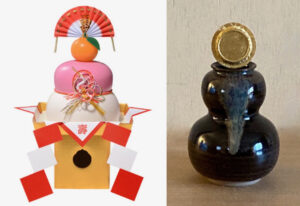
Left: a sanbō adorned with with red and white shi-de, 四手, four-hand. Shide are Shintō zigzag paper pendants displayed to invite Shintō spirits. Atop the sanbō, is kagami mochi with a red sphere set atop a white sphere referred to as form of ko-haku, 紅白, red-white, the kagaimi mochi is adorned with mizuhiki with the form of a crane incorporated in the design, atop the kagami mochi is a leafy daidai, as well as an elaborate kohaku paper folded into the form of a fan.
Right: cha-ire, 茶入, tea-container, in the form of a hyō-tan, 瓢箪, gourd-basket. The chaire’s futa, 蓋, lid, set upright to show the gold foil on the underside of the lid to show the resemblance to both the kagami mochi as well as to exemplify the sun-like aspect that is present on the lid of the chaire.
The Kanji hyō, 瓢, is also read hisago, which refers to the fruit of the gourd or the container made from it after drying. The word hisago may be composed of hisa and go, meaning, 久後, ever-after.
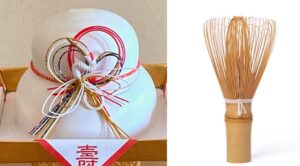
Left: two rounds of mochi with red and white mizuhiki, the paper strings that ‘tie’ the two mochi together. A decorative goshiki of five colors including the image of a crane, that is believed to live a thousand years. The pictured crane is named, tan-chō tsuru, 丹頂鶴, red-crown crane, (Grus japonensis), as it has a patch of red feathers on the top of its head, Right: a bamboo cha-sen, 茶筅, tea-whisk, with a white string that keeps the outer tines separated.
The kagami mochi, as well as the chasen have a cord wrapped around the center of their forms, they can be seen to bear a striking resemblance to a bottle gourd, hyō-tan, 瓢箪, gourd-basket. The character 瓢 is read as hyō or hisago, originates from Chinese characters representing a ladle or gourd.
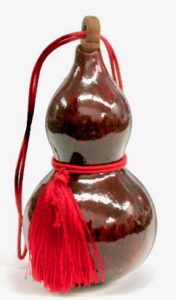
A natural bottle gourd, hyō-tan, 瓢箪, gourd-basket, with clear, brown lacquer finish and tied with red cord wound twice and ending with an elaborate tassel. The long red cord secures the small stopper. The purpose of the wrapping cord is to conceal the join where the gourd was cut to empty the seeds and contents from before drying. Because one of the original functions of the gourd was to store various medicines and elixirs, it can act as a charm to ward off negative energy and illness. It is also often used as a wish to symbolize prosperity.
While functional, there is also a profound purpose to the use of gourd, as the bottle gourd is sacred in Taoist philosophy. It represents the Universe and is carried by one of the Eight Immortals.
One of the beliefs inherent in the Taoist philosophic system is that the gourd is said to represent the union of Heaven, which is emblematic of the principle of Yō, 陽, positive, and Earth,which emblematic of the principle In, 陰, receptive. In Taoist based philosophy, when Heaven and Earth are united this forms a whole referred to as Taiji, in Japanese, Tai-kyoku-zu, 太極図, Big-extreme-plan.The Taiji symbol is familiar around the world.
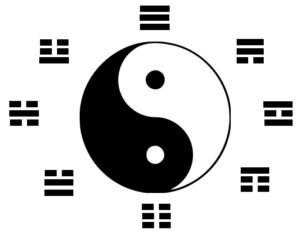
Taji symbol, known in Japanese as Taikyokuzu, with the foundational eight trigrams that form the Cosmos. The trigram for Heaven, Ken, 乾, ☰, is pictured at the top of the diagram, North, and the trigram for Earth, Kon, 坤, ☷, is pictured at the bottom, South.
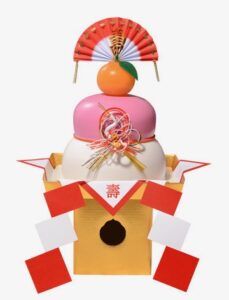
Kagami mochi with decorative red and white paper shide, mizuhiki and daidai fruit and leaf, displayed on a traditional Shintō style offering stand, sanbō. Red and white are widely considered to be auspicious colors throughout Japan, particularly in Shintō. From the Shintō perspective, white is considered to symbolize purification, while red is said to represent vitality, prosperity, and protection.
Kagami mochi displayed during New Year’s is generally two spheres that are either both white or red and white nationwide.The colors of the mochi are somewhat dependent on the offering location. There are red and white versions in some areas, but it is said that the Kaga region of Ishikawa is famous for the kō-haku version which is traditionally made throughout the town.
Originally, red and white Kagami mochi was a part of samurai culture, with the top being white and the bottom being red. The reason for the red and white color is said to be that red was considered an auspicious color even during the feudal era, and that red rice was cultivated in the Kaga domain. The colors were reversed after the Meiji period, as it spread to the common people.
Red and white colors have a long history in samurai and common traditions of Japan, as well as within the Imperial court. It is said that during the Asuka period Emperor Monmu (683–707AD), used a flag during court ceremonies that had a background of a white with a large red circle in the center. The red color and circular shape was thought to represent Amaterasu, Goddess of the Sun, who was believed to be the legendary ancestor of the Japanese Imperial family.
Within the legend of Amaterasu is the tale of her divine messenger and steed, Ya-ta-garasu, 八咫烏, Eight-span-crow. The three legs of Yatgarasu can be said to symbolize that heaven, earth, and mankind all come from the same sun, and are like kin to each other. They are also said to represent the three virtues of the gods: wisdom, benevolence, and valor. The three legs may also represent the three powerful clans of ancient Kumano—Ui, Suzuki, and Enomoto—who use a three-legged as their crest.
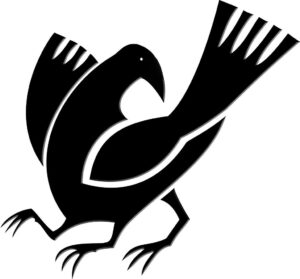
Additional meaning to the three legs of the crow could be found in the wisdom traditions of both Vajrayana Buddhism, as well as various yogic traditions from India. In both systems of thought, there is the concept of subtle energy channels within the body, of which there are three. In the yogic traditions these channels are referred to as Nadis, of which there are three, Ida, Pingala, and Sushumna. In Japanese, these channels can be translated for Ida as, 陰のナデ, In channel, Pingala as, 陽のナデ, Yō channel, and Sushumna as, 中央のナディ, Central channel, or as Chūō no Keiraku 中央の経絡.
Ida is related to the color white, generates cooling energies, has qualities related to the Divine Feminine, and connects to the parasympathetic nervous system. Pingala is related to the color red, generates heating energies, and is related to the Divine Masculine, and the sympathetic nervous system. Sushumna is related to the color amber, is related to awakening energies, and to the ultimate union of the divine feminine and masculine, the union of In and Yō which creates Undifferentiated Illumination.
The three colors of the channels within the subtle body can correlate to kagami mochi that is made of a white ovoid, a red ovoid and is adorned with a daidai. The daidai is both a matching color to Sushumna and it contains many seeds, which could be seen as a physical representation of the thousand petaled lotus that is said to open once Sushumna is awakened within the crown of the head.
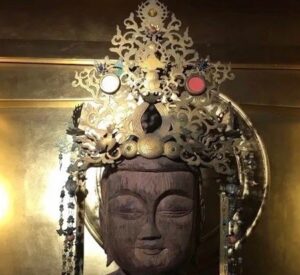
Kannon with crown adornment which includes two disks – one red, kō, 紅, in the east representing the sun, nichi, hi, 日, and one white, haku, 白, representing the moon, getsu, tsuki, 月, in the west. Kō-haku is a concept seen in many aspects of Japanese culture. The figure of Shō Kan-ze-on, 聖観世音菩薩, Holy See-world-sound Grass-buddha, from the Heian period, which has been adorned with gold filigree ornament after the 17th century, treasured at Fu-mon-ji, 普門寺, Universal-gate-temple, Toyohashi, Aichi Pref.
When a human being (or deity) is at the point of enlightenment, the white Ida channel rests within and governs the right side of the brain and the red Pingala channel rests within and governs the left side of the brain. From these resting points the Shushumna Nadi, the central channel, is awakened and moves to the crown of the head from which it is said that enlightenment is represented by an etheric thousand-petaled lotus.
The three colors of the channels within the subtle body can correlate to kagami mochi that is made of a white ovoid mochi, a red ovoid mochi, and is adorned with a daidai. The daidai is both a matching color to Sushumna Nadi, and it contains many seeds, which could be seen as a physical representation of the thousand-petaled lotus that is said to open once Sushumna is awakened within the crown of the head.
Many Buddhist deities are adorned with elaborate crowns which indicate enlightenment, and iconography of the Buddha often depicts a myriad of coiled hair which represents the thousand petaled lotus being open, i.e., enlightenment.
Regardless of the philosophic ideas that may be an aspect of people’s desire to present kagami mochi, there is an inherent aspect to the offering that relates to three treasures. Depending on the wisdom tradition that is embraced the approach can vary. There is the possibility that an internal practice of attaining enlightenment can relate to the Nadis and attaining enlightenment. There is also an external perspective of Buddhist practice that the three treasures can relate to the Buddha, the Dharma, and the Sangha.
From a cultural perspective, that does not necessarily imply relioghius orientation, the offering can relate to the celebration of the New Year and the welcoming of the Toshi-gami, 年神, Year-god, in Shintō traditions, or hotoke, 仏, buddhas, in Buddhist traditions, with the kagami mochi providing a sacred temporary location for the wishes of good fortune, health, and longevity before the time comes for kagami biraki, 鏡開き, Mirror-break, which is when the offering is broken open with a mallet and the components are enjoyed in various forms of edible delights.
It should be remembered that the offering of kagami mochi likely began within the Muromachi period and is originally deeply rooted in Shintō tradition.
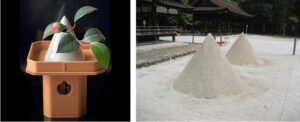
Left: hana-ire, 花入, flower-into; clear-glazed, ji-ki, 磁器, porcelain-utensil, conical vase with angular opening, by An-dō Takumi, 安藤工, Peace-wisteria Artizan, with a tsubaki, 椿, camelia, displayed on plain wood san-bō, 三宝, three-treasures; H. 5 sun kane-jaku. The three treasures in Shin-tō, 神道, God-way, are rice, kome, 米, salt, shio, 塩, and water, mizu, 水. In some instances, sake, 酒, alcohol, is included in the offerings.
Right: two conical mounds of sand as offerings to the gods of Kami-gamo Jin-ja,上賀茂神社, Upper-joy-dense God-shrine, Kyōto. The sand cones are a constant presence of the sacred grounds, and which may allude to the mounds of salty sand collected and dried in sun, extracting the salt.
Pine needles, matsu-ba, 松葉, pine-leaf, are placed at the peak of the both cones. Facing the shrine, set in the north, two pine needles are placed at the peak are toward the east representing In, 陰, Yin, receptive, negative, and three pine needles are placed at the peak of the cone on the left, toward the west representing Yō, 陽, Yang, penetrative, positive. The active nature of the sun is a transit from east to west. This is made manifest in the pine needles, matsuba.
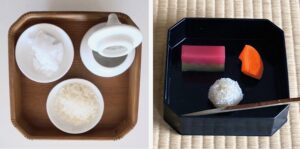
Central to Shintō offerings is raw rice on a small white porcelain dish. It is flanked by a similar dish of sea-salt, on the right, and a cone-shape covered spherical bowl of water on the left. These are the prime representations of the sacred Shintō san-bō, 三宝, three-treasures. The three treasures in Shin-tō, 神道, God-way, are rice, kome, 米, salt, shio, 塩, and water, mizu, 水. In many instances, sake, 酒, alcohol, is included in the offerings.
Rice represents the treasure from the land. Salt is the treasure from the ocean, and Water represents raindrops treasure from heaven.
These three treasures are also represented by the three sweets offered before certain preparations of Chanoyu.
The ‘rice’ is identified with the freshly made sweet at the front of the serving piece. The ‘salt’ is identified with the preserved gel yō-kan, 羊羹, sheep-stew, back left. The ‘water’ is identified with the fresh fruit, which is also called mizu-mono, 水物, water-thing, at the back right.
The concept of the importance of the mirror offering is further exemplified in Chanoyu during the opening of tea presentations when the tei-shu, 亭主, house-master, first handles the hishaku in a gesture called kagami bi-shaku, 鏡柄杓, mirror handle-ladle.
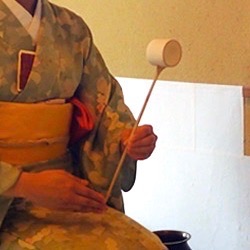
In Chanoyu when preparing Tea, the teishu holds the bamboo ladle with the cup upright in the kagami bishaku gesture. The ladle is held so the cup, gō, 合, gather, is at the same level as the heart. The gō is perpendicular in way that may evoke Daruma when he faced the wall of the cave where he meditated for nine years – men-peki, 面壁, face wall. It may also evoke the spirit of Amaterasu, who also stayed in a cave. The hishaku gō is a ‘mirror of the heart,’ not one’s face. The gō as a cup has both aspects of In and Yō, 陰 and 陽, Yin and Yang. When held upright, in the gesture of kagami bishaku the cup manifests both aspects of In and Yō simultaneously, and may present a moment for both host and guests to experience the pure presence and the heart of Tea.
For further study, see also: Chanoyu and the Mirror, Chanoyu and the Orange, and Kagami Mochi Collection

Addendum – Further Exploration of Ko-haku and Kagami Mochi Related Concepts
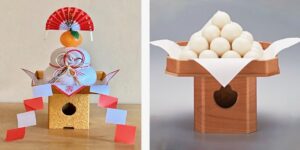 Left: kagami mochi, 鏡餅, mirror mochi; offering of two settled rounds of mochi, pounded glutinous rice, of different sizes, adorned with a daidai, 橙, bitter orange, red and white paper threads, mizu-hiki, 水引, water-draw, tied in a bow, musubi, 結, knot, red and white square of paper, etc. displayed on a Shintō offering stand, san-bō, 三宝, three-treasures. The measurement of the bottom support width is 2.5 sun kane-jaku; upper tray width is 4.3 sun kane-jaku square
Right: tsuki-mi dango, 月見団子, moon-see round-of, stacked on a Shintō san-bō, 三宝, three-treasures.
Mochi is offered in different forms throughout the year. Kagami mochi is most often seen in the winter months, though some Shintō shrines do offer a more austere form of kagami mochi on a monthly basis: whereas dango is often culturally associated with summer and autumn.
The image of Kagami mochi above shows a form that has a ratio between the diameters of the two rounds of mochi that measures 6.6. The number six, roku, 六, is symbolic of the Infinity in Time.
In Buddhism, roku- roku, 六六 , six-six, signifies the six sense organs, eyes, ears, nose, tongue, body, and mind and the six sense objects which are form, sound, smell, taste, touch, and mental objects which are perceived and experienced through the corresponding organs. In this system of thought it is said that the ways in which humans perceive the world around them dictates the causes and conditions for the cyclic patterns that generate attachments and rebirth. The cleansing of perception is practiced through cultivating what is known as the six perfections, these are: generosity, morality, patience, diligence, meditation, and wisdom. In some systems of Buddhist teachings, it is also said that one can realize that these twelve sense bases, the six sense organs and the six sense objects are Empty. It is through this realization that one can reach a state of the purity which leads to enlightenment.
Roku roku may also be identified with Roku-gatsu Roku-nichi, 6月6日, Sixth Month Sixth Day. According to the Gregorian calendar, June is the sixth month of the year. June 6th is general start of the rainy season, tsuyu, 梅雨, prunus-rain. In the old calendar, June is called Mi-na-zuki, 水無月, Water-not-month, and refers to the time when water is drawn into the rice fields. June 6th is designated as a day for many commemorative events.
Roku roku in the Lunar calendar, 6月6日, which is near the time of O-bon, お盆, Hon.-tray, is often when dango mochi, which generally symbolizes gratitude, health, and happiness is offered to the moon and enjoyed.
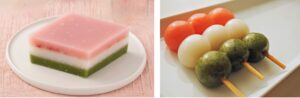
Hishi mochi, 菱餅, diamond mochi, is typically served around the time of the Hina Matsuri, 雛祭, Chick (Doll) Festival. Hina Matsuri occurs on the third day of the third month. According to the lunar calendar, this happens about the time that peach trees are in bloom, lending its name to the festivities – momo no se-kku, 桃の節句, peach’s season-divide. Peaches are believed to have the power to ward off evil. The sweet is diamond-shaped and composed of three layers of different colors: pink, white and green. These are the same colors as the sanshoku dango, and that relate to the colors of the kagami mochi display.
When eating sanshoku dango at a flower viewing party, the sweets are called ‘Hanami dango’. The first sweet to be eaten is pink, then white, and green. Together the red and white are identified as kō-haku, 紅白, red-white, which is most auspicious – cherry flower buds are red and the flower petals are white. The color red or pink is often derived from red beets. Sakura mochi, 桜餅, cherry mochi, is wrapped in sakura leaves that are shio-zuke, 塩漬け, salt-pickled. Green dango are often flavored with yomogi, 蓬, mugwort, and / or ma-tcha, 抹茶, powder (green)-tea. Identifying the dango as ‘hanami’, flower-see, is understood that the ‘flower’ represents the color of cherry blossoms. However, the dango’s connection to Momo-no-sekku, suggests that the flower is the peach.
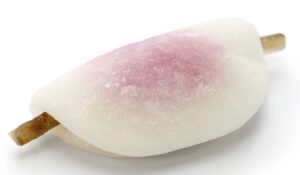 Hishi hanabira mochi, 菱葩餅, diamond flower-petal mochi, served primarily during the solar New Year activities. The sweet is comprised of sweetened shiro miso, 白味噌, white miso, a candied go-bō, 牛蒡, ox-burdock, great burdock (Arctium lappa), root. ‘Hishi’ refers to the diamond-shaped pink miso patch on the underside of the gyū-hi, 牛皮, cow-hide, mochi-like wrapping, also written gyū-hi, 求肥, want-more.
The hishi hanabira mochi has aspects of the kagami mochi: two tiers of white mochi, the pink color, the reference to plant life in the gobō and daidai orange. The sweet consists of the three treasures: rice in the gyūhi is a treasure from the field, salt in the preserved miso is a treasure from the sea, and gobō is a treasure from the mountain.
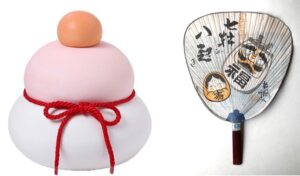
Left: kagami mochi with pink/red mochi placed on top of larger white mochi – a red, twisted cord tied around the middle, a daidai, orange placed on the top.
Right: uchiwa, 団扇, round open fan with an image of two roly-poly dolls of Daruma, enrobed in white, and a small figure of Otafuku enrobed in red/orange. The profile of the uchiwa is the shape of Daruma inverted – hi-kkuri kaesu, 引っ繰り返す, ‘to turn something over’.
In Japan, this type of roly-poly doll is called an oki-agari ko-bo-shi, 起き上がり小法師, wake-up little-law-master, and is often made of papier-mâché. The okiagari koboshi doll dates back to the 14th century. They are good-luck charms. With the small Otafuku doll placed on top of the larger Daruma doll, the two figures resemble the pink and white kagami mochi. Note that the red cord around the mochi is like the cord around Daruma’s head.
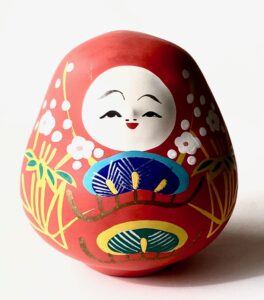
Nin-gyō, 人形, person-like, doll of Hachi-man Oki-agari, 八幡起き上がり, Eight-penant Get-up, roly-poly dolls. Originating in the Heian period at the Yasu-e Hachi-man-gū, 安江八幡宮, Peace-bay Eight-penant-palace, in Ka-ga, 加賀, Increase-joy. The doll represents Ō-jin Ten-nō, 応神天皇, Answer-god Heaven-emperor, military leader, who dressed as a baby wrapped in red swaddling cloth like an aka-chan, 赤ちゃん, red-‘little one’. Indicating that he was an infant Hachi-man, 八幡, Eight-banners, the greatly revered god of war. Adorning his robe are the very auspicious designs of shō chiku bai, 松竹梅, pine bamboo ‘plum’ that are displayed at the New Year, and other festivities.
Although formulaic, each of the millions of dolls is unique. Ideally, for some, each round of mochi that comprises a kagami mochi display would be a sphere that would roll around, emulating the concept of an okiagari koboshi. However, its own weight causes the mochi to settle into an oval that does not roll.
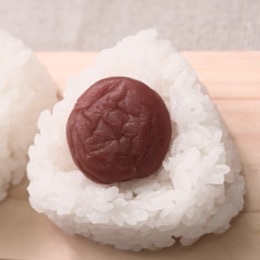
As an aspect of ko-haku that is seen in kagami mochi, is also seen in the staple in the Japanese diet, the o-nigiri, お握り, hon.-grasp, O-musubi, お結, Hon.-tie. The onigiri is made of cooked, somewhat sticky rice formed into a triangle, wrapped in no-ri, 海苔, sea-weed, that usually has within it an ume-boshi, 梅干, ‘prunus’-dry. Red, white and green. The sources of the three treasures are represented by the ingredients – rice from the field, nori from the sea, and the umeboshi from the mountain. These are the san-bō, 三宝, three-treasures of Shintō. Sanbō is also written 三方, three-sides.