Horse, Grasses, and Chanoyu
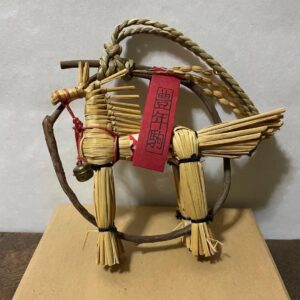
Ha-ssaku no Uma, 八朔の馬, eight-first day-of-horse, is a decorative straw horse given as good luck charms, especially to young boys on Hassaku (the first day of the eighth lunar month), which is some areas is considered to be a type of birthday celebration for boys. The Hassaku no Uma pictured above is from Ashi-ya, 芦屋, Reed-house, Kita-kyū-shū, 北九州, North-nine-states.
The horse referred to as Hassaku no Uma is made of ‘white’ straw grass, or wood. One significant location that venerates the white horse is Kami-ga-mo Jin-ja,上賀茂上神社, Upper-joy-dense God-shrine. The shrine is more formally known as Ka-mo Wake-ika-zuchi Jin-ja, 賀茂別雷大神社, Joy-dense Divide-thunder Great-god Shrine, and is considered one of the oldest Shintō shrines in Japan, with documented practices that date to the 6th century.
It is said that when the enshrined deity at Kamigamo Jinja, Ka-mo Wake-ika-zuchi no O-kami, 賀茂別雷大神, Joy-dense Divide-thunder Great-god, descended to earth, he received a divine message saying:
馬に鈴をかけて走らせよ
“uma ni suzu wo kakete hashrasuyo.”
“Hang a bell on the horse and let it run.”
This message may indicate why, in many depictions, there is often a bell hung round the neck of many horse emblems. It may also serve as an indicator as to why. Kamigamo Jinja is often considered the birthplace of Japanese horse racing, wherein a racing ritual is held annually in May to pray for a good harvest and peace.
On January 7th, the Kamigamo Jinja also hosts an event called Haku-ba Sō-ran Shin-ji, 白馬奏覧神事, White-Horse-Complete-See-God-matter. This festival involves the shin-me,神馬, god-horse, or sacred white horse, who is dedicated to the shrine to serve as a divine messenger for the deity Kamo Wakeikazuchi no Okami.
This auspicious event of seeing a white (or blue) horse at the start of the new year is said to ward off evil and provide good fortune and abundance for the year to all those who view the sacred horse. The shinme is also available for visits at other times throughout the year, and visitors are able to both view and feed the shinme carrots.
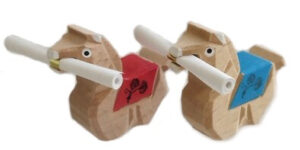
Kamigamo Shrine wooden horse o-mi-kuji, 御神籤, honorable-god-draw. The small omikuji are carved wooden horses that hold a form of a scroll fortune-telling paper in their mouths and are available at the shrine for both souvenirs as well as useful ways to record wishes for the new year.
It is significant to note that prior to 1872, traditional events celebrating the new year would have been held in accord with the Tenpō calendar, which was the last official lunisolar calendar followed in Japan. This means that the Hakuba Sōran Shinji held at Kamigamo Jinja often would have been celebrated much later than January 7th.
Importantly, O-da Nobu-naga, 織田信長, Weave-field Truth-length, who employed Sen no Ri-kyū, 千利休, Thousand Riches-quit, as his tea master, was a great patron of Kamigamo Jinja, and donated a horse to the shrine for the annual horse racing celebration known as Ka-mo Kurabe-uma, 賀茂競馬, Joy-Dense Contest-horse, which coincides with the Aoi Matsuri, 葵祭, Wild ginger Festival, held at the shrine in May.
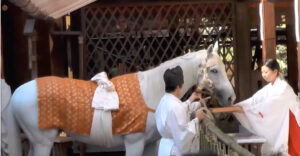
During the New Year celebration of Hakuba Sōran Shinji, the shinme is adorned with ceremonial tackle, yu-tan, 油単, oil-sheet, which is a lavish silk cloth embroidered with the shrine’s aoi mon, 葵紋, wild ginger crest, and is led to visit the enshrined deity, Kamo Wakeikazuchi no Okami. The ritual of leading the sacred horse and feeding it soybeans is held in front of the enshrined deity at Hoso-dono, 細殿, Hemp cord-hall, the during the procession the shinme circumambulates the Hashi-dono, 橋殿, Bridge-hall, three times. Visitors are invited to view the shinme as the procession continues. On the day of the event, nana-kusa-ga-yu, 七草 が湯, seven-grass-herb-of-hot water, a type of rice porridge, is also served to visitors on the shrine grounds.
As its name indicates, nanakusa gayu, is a rice porridge containing seven herbs, or grasses, generally as listed below:
Seri, 芹, Japanese parsley (Oenanthe javanica)
Nazuna, 薺, Caltrop or water chestnut (Capsella bursa-pastoris)*
Go-gyō, 御形, Honorable-form/jersey cudweed (species of cottonweed, Gnaphalium affine)
Hakobera, 繁縷, Luxuriant-thread, chickweed (Stellaria sp.)
Hotoke-no-za, ほとけのざ, Nipplewort
Suzuna, 菘, Turnip
Suzushiro, dai-kon 大根, Large-root, Japanese radish
*Note a caltrop is also a metal device used in military action to impede horses
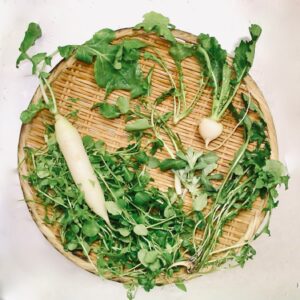
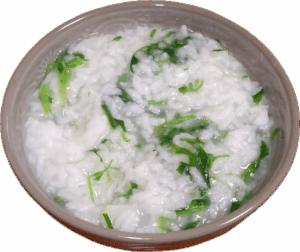
Grasses in the form of herbs such as those used in nana kusa gayu are essential for human health and well being. Horses, too, need grasses to survive. One grass that is essential in the diet of horses native to Japan is sasa, 笹, bamboo grass. Sasa is particularly important for native horses in the winter when it is a necessary food source in areas where other vegetation is scarce
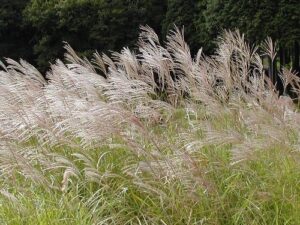
Both Horses and grasses are featured prominently in many styles of Japanese poetry. Here is a haiku by Taka-hashi Awa-ji-jo, 高橋淡路女, High-bridge Light-path-woman who was born in 1890 in Wa-da-misaki, 和田岬, Harmony-field-cape, Hyō-go-ken, 兵庫県, Military-storehouse-prefecture. The poem in some ways suggest both late autumn or winter as well as new life in the new year.
尾を強くふりゆく馬や枯芒
A horse, actively swishing its tail through withered susuki.
The horse swishing its tail through the dried pampas grass contains word play with the use of the words furi and yuku which combines the imagery of both the sense of growing old, or aging, with the potentiality of new life contained within the falling seeds contained of the grass.
The poem plays off the stillness of the grass, the movement of the horse’s tail, the very movement which will allow the seeds to fall, disperse, and grow again. This play on words indicates the cycle of life, old age, and rebirth are simultaneously represented. The poem contains the essence of the propulsive and ever moving and shifting states of the life process.
In this case, the ongoing shifting state of life is exemplified by the movement of the horse’s tail coming into contact with the still and dried grass, which contains seed for new growth that must be dispersed in order to grow again. The poem is a poignant and simple presentation of the essence of the forward movement that Horse and a new year represents.
Susuki is known as bamboo grass, and susuki (Miscanthus sinensis) and bamboo are related. They are both members of the Poaceae family, which is the botanical family for true grasses. However, they do belong to different subfamilies.
One of the essential grasses employed in the practice of Chanoyu is bamboo. Bamboo is clearly present in the tearoom in the form of utensils. While sometimes overlooked, bamboo is present as an aspect of the tea presentation during chaji on the outside of the tearoom as well, in the form of sudare, 簾, (hanging)blinds.
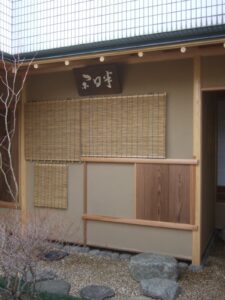
Cha-shitsu, 茶室, tea-room, with shita-ji mado, 下地窓, down-ground window, are covered with sudare, 簾, (hanging)blinds. Such reed blinds darken the Tearoom during the sho-za, 初座, first-seating, of a Cha-ji, 茶事, Tea-matter. At the start of the go-za, 後座, latter-seating, when Tea is presented, the guests enter the room and proceed to see the flower in the tokonoma. Outside the room, beginning near the tokonoma, the sudare are rolled up and removed from the windows. Thus the room is brightened for Tea. The shadow of the blinds is seen on the shoji paper panels inside.
Sudare are made of a variety of grasses or reeds. The Kanji, 簾, has the crowning bamboo radical, ⺮ , which indicates that the Kanji includes take, 竹, bamboo.
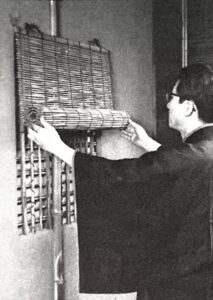
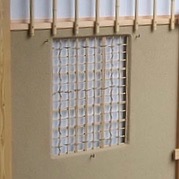
Rolling up the sudare as the go-za, 後座, latter-seating, begins. Right: sudare kugi, 簾釘, blinds-hooks, embedded in the exterior wall to cover the shitaji mado.
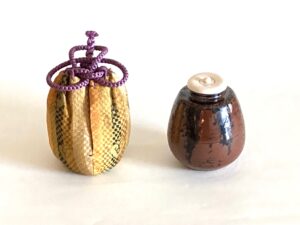
The chaire is made of brown tō–ki, 陶器, ceramic-container, in the form of shiri-bukura, 尻膨, bottom-swell, with mottled, glossy brown glaze, Kyō yaki, 京焼, Capital fired, by Ima-shiro Sato, 今城聡, Now-castle Wise, Ryū-ki gama, 龍㐂窯, Dragon-joy kiln, Kyōto. The chaire is a copy of ‘I-yo Sudare’, 伊予簾, That-previous Blinds, with zō–ge buta, 象牙蓋, elephant-tusk [ivory] lid, and multi-colored striped silk bag, shi-fuku, 仕覆, work-cover, with pattern of ‘I-yo Sudare don–su,’ 伊予簾緞子, That-previous Blinds damask-of.
Iyo sudare chaire is named for sudare made in the Iyo area of Shikoku, and are identified as shino-dake, 篠竹, bamboo grass-bamboo.
Originally, the chaire belonged to Ko-bori En-shū, 小堀遠州, Small-moat Distant-state, who described the interweaving of the potter’s wheel marks and glaze as resembling an Iyo bamboo blind. The chaire has been in the collections of Ko-bori Masa-tsune, 小堀政恒, Small-moat Govern-constant, Tsuchi-ya Sagami-no-kami, 土屋相模守, Earth-house Mutual-copy, Matsu-daira I-ga-no-kami, 松平伊賀守, Pine-level That-joy-crown, Aka-boshi ke, 赤星家, Red-star-family, and Gō-tō ke, 後藤家, Latter-wisteria family.
The poem which Enshu attached to the chaire is found in the Shi-ka Wa-ka-shū, 詞花 和歌集, Poetic-flower Harmony-poem-collection, ‘Collection of Verbal Flowers’ anthology. It is by the celebrated poet monk, E-gyō Hō-shi, 恵慶法師, Bless-rejoice Law-master, and reads:
逢ふことはまばらに編める伊予簾いよく我を佗びさするかな
‘Au Fu Koto Wa Mabara Ni Ameru Iyo Sudare I Yoku Ware o Wabi sa Suru Ka na’
Possible translations of this poem include:
‘Our encounters are sparsely woven through the Iyo sudare. This makes me feel even more lonely.’
‘Our meetings are as infrequent as the loosely woven threads of an Iyosudare blind; how much they make me feel lonely.’
‘My chances of meeting my beloved are sparse, and the opportunities to do so are as intermittent as the irregular Iyo sudare, making me feel all the more lonely.’
For further study, see also: Horse Tale in Tea and New Year Collection