
Winter Solstice, the Tearoom Calendar, and the First Tea Harvest
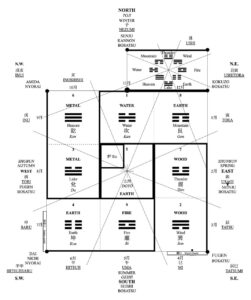
The yo-jō-han, 四畳半, four-mat-half Tearoom, may be perceived as the center of the world, the world of Chanoyu, certainly. It can be a calendar and a map. When viewed as a map, the simplest division is its directions. In the ideally placed tearoom, this would be due north, south, east, and west. While the ideal placement is not always possible, the North is established by the presence of a toko-no-ma, 床の間, bed/floor’s-room. It is an alcove located toward the East. This is to protect against the harsh influences from the Northeast.
The width of the tokonoma is half the width of the wall. This direction is called the ki-mon, 鬼門, demon-gate, and in fact establishes the North wall. The directions of the room are such that, like a map, the room can be oriented in any direction, but the North wall remains fixed. In the middle of the North wall at the corner of the tokonoma is the toko-bashira, 床柱, floor-post. In its own way the placement of the tokobashira establishes the ‘North’.
The exact North direction can be equated with the Winter Solstice (sun-stop), just as exact South can be equated with the Summer Solstice. Halfway between these two polar extremes to the east is the Vernal Equinox (equal-night), and likewise to the halfway point between the polar extremes to the West is the Autumnal Equinox. Any date in the solar year could be ascertained by imagining the tearoom as a calendar.
For the year 2025, Winter Solstice, Tō-ji, 冬至, Attain-winter is on December 21 (though, depending on the time zone, it may also occur in some parts of the world on December 20). Winter Solstice is the one day of the year when the daylight is the shortest and the night is the longest.
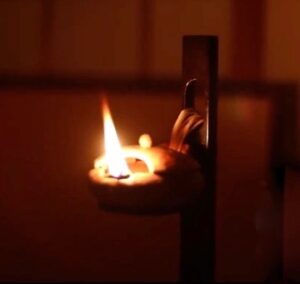
It is interesting to note that Tōji, is demarcated in the tearoom by the tokobashira, a tree that is no longer producing leaves and fruit. In many places of Southeast Asia, including in Japan, the start of cha-tsumi, 茶摘, tea-picking, is centered on Sei-mei, 清明, Pure-bright, (Sei-jō Mei-ketsu, 清浄明潔, Pure-clean Bright-noble), which is 108 days after Tō–ji, 冬至, Winter-attain, the winter solstice. Hyaku-hachi, 百八, 100-8, represents the number of earthly desires that must be controlled in Buddhism.
Chatsumi is not only 108 days after the winter solstice, it is also hachi-jū-hachi-ya, 八十八夜, 88 nights after Ri-sshun, 立春, Start-spring. The Kanji for cha, 茶, tea, is composed of numbers 20, 艹, 8, 八, 10, 十, 8, 八. When added together, the strokes in the Kanji for tea 20, 80, and 8 equals 108.
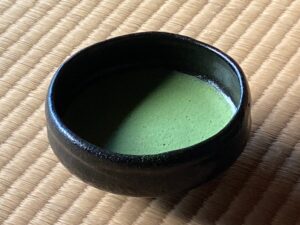
Tōji is the Winter Solstice and is identified as directional North in the yojōhan. Tōji, the Winter Solstice, is the darkest day of the year, and it is also the promise of new light to come. We can appreciate both darkness and light in the tearoom. One thing is not only one thing.
For further study, see also Winter Solstice and Chanoyu and December Collection