
Tanabata, Paper, and Letter Writing Month
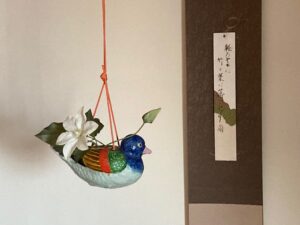
Tsuri-hana-ire, 釣花入, suspend-flower-receptacle, in the form of a bird. Kake-mono, 掛物, hang-thing, tan-zaku, 短冊, short-volume, temporarily mounted on paper and fabric hanging scroll, tan-zaku kake, 短冊掛, short-volume hang 2 x 12 sun kane-jaku. Tan-zaku-kake, 短冊掛, short-volume-hanger, paper and fabric scroll with threads at the corners to hold a tanzaku; L. 4.5 shaku kane-jaku, or 3.6 sun kujira-jaku. The scroll is hung on go-ma-dake ji-zai, 胡麻竹自在, foreign-hemp bamboo self-exist, with adjustable metal hook. Tanzaku, decorative pasteboard with calligraphy:
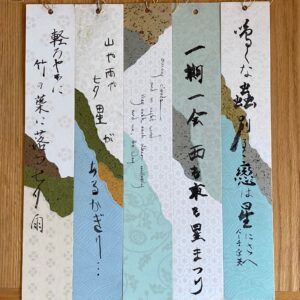
軽やかに竹の葉に落ち七夕雨,
karoyaka ni take no ha ni otsu ni tanabata u,
lightly on bamboo leaves falls Seven Night rain
Fumi-zuki, 文月, letter-month, is one of the old lunar calendar names for the seventh lunar month. Many of the events that would be observed at the time are in modern times celebrated in July. Major events such as Obon, お盆, hon.-tray, when spirits of the dead return to ancestral homes, is observed primarily in mid August, rather than in direct relation to the lunar Tanabata. Obon is a lunar event that corresponds with the full seventh moon. In preparation for Obon, seven days before, which corresponds with the seventh day and night of the seventh moon, what has become known as Tanabata, the home is purified by ancient rites which include placing a stalk of leafy bamboo, sasa, 笹, at the front door. Traditionally, cleaning and dusting is done with leafy bamboo. Streamers of hemp paper may be attached to the duster. In time, prayers were written on the paper streamers, which later developed into written offerings and prayers and well-wishes were written and attached to the sasa of the home.
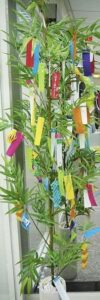
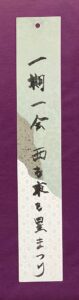
This preparation for honoring the ancestors has developed into a celebration of the stars Altair and Vega, attracting people to look to the heavens and the stars where ancestors may dwell. The prominent star cluster during the Obon period is the Summer Triangle, which is composed of Altair, Vega, and Deneb.
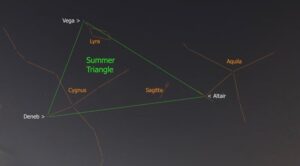
Illustration of the Summer Triangle, Natsu no Dai-san-kaku, 夏の大三角, Summer’s Great-three-corner. The Summer Triangle is composed of three stars, each are a part of individual constellations, Deneb is in the tail of Cygnus, Altair is in Aquila, and Vega is in Lyra. In old China, these stars were given a story of a cowherd, and a weaver princess. Their love took precedence over their labors, so that the emperor allowed them only one night of the year to meet. Legend reveals that Altair is identified as Hiko-boshi, 彦星, Boy-star, and Ken-gyū,牽牛, Lead-ox, and Vega is identified as Ori-hime, 織姫, Weave-princess. Deneb is identified with the bridge that allows the lovers to meet once a year and is sometimes referred to as Ama-no-hashi, 天橋, Heaven’s-bridge.
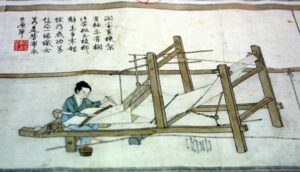
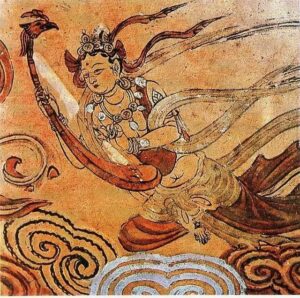
Left: picture of an ancient ‘Chinese’ weaver’s loom, shō-ki, 織機, weave-loom, also tana-bata. The original words for tana-bata, 七夕, seven-night, were tana-bata, 棚機, mantle-loom.
Right: Yashinae Bo-satsu, 養菩薩, Developing Grass-buddha, playing a phoenix headed konghou harp, this is a depiction of a painting found in Mogao Caves, also known as the Thousand Buddha Grottoes or Caves of the Thousand Buddhas
Sagitta, Latin for arrow, is a dim but distinctive constellation in the Northern Hemisphere seen within the Summer Triangle, as shown above. Representing an arrow, it is one of the 48 original constellations cataloged by Ptolemy in the 2nd century. It could be imagined that the ‘arrow’ constellation may represent the shuttle, hi, 杼, or 梭, that is part of the weaver’s ‘loom’ constellation.
‘Deneb’ is derived from the Arabic word for ‘tail’, which in the Summer Triangle is the tail of Cygnus, the Swan. Deneb is imagined to become the bridge to cross or ford the river called the Ama-no-gawa, 天の川, Heaven’s River, the Milky Way which during the summer is seen streaming through the center of the Summer Triangle. In the tale, Altair and Vega are on opposite sides of the ‘river’. Deneb acts as a bridge for the lovers to cross and meet.
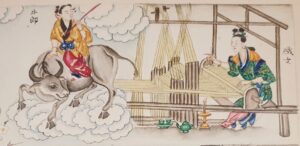
Within the celestial tapestry of the Tanabata legend, the star Deneb is recognized as Tianjin Si, 天津四, the Fourth Star of the Celestial Ford. It serves as a vital intermediary, manifesting as the mystical bridge of magpies that facilitates the reunion of Ori-hime, 織姫, Weave-princess, Vega, and Hiko-boshi, 彦星, Lad-star, also called Gyū-rō, 牛郎, Cow-herd, the cow is originally a water buffalo, Altair, to metaphorically cross the vast expanse of the Milky Way, or Ama no Gawa.
In the tradition of ancient astronomy, the glowing band of the Milky Way was envisioned as a celestial river, Tianjin. Within this cosmic flow, Deneb functions as the essential crossing point, a symbolic ferry or bridge that allows for the temporary transcendence of separation between the two lovers. Though the legend does specify that if there is rain on that day, the lovers must wait a full year before the opportunity to meet will be present again.
Thus, began the romance of Tanabata, 七夕, Seven-night, and the lovely custom of writing letters to these two stars as well as wishes and blessings for one’s ancestors. Writing on paper in Japan dates back to the 7th century, when it was imported from China. A popular type of paper is called kai-shi, 懐紙, heart-paper, as it is kept in one’s kimono near the heart.
Carrying kaishi has evolved over time and the sizes of kaishi vary greatly among many practices of poetry, kō-do, 香道, incense-way, Chanoyu, and also gift giving. Some common measurements include:
Han-shi, 半紙, half-paper: 242 x 333 – 8 x 11 sun kane.
Han-kai-shi, 半懐紙, half-heart-paper: 245 x 365 – 8 x 12 sun kane.
Zen-kai-shi, 全懐紙, full-heart-paper: 485 x 365 – 16 x 12 sun kane.
Paper is essentially a combination of vegetable fibers and water, pure cold water is also vital to the art of making wa-shi, 和紙, harmony (Japan)-paper. The main ingredient in high quality paper is the fibers that are used. The three fibers used to create washi are kōzo, ganpi, and mitsumata.
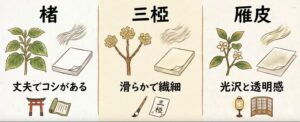
Kōzo, 楮, kozo (Broussonetia kazinoki x papyrifera); Japanese paper mulberry tree. A variant is kaji, 梶, paper mulberry paper mulberry (Broussonetia papyrifera).
Mitsu-mata, 三椏, three-(tree) fork; Oriental paper bush (Edgeworthia chrysantha).
Gan-pi, 雁皮, goose-skin, also called tori-no-ko, 鳥の子, bird’s-of, (Diplomorpha sikokiana).
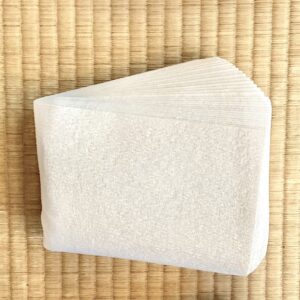
Kami kama-shiki, 紙釜敷, paper kettle-spread, a folded ream of fine papers 6 sun kujira jaku x 8.8 sun kujira jaku. The number six is emblematic of Infinity in Time and the number eight is emblematic of Infinity in Space. The kami kamashiki was the original kai-shi, 懐紙, heart-paper, that Rikyū cut approximately in half to be less extravagant to be used as kaishi. However the large kaishi are used with the kama, and are often displayed in the tokonoma to support a kō-gō, 香合, incense-gather.
The size of the original kaishi that became the kami kamashiki is relatively similar to the size of the kaishi used for writing wa-ka, 和歌, harmony-song, poetry.
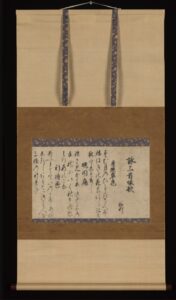
Kakejiku; wa-ka kai-shi 和歌懐紙, harmony-song heart-paper, a poetic record capturing the ephemeral moments of a specific gathering. These three inscriptions were written by the Tendai monk Jō-ben, 浄弁, Pure-speech, a figure later revered as one of the Waka shitennō, or the Four Heavenly Kings of Court Poetry. His legacy, celebrated through the centuries, is exemplified on this sheet of kaishi with the final piece titled ‘Praying for Love’, which is a classic waka style love poem:
あうまでと いのるこゝろ しるしありて
いつかは人を 三輪の神すぎ
It serves as a marker
that in my heart
I was praying for
the moment we might meet—
the cedar of Miwa Shrine.
One of the purposes of the kakejiku is to display kaishi – Zen phrases are in a class by themselves and are sometimes called cha-kake, 茶掛, tea-hanger, to be displayed at a Tea gathering. In long-held tradition in Chanoyu, the tanzaku is not regarded as the most appropriate for display in the tokonoma for a Tea gathering. A treasured tanzaku may be mounted as a kakejiku, as seen above. However, a tanzaku is often displayed in the machi-ai, 待合, wait-gather, where the guests gather before entering the Tearoom.
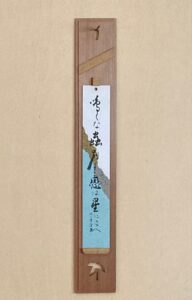
Tanzaku, with calligraphy, ‘Na-ku-na mushi waka-ru-ru koi wa hoshi ni sae’, 鳴な蟲別るる戀は星にさへ, Cry not insects separation love stars even among, poem by Ko-bayashi Issa, 小林一茶, Small-grove One-tea. Calligraphy by Michael Sōei Birch, London. In the Tanabata poem, Issa refers to insects singing plaintively, a sound that would be heard in August, not in July when Tanabata is more popularly observed.
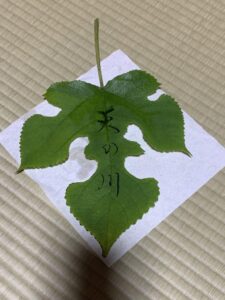
Kaji, 梶, paper mulberry (Broussonetia papyrifera), Tanabata poems written on leaves of the paper mulberry, kaji no ha, 梶の葉, mulberry’s leaf. The leaves are then hung on branches of bamboo, sasa, 笹.
A homonym for kaji is ka-ji, 加持, join-hold, prayer (to get rid of misfortune, disease, etc.); incantation; faith healing, it is a ritual practiced in Shingon Esoteric Buddhism. It involves forming mudras (hand gestures), chanting mantras, and visualizing Buddhas and Bodhisattvas in one’s mind, thereby becoming one with them. By extension, it refers to praying for the protection of the Buddha’s divine power through the ritual described in, for worldly benefits such as the fulfillment of wishes or recovery from illness.
One of the mudras that could be evoked by the folding of a single sheet of kaishi is bringing the hands together in prayer, a mudra known in Sanskrit as anjali mudra, in Japanese, gas-shō, 合掌, join-hands.
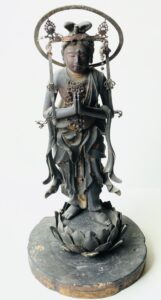
Left: a figure of walking Sei-shi Bo-satsu, 勢至菩薩, Strength-attain Grass-buddha, gilt wood, Muromachi period; with hands together in anjali mudra, Sanskrit, in Japanese called gasshō; H. 8 sun kane-jaku. Seishi, together with Kannon, attends Amida Nyorai, the Buddha of Compassion.
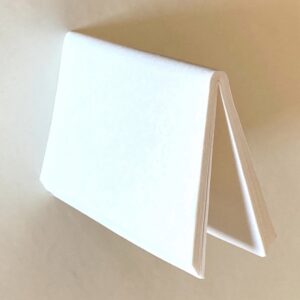
Right: folded pack of 30 sheets of kaishi. Collectively, there are 60 layers of paper. The number 60, roku-ju, 六十, is the regarded as an important age, because there are 60 years of the cycle of the 12 zodiac signs combined with the five elements and In and Yō, 陰, negative, and 陽, positive. Hence, a complete life. 60 years after one’s birth, the cycle begins again, and is celebrated as a Kan-reki, 還暦, Return-calendar.
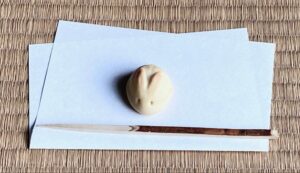
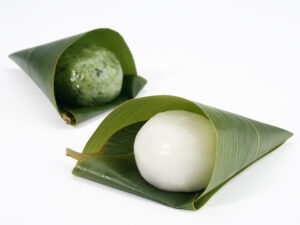
A sweet is placed on a folded sheet of kaishi that has been folded in half. The pictured sweet is usagi manju which could evoke the image of the moon with a hare pounding mochi: Gyoku-to, 玉兔, Jade-hare. Right: in its simplest form, the sweet can be served on a bamboo leaf such as sasa mochi, 笹餅, bamboo grass mochi. The pictured sweet is a popular treat enjoyed around the time of Tanabata.
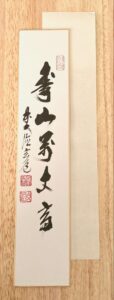
The tanzaku reads; Ju-zan ban-jō takeshi, 寿山萬丈高, Longevity-mountain Ten thousand-‘jō’ high, signed Zen-Dai-toku Gen-dō, Before-Great-virtue Mystery-way, by Su-ga Gen-dō, 須賀玄道, Necessary-joy Mystery-way, chief priest of Zui-sen-ji, 瑞泉寺, Auspicious-spring-temple, Ō-ita–ken, 大分県, Great-division-prefecture, Kyū-shū, 九州, Nine-states. Measures 12 sun kane jaku by 2.5 sun kane jaku – this is a standard measurement, though there are many sizes.
The piece of plain white paper pictured behind the tanzaku was wrapped around the scroll furnished by the artist who made the scroll furnished to hold the tanzaku, it is called a maki-gami, 巻紙, wrap-paper.
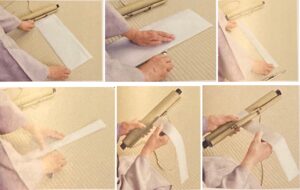
Creating the maki-gami, 巻紙, wrap-paper:
A full sheet of paper is folded into thirds, and one-third of the paper is cut away. The folded two-thirds is used as maki-gami, and the remaining one-third is for identification or is reused for another purpose. The folded makigami is approximately the same size as the standard tanzaku.
Fū-rin, 風鈴, wind-bell; suspended iron bell with green patination, in the form of a matsu-kasa, 松笠, pine-cone, with clapper inside, and an attached tanzaku to catch with wind and ring the bell.
Tanzaku suspended from a fūrin, fulfills a role that is both functional and symbolic. It is designed to catch the subtle movement of air to sound the bell, while also serving as a vessel for ka-ji, 加持, join-hold, offered to the celestial realms to safeguard the household and its ancestors, as well as to invite a sense of tranquil coolness to one’s spirit.
Kaji, read as mulberry leaf, is featured prominently in some schools of Chanoyu during the Tanabata season.
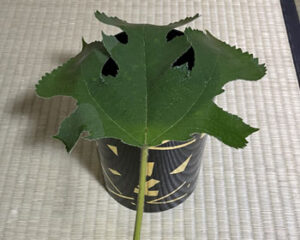
During the peak of summer, coinciding with the celestial observance of Tanabata, the Star Festival, a specific tradition within Chanoyu emerges where a fresh leaf serves as a temporary lid for the water container. This evocative practice was created by the eleventh-generation grand master of the Urasenke school, Gen-gen-sai Sei-chū, 玄々斎精中, Mystery-mystery-abstain. Its origins can be traced to a particular gathering where, to honor the theme of the Weaver Princess and the Cowherd, he repurposed a mage tsutsu, 筒, cylinder, insert of a sue-hiro kago, 末広 籠, ends-wide basket. Often the tsutsu would be covered in black lacquer to keep the bamboo from splitting. Gengensai also had gold maki-e, 蒔絵, embed-picture, metal-lacquer leaf applied to the vessel and used a kaji leaf to cover it, transforming it into what is now known as the Ha-buta mizu-sashi, 葉蓋 水指, Leaf-lid water-indicate. This inspiration echoes an earlier gesture by Rikyū, who, to shield the water from the sun, famously placed a single leaf atop the chō-zu bachi, 手水鉢, hand-water bowl, at the tsukubai, 蹲, crouch-down, within the uchi ro-ji, 内露地, inner dew-ground.
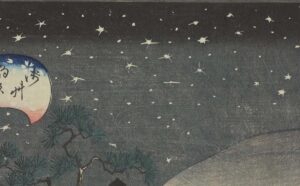
Close up view of a print by Hirokage Utagawa, ‘Comic Views of Famous Places in Edo, No. 36: Asakusa Komagata-do’.
There is a possibility that Gen-gen-sai Sei-chū, 玄々斎精中, Mystery-mystery-abstain, was inspired to place the gold leaf patches on the mizusashi because of the celebratory nature of the night sky filled with stars and twinkling light during the Tanabata season. The gold patches reflect light, enhancing the dimly lit nighttime tranquility of the Tea room.
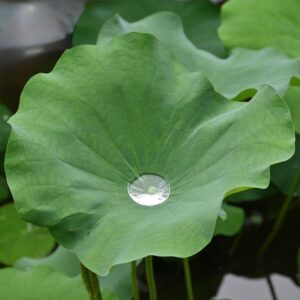
Dew, tsuyu, 露, on a 蓮の葉, lotus’s leaf, is gathered on the morning of the 7th day of the 7th month, to wet the suzuri, 硯, inkstone, to write poems and salutations to the stars of Tanabata. Dew from heaven is returned in its own way to the heavens. The lotus is sacred in Buddhism, and dew is the essence of the transience of life. Anitya in Sanskrit is the essence of the transitory nature of life, and conveys the notion that all which life contains is in a constant state of change. In Buddhist philosophy this translates to the well-known phrase, sho-gyō mu-jō, 諸行無常, various-journeys not-long lasting. A lotus leaf may be used in place of the mulberry leaf as a lid on a mizusashi, as in a Tanabata themed Tea presentation, Ha-buta, 葉蓋, Leaf-lid.