Sōtan-ki Tribute
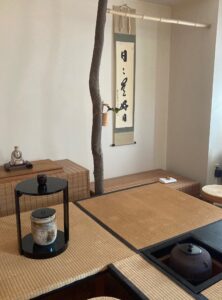
Garandō set for Sōtan Memorial: tokonoma – hanging scroll ‘Hi-bi Kore-ko-jitsu’, by Ōnishi Ryōkei, Kiyomizudera; hanging bamboo hanaire by David Flanagan; ‘Raku’ incense container, ‘Busshukan’. Iron Amida-dō kama in ro. Display stand, ‘Sōtan maru-joku’, ceramic water vessel by Ōhi Toshio; tea container, ‘Rikyū chū-natsume’. Porcelain figure of Sen no Rikyū, Ku-tani.
Sen Sō-tan, 千宗旦, Thousand Sect-dawn, also known as Gen-paku Sō-tan, 元伯宗旦, Origin-uncle Sōtan, was born on the 1st day of the 1st month in Tenshō 6 (1578) in Sakai, during Japan’s Azuchi-Momoyama period. He died at the age of 81 on the 13th day of the 12th month in Manji 1 (1658), during the Edo period.
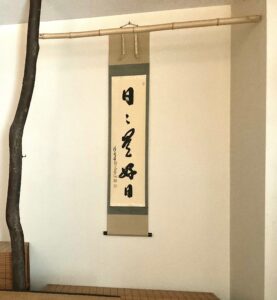
Kake-mono, 掛物, hang-thing, with calligraphy, ‘Hi-bi kore kō-jitsu’, 日々是好日, Day-day is good-day. Buddhist reading is ‘nichi nichi kore kō nichi.\’. Chinese: ‘Ri ri shi hao ri’ and ‘Jih jih shih hao jih’.
Calligraphy by Ō-nishi Ryō-kei, 大西良慶, Great-west Good-delight, 1875-1983, chief priest of Kiyo-mizu-dera, 清水寺, Pure-water-temple, Kyōto.
Signed at left, Kiyo mizu dera hon zon ryō kei, 清水寺本尊良慶, Pure water temple true lord Good-delight, Ichi-mon-ji, 一文字, one-letter-character, and hanko; with fū-tai, 風帯, wind strap, Kara-kusa kin-ran, 唐草金襴, Tang-grass gold-brocade, on white cloth. Chū-mawashi, 中廻し, middle-surround, blue silk don-su, 緞子, damask-of. Ten-chi, 天地, heaven-earth, brown silk. Jiku, 軸, scroll, black-lacquered wood.
‘Hi-bi kore kō-jitsu’ is one of the most famous phrases in Zen studies. The expression on the hanging scroll is included in the Heki-gan-roku, 碧巌録, Blue-cliff-record. Case 6: Yun-men’s “Good Day,” Yun-men, 雲門, Cloud-gate, the great Chinese Zen priest. Yunmen, in Japanese, is called Unmon. It is said that he gave the following koan to the monks:
十五日已前不問汝,十五日已後道将一句来
“Jū-go-nichi i-zen fu-mon nanji, jū-go-nichi i-go dō-shō i-kku rai? ”
“I don’t ask you about before the fifteenth day; bring me a phrase about after the fifteenth day.”
Yun-men himself answered instead of the monks:
日日是好日
“Hi-bi kore kō-jitsu”
“Every day is a good day.”
The choice of the hanging scroll relates to a story involving Sen Sōtan’s exchange with an abbot of Daitokuji. When Sōtan retired, he lived with his young son, So-shitsu, 宗室, Sect-room, in the back part of the family estate. Later, he built a hut that has an interior of two tatami, however it is an ichi-jō dai-me, 一畳台目, one-mat support-eye, that has a board that fills the empty space of the daime. To inaugurate the opening of his Tea hut, he invited various abbots, one at a sitting, as the space was intended for only two persons.
One of the invited abbots did not arrive at the appointed time. Believing that his guest could not come for Tea, Sōtan left a note bidding him to come another day. The guest, Sei-gan O-shō, 清巌和尚, Pure-cliff Harmony-esteem, the abbot of Dai-toku-ji, 大徳寺, Great-virtue-temple, arrived, and unable to find Sōtan, also left a note stating that for a lazy monk there is only today, kon-nichi, 今日, now-day. Thereafter, Sōtan called his home, Kon-nichi-an, 今日庵, Now-day-hut, which identifies Urasenke to this day. The Kanji, 今日, are also, more commonly read kyō.
Sen Sō-tan, 千宗旦, Thousand Sect-dawn, (1578–1658), is also known as Gen-paku Sō-tan, 元伯宗旦, Origin-uncle Sōtan. The name genpaku is given to Sōtan as he was the progenitor and founder of the San-Sen-ke, 三千家, Three-Sen families, each of which was headed by one of his three sons:
Omote-Sen-ke, 表千家, Front-Thousand-family, Sō-sa, 千宗左, Sect-left
Ura-Sen-ke, 裏千家, Back-thousand-family, Sō-shitsu, 千宗室, Sect-room
Mu-sha-ko-ji-Sen-ke, 武者小路千家, War-rior-path Thousand-family, Sō-shu, 千宗守, Sect-guard
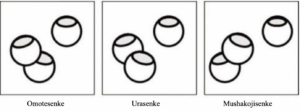
Tsubo-tsubo mon, つぼつぼの紋, jar-jar crest, of the three Sen families. Each of the three family crests feature two tsubo are near each other at different angles and overlays, while the third tsubo remains upright and is the same in all three crests.
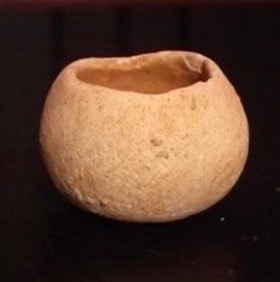
The three Sen families have variations of the tsubo-tsubo-mon. Sōtan based this motif on the sacred water vessel, ‘den-bo’, 田宝, ricefield-treasure, from Fushi-mi-inari Tai-sha, 伏見稲荷大社, Down-see-rice plant Great-shrine.
Sōtan-ki Tribute: The preferred choices of Sen Sōtan – Sōtan Konomi
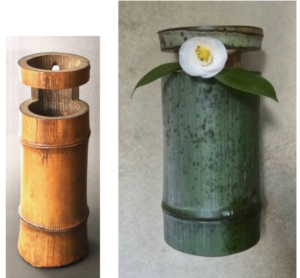
Left; kake hana-ire, 掛花入れ, hanging flower-into; take, 竹, bamboo, ichi-jū-giri, 一重切, one-tier-cut, single side opening. The camellia flower, tsubaki, 椿, is related to the tea plant, camellia sinensis.
Right: ichijūgiri hanaire attributed to Sōtan. Note that Sōtan did not include a fushi, 節, node, at the top of the bamboo.
Rikyū expression on chabana, 茶花, tea-flower:
青竹を切り、清らかな水を満たし、純粋な心で花を生ける。その純粋な心で、まず花を見つめ、それから花器に目を向ける.
‘Cut pure green bamboo, fill with pure water and arrange the flowers with a pure heart. With a pure heart look at the flowers first and then the vase.’
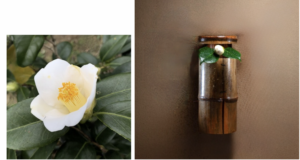
‘Sōtan’ Tsubaki.
The camellia, tsubaki, 椿, is the preferred cha-bana, 茶花, tea-flower, and one of the most favored is named after Sōtan. The original tree is located at Ju-kō-in, 聚光院, Assembled-light-sub-temple, the Sen family temple in Dai-toku-ji, 大徳寺, Great-virtue-temple, Kyōto.
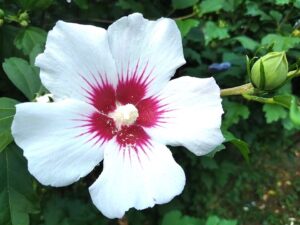
Sōtan muku-ge, 宗旦木槿, tree-rose of Sharon (Hibiscus syriacus); Korean rose. It is the quintessential cha-bana, 茶花, tea-flower, displayed when preparing Tea with the portable fu-ro, 風炉, wind-hearth. It has five white petals with a deep red center. Note the similarity between the flower bud and the wish-granting hō-ju, 宝珠, treasure-jewel. Sōtan favored this flower for Chanoyu. Because the mukuge blooms in the morning and withers by evening, it embodies the Zen concept of ichi-go ichi-e, 一期一会, one time, one meeting.
Known as mugunghwa in South Korea, the hibiscus is celebrated as the National Flower. A Korean tradition views its continuous cycle of opening fresh daily buds as a symbol of eternal, endless prosperity. Rikyū’s maternal grandfather was Korean.
It is a welcome and familiar sight to see a flower in a bamboo hanaire in a tokonoma when having Tea. With a more objective look, it can seem a bit strange. A bamboo grove is so dense that it prevents the growth of other plants. The bamboo stalk is relatively impenetrable. When a bamboo stalk is cut down, it often leaves a hollow stump, which can fill with water. It is there that a plant may grow. However, it is unlikely that an opening in the side of a bamboo stalk would occur.
A bamboo hanaire is very often hung on a hook driven into the side of a tokobashira. For a Chaji, a hanaire of almost any kind is hung on the hook in the tokobashira, as well as on a hook mu-sō-kugi, 無双釘, no-pair-hook, The musokugi is located in the middle of the back wall of the tokonoma. The hook is often concealed by the hanaire, this makes it appear as though the flower is floating in the air. There can be an otherworldly feeling to seeing the flower suspended in its vase on the wall. There may be some symbolic reasoning.
Shortly after his enlightenment, the Buddha taught in a bamboo grove, chiku-rin, 竹林. The area, known as Veluvana, was given to the Buddha and his community by King Bimbisara of Magadha. Veluvana was the first land donation and monastery given to the Buddha and his monastic community.
The bamboo plant is a source for building material as well as being used in making an endless variety of objects. Bamboo’s natural properties include hollow chambers, it grows straight, attains its full height in one season, is an evergreen, and a vast grove can be a single plant – all of which can be seen as symbolic.
Bamboo does not have typical flowers. It blooms once and dies. One species, Phyllostachys bambusoides (also known as Japanese timber bamboo plant), has a life span of 120 years. A wonder, but it has its unfortunate consequences, as broad areas can be devastated, rendering the dead bamboo useless. Death is not truly complete as the root system, after dormancy, may spring back to life, although it could take decades to thrive. Within Buddhism, bamboo represents rebirth, re-juvenation. ‘Be empty’ is the model taken from bamboo’s empty chambers.
There is a Zen expression: Sei-sei-sui chiku jin-ze-ho-sshin, 青青翠竹 尽是法身, blue-blue-green-bamboo, that connects bamboo and the Buddha. The bamboo grove itself is seen as the body of the Buddha (Dharmakaya), and it flowers, represent the supreme wisdom (Prajna) taught by Shakyamuni. This represents the Zen worldview that the teachings of Buddha and the truth of Shakyamuni are not only found in special scriptures, but are also fully present in the natural world.
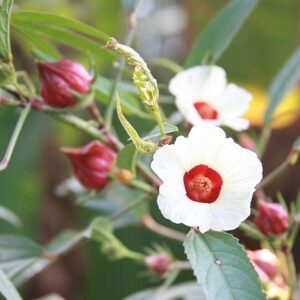
Traditionally, hibiscus ‘tea’ is a tart herbal infusion made primarily from the dried or fresh calyces the cup-like structures at the base of the flower commonly known as the Roselle. Roselle is a kind of hibiscus, scientifically known as Hibiscus sabdariffa. It belongs to the mallow family (Malvaceae) and the genus Hibiscus.
The ‘tea’ has been used in herbalism, as the plant contains vitamin C, antioxidants (anthocyanins), and mucilage, and is sometimes used to help soothe the digestive tract or support healthy blood pressure used in herbalism. The entire plant has been the source of various health aides, and many parts are edible.
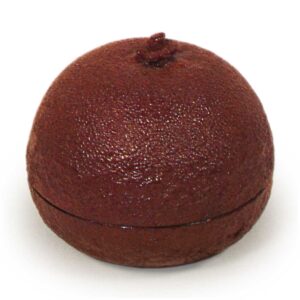
Tachibana Kō-gō, choice of Sōtan.
The tachibana kō-gō, 橘, mandarin orange incense-gather, is natural citrus that is cut in half, emptied of its contents, and allow to dry. The interior of this kōgō is lacquered black. Sōtan also had gourds made into kōgō. The natural orange peel kōgō is not ceramic, and may seem more appropriate with the furo. Rikyū, Sōtan’s grandfather, said that the ro should be opened when the yuzu turns yellow. The yuzu, 柚, citron, is a kind of citrus.
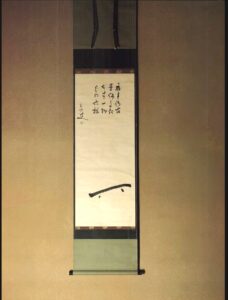
Kake-jiku, 掛軸, hang-scroll, with calligraphy and drawing by Sōtan.
Ya-han no den-e 夜半傳衣 Night-half (’s) bestow-robe ‘Buddhist kesa.
Kore nani goto to ya 是何事哉 Is this thing what (?)
Hon-rai ichi motsu 本来一物 Origin-begin one thing
Bu-usu roku-so 分臼六祖 Dividing-mortar six-patriarch.
Sōtan’s drawing appears to be a simple bridge of sorts. The last line of his writing identifies it. Bu-usu is a mortar of wood or stone in which steamed rice is pounded into a glutenous mass of mochi. Roku-so refers to E-nō, 慧能, Wise-ability, Zen-shū Roku-so, 禪宗六祖, Zen-sect Sixth-patriarch, (638 – 713) of Chan Buddhism. He spent eight months working in the kitchen backyard of Master Daman Hongren, 弘忍, Vast-endure, 禪宗五祖, Zen-sect Five-patriarch, of Chan Buddhism monastery pounding rice and splitting firewood. Because he was an uneducated commoner from the south, he was hidden from the other monks and tied a heavy stone to his waist to help leverage the heavy rice mortar.
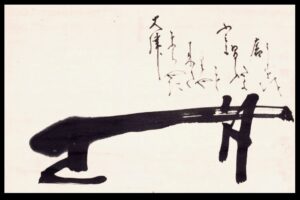
‘The Sixth Patriarch’s Rice Mill’, Edo period, by Haku-in E-kaku, 白隠 慧鶴, White-conceal Wise-crane, (1686 – 1769), is also known as Koku-rin, 鵠林, Swan-grove
Sōtan created some Tea utensils that were lavish, colorful and appropriate for her and her court. One of the most favorite of Sotan’s motifs is the lacquered design of hana-ikada, 花筏, flower-raft, which was applied to a ro-buchi, 炉縁, hearth-frame. The motif is now used for several tea utensils including tea caddies and mizusashi.
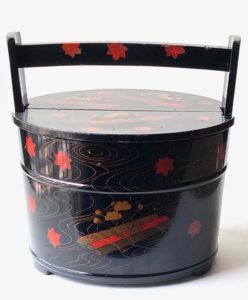
Mizu-sashi, 水指, water-indicate, te-oke, 手桶, handle-bucket, with wari-buta, 割蓋, divided-lid, black-lacquered wood with a color design of ‘hana-ikada’, 花筏, flower-raft; choice of Sōtan.
Sōtan-ki Tribute at Garandō: in the style of the daime Konnichian Tearoom created by Sen Sōtan
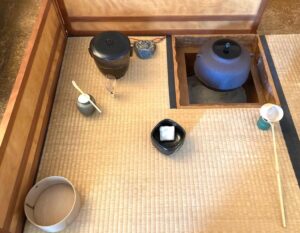
Garandō with arrangement of Tea utensils using a mukō-giri ro, 向切炉, opposite-cut hearth.
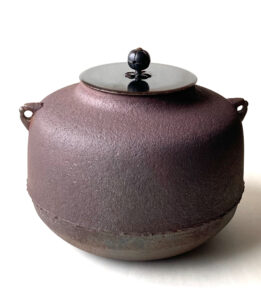
A-mi-da-dō gama, 阿弥陀堂釜, Praise-increase-steep-temple kettle, tetsu, 鉄, iron, with futa, 蓋, lid, Kara-kane, 唐銅, Tang-copper, by Kiku-chi Masa-toyo, 菊地政豊, Chrysanthemum-ground Govern-excellent, Yama-gata, 山形, Mountain-form: Rikyū choice. The size of the kama is appropriate for the ro, the sunken hearth.
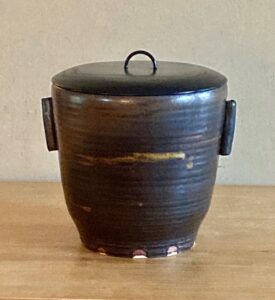
Mizu-sashi, 水指, water-indicate; flared cylindrical, ceramic vessel with kuda-mimi, 管耳, tube-ears, and brown glaze – with black-lacquered, slightly domed wooden lid; 5 sun kane-jaku, by Steven Murphy, Boston.
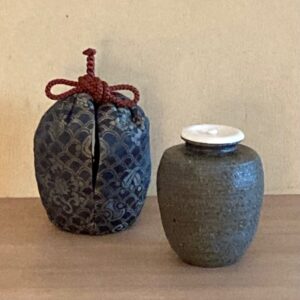
Cha-ire, 茶入, tea-receptacle, ceramic jar with kata-tsuki, 肩付, shoulder-thrust, with ash-glaze, Chō-setsu-gama, 聴雪窯, Listen-snow-kiln, by Tsuchi-da Takeshi, 土田健, Earth-field Strength, Yama-gata, 山形, Mountain-form. With zō-ge buta, 象牙蓋, elephant-tusk lid, interior lined in kin-paku, 金箔, gold-foil. Choice of Sen Zabōsai, XVI, Oiemeoto, Urasenke, Kyōto.
Shi-fuku, 仕服, serve-cover, silk fabric pouch with pattern of ‘Hon-nō-ji don-su’, 本能寺緞子, True-skill-temple damask-of, by Tsuchi-da Yū-ko, 土田友湖, Earth-field Friend-lake.
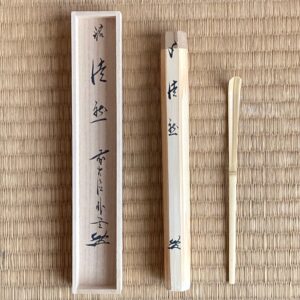
Cha-shaku, 茶杓, tea-scoop; take, 竹, bamboo, with naka-bushi, 中節, middle-node, by Kage-bayashi Sō-toku, 影林宗篤, Shadow-grove Sect-kind, named ‘Tsure-zure’, 徒然, Vanity-if so, Idleness; L. 6 sun kane-jaku, by Sa-tō Boku–dō, 佐藤朴堂, Help-wisteria Simple-hall, abbot of Fuku-ju-in, 福聚院, Fortune-assemble-temple, Ō-tsu Shi, 大津市, Great-port-city.
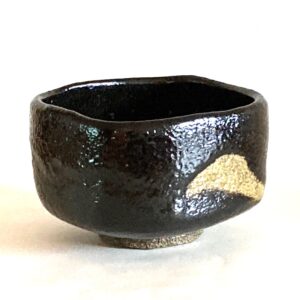
Cha-wan, 茶碗, tea-bowl, four-sided, ceramic bowl with black glaze, with unglazed patch, by I-tō Kei-raku, 伊東桂楽, That-east Katsura-pleasure; h. 2.5 sun kane-jaku. Inspired by a chawan made by 3rd generation Raku Dō-nyū, 楽道入, Pleasure Way-enter, named ‘Chidori’, 千鳥, Thousand-birds. Raku Dōnyū (1599-1656), also named Nonkō, ノンコウ, made ceramics for Sōtan and the other Sen families. The origin of the name ‘Nonkō’ is unclear, however it is the name of a bamboo ni-jū-giri hana-ire, 二重切花入, two-tier-cut flower-container, made by Sōtan and given to Dōnyū. It is thought that the name ‘Nonkō’ comes from the Noko teahouse near a bamboo grove in Suzuka, Mie, where Sōtan was resting.
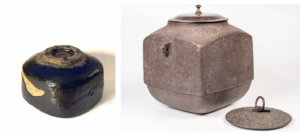
Left: square chawan inverted. Right: kama, 釜, kettle; yo-hō, 四方, four-directions, with two lids.
Some early Raku chawan were modelled after kama that were turned upside down. Rikyū had a square kama that became the model for a chawan made by Chō-ji-ro, 長次郎, Long-next-son.
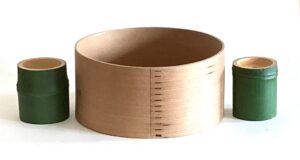
Ken-sui, 建水, build-water, cylindrical, bowl of sugi, 杉, cedar, ‘mage-mono’, 髷物, bend-thing, with kabazaiku, 樺細工, cherry bark stitches establishing the shō-men, 正面, correct-face; diam. 5 sun x h. 2.4 sun kane-jaku. Two ao-dake futa-oki, 青竹蓋置, green-bamboo lid-place; h. 1.8 sun kane-jaku: left: naka-bushi, 中節, middle-node, used with the ro, right: ten-bushi, 天節, heaven-node, also called moto-bushi, 元節, origin-node. Both are made with the bamboo inverted from the direction of its growth – the root end is at the top.
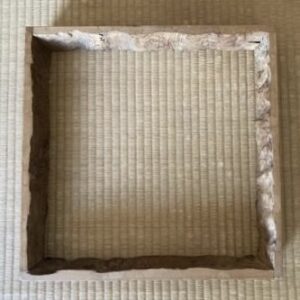
Weathered robuchi was from the horse keeper’s tea room in Go-sho, 御所, Hon.-place. 1913. Sōtan was the Chanoyu teacher of Tō-fuku-mon-in, 東福門院, East-fortune-gate-sub temple, Toku-gawa Masa-ko, 徳川和子, Virtue-river Peace-child. She was empress consort, the wife of Go-mizu-nō Ten-nō 後水尾天皇, Latter-Water-tail Heaven-emperor. The area of Sōtan’s Konnichi-an is equal to two tatami, ni-jō, 二畳, or 6 shaku square. This is identified as one tsubo, 坪, equal to 36 square feet. The room has a mukōgiri ro and mukōita.
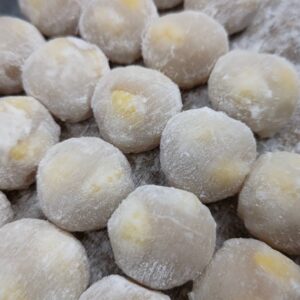
Sōtan is inextricably associated with the ginkgo tree, its leaves, and nuts. He had planted a ginkgo tree next to his Tea hut Yūin. There are several aged ginkgo trees on the Urasenke property in Kyōto. Followers refrain from eating ginkgo nuts until the Sōtan-ki ceremonies and Teas.
The principal sweet often served at Sōtan-ki memorials are ‘gin-nan mochi’, 銀杏餅, silver-apricot mochi, which are made of red bean an, 餡, puree, studded with ginkgo nuts, and wrapped in gyū-hi, 求肥, want-plump, soft, rice covering, steamed and dusted with kata-kuri-ko, 片栗粉, side-chestnut-flour, dogtooth violet bulb.The katakuriko plant, a very small violet, is a member of the dens-canis (‘tooth-dog’ after the shape of the root bulb) group and is often described as Erythronium dens-canis var. Japonicum. Because of its scarcity, potato or other starch is substituted.
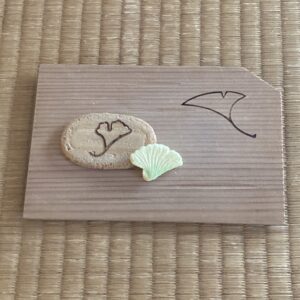
Sweets chosen for Sōtan-ki Tea at Garandō: single serving of two higashi: rakugan in the shape of a ginkgo leaf, and wheat fu-no-yaki, 麩の焼き, gluten-’s-toasted, with a branded ginkgo leaf motif, designed by Sen To-mi-ko, 千登三子, Thousand Ascend-three-child, wife of Hōunsai. Regardless of the manner in which the single serving of sweets is presented on an usu-ita, 薄板, thin-board, the rakugan is eaten first. At Urasenke, sweets are offered on small rectangular cedar usu-ita, 薄板, thin-board, that has the far right corner cut off, and branded with a ‘Sōtan’ ginkgo leaf.
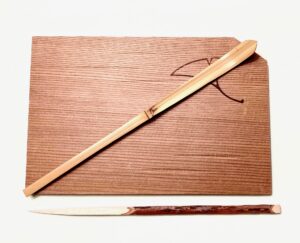
Cha-shaku, 茶杓, tea-scoop, bamboo naka-bushi, 中節, middle-node, scoop with ken-saki, 剣先, sword-point, placed diagonally on an usu-ita, 薄板, thin-board, that has the far right corner cut off. The branded icho no ha, 銀杏の葉, silver-apricot’s leaf, ginkgo leaf is a motif identified with Sōtan and Urasenke. Spicebush wood pick, kuro-mo-ji, 黒文字, black-letter-character; L. 6 sun kane-jaku.
Sweets served on the board are usually taken and eaten with a kuromoji. The presence of the chashaku on the board illustrates the connection between serving and handling sweets and handling tea. It is perhaps no coincidence that the utensils have similar sizes and forms.
Sōtan-ki Tribute: Retrospective
During Sōtan-ki events, ‘Ka-getsu’, 花月, Flower-moon, is often featured. Any number of Kagetsu styles may be presented to honor Sōtan’s legacy of wabi-cha, 侘茶, quiet-tea. The choice often features at least one of the Shichi-ji-shiki Ka-getsu, 七事式 花月, Seven-matters-rite Flower-moon, practicespresented to honor Sōtan’s legacy of wabi-cha, 侘茶, quiet-tea.
In Urasenke traditions, Kagetsu is an interactive group exercise involving five participants who draw lots from an envelope-like ori-sue, 折据, folded-set, to randomly assign roles, including preparing and partaking of tea.
Due to the swift and unpredictable shifting of roles during each round, participants must embody continuous awareness, harmonized coordination, and precise movement. There is traditional Chanoyu adage observes, ‘Kagetsu hyaku-bu, Tsuki oboro’, 花月百步月朧, Flower-moon hundred-steps Moon mist-cloud, expressing that even after engaging in Kagetsu a hundred times, the refined progression remains as veiled as a haze-shrouded moon. Across generations, grand masters further developed the foundational Hira Kagetsu, 平花月, flat-flower-moon, into intricate variations integrating seasonal floral displays, incense appreciation, and charcoal building procedures.
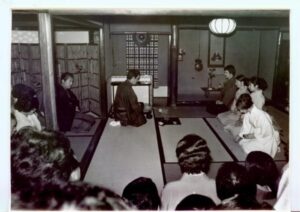
Group presenting Kagetsu during Sōtan-ki held in ‘Totsu-totsu-sai’, 咄々斎, Tsk-tsk-abstain, at Urasenke in Kyōto. Hōunsai Daisōshō (far left) presided over the preparation of making several bowls of tea by different hosts determined by small bamboo cards. Positions of the five main participants change throughout the presentation. Picture taken in 1974: preparing tea – Allan Palmer; participant near tokonoma – Mike Brown, Judith Clancy, Midorikai participant, and Janice Levine. This was the first time a group of non-Japanese people presented Tea for such a prestigious occasion at Urasenke. The participants were members of ‘Midori-kai’, みどり会, ‘Green’-group, who were studying Chanoyu at Urasenke.
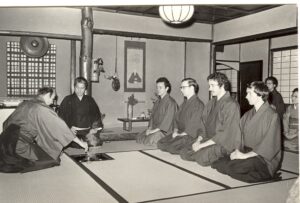
Hōunsai presiding over a presentation of Kagetsu at Sōtan-ki in Totsutotsusai at Urasenke in Kyōto. Pictured preparing tea is Michael Birch; nearest tokonoma – Allan Palmer, John Freeman, John McGee, Ronald Nado. Held in 1975, this was the first time that a group of non-Japanese men presented Chanoyu at an Urasenke memorial.
The sons of Sotan began three different ways of preparing chanoyu, which became standards: Omotesenke, Urasenke, and Mushanokōjisenke. Each in their own way was encouraged by their father. There are many differences in preparation and presentation, and yet each retains the true cha no kokoro, 茶の心, tea’s spirit. Sen Sōtan reinforced that tea preparation is not merely serving a beverage. Through his dedication and creativity, he taught his sons to treat every simple action as a mindful discipline. While the Sen schools differ in external principles of Tea preparation, they all retain the internal values of cultivating inner peace, mutual respect, and deep presence.