Omizutori
O-mizu-tori, 御水取り, Hon.-water-take, annual rite held at Ni-gatsu-dō, 二月堂, Two-month-hall, of Tō-dai-ji, 東大寺, East-great-temple, in Na-ra, 奈良, What-good. Tōdaiji was founded in Nara, Japan, by Emperor Shōmu in 738 CE and officially opened in 752 CE.
The ceremony’s official name is Shu-ni-e, 修二会, Discipline-two-gathering which includes the offering of Omizutori as one aspect of the practice. The ceremony takes place in the two weeks at the beginning of the second lunar month, which generally corresponds with the beginning of March in the solar calendar.
The event takes place as a ritual offering to Jū-ichi-men Kan-non, 十一面観音, Ten-one-face See-sound, Buddhist goddess of Mercy. In December, eleven monks are chosen to participate in the key aspect of the ceremony called Shu-ni-e, 修二会, conduct-two join, or second month service. This service is focused on the monks making amends to Juichimen Kannon as well as offering prayers for the welfare of society. The main area in which the rituals for the public is held is at the Nigatsudō, meaning the Second month hall, which refers to both the lunar month in which the ceremony occurs, as well as the location of where the deity of the elven headed Kannon is housed.
The ceremony begins for the monks long before the public is invited to participate, and while the dates vary slightly, the public offering occurs over a period of 11 days. The first public offering is the highly vibrant running of torches across the main platform of the Nigatsudō.
This first public day and night of Shuni-e and Omizutori also coincides with an event held at Jin-gu-ji, 神宮寺, Kami/Gods-shrine-temple, in Obama in Fukui Prefecture, nearly 150 km, or 93 miles away from Todaiji in Nara. This event is called O-mizui okuri, お水送, great-water- sending.
The origins of the Omizu Okuri event held at Jinguji, near the sea of Japan, is shrouded in myth. It has been said that when the great Buddha statue of Todaiji temple was completed in 752, all the gods of Japan congregated in Nara to celebrate. The deity Wakasahiko Kami, however, was preoccupied with fishing and missed out on the celebration. As a way to apologize for missing the event, it is said that he sent sacred water from the Akai Well located within Jinguji, via a mythical underground river.
Jinguji is known for its practice of Shin-butsu-shugo, 神仏習合, Shintō-Buddhism-learn-join. This is a practice of syncretism of both Shintō and Buddhist traditions. During the Omizu Okuri event, the shrine also incorporates aspects of a lesser known practice of Shu-gen-dō, 修験道, Discipline-effect, path. Shugendō is practiced by individuals called yamabushi, 山伏, mountain-prostration. The origins of this practice have been dated to the 7th century. Shugendō, too, is a syncretic religion blending Esoteric Buddhism, Shintō, Taoist, animistic, and shamanistic practices.
Following the closely guarded proceedingings inside Jigu-ji, outside the public gathers to see the temple grounds ablaze with torchlight. There are two go-ma, 護摩, Protect-polish, offerings. One goma begins before the sacred water is carried to the river. And another goma offering happens following sending the water to Tōdaiji. The goma are slightly different from the standard Buddhist practice in that they are outdoors and branches of cedar are staked to encircle the goma sticks. There is continuous chanting and praying during the goma-like fires, the water procession, and sending of the water. This also incorporates symbolic implements used to ward off evil spirits.
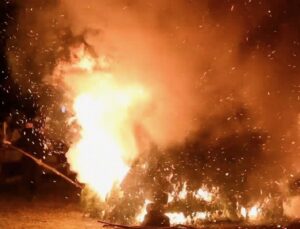
The flames are said to serve as a doorway to the spiritual world. Through the rising smoke, the prayers or sutras, whether chanted before the fire or inscribed on wooden pieces and then burned, ascend to reach the Buddha, the Shintō kami, and animistic gods.
Following the first goma fire, torches and implements needed for the ceremony are carried two kilometers to the sacred site of Unose, where the water drawn from Jinguji’s spring is poured into the churning waters of the Onyu River.
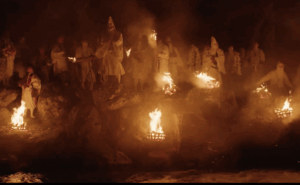
Omizu Okuri ceremony at Onyu River, Obama, Fukui Prefecture. Final prayers are offered before the water is sent to Todaiji Temple in Nara. The head priest of Jinguji acts as master of ceremonies, and is aided by a group of yamabushi.
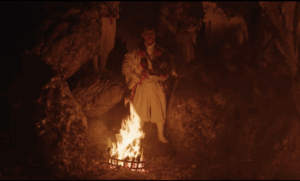
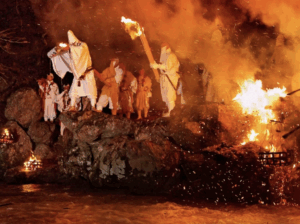
On the physical plane, the Onyu River empties into the Sea of Japan. However, in the spiritual domain, its waters traverse caverns of the liminal realm, descending to Nara’s Todaiji Temple. There, through sacred ritual, the gift of water from Jinguji will be drawn from the Wakasa Well.
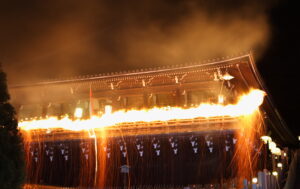
Meanwhile, at Tōdaji, the fire display from the balcony of Nigatsudō is provided for the public on the first nine nights of the ceremony. For the first nine nights there are 10 monks who carry the long flaming torches; they are joined on the final 10th night by an 11th monk. The largest display is in the early evening on the last night of the observance when fire rains down from great torches, tai-matsu, 松明, pine-bright, onto the worshippers below the veranda.
In the early hours of the following day, which is the 11th day of the observance, the sacred drawing of water from the well in front of the temple occurs. The water from this well is said to flow only once per year and the drawing up of the water is first offered to Juichimen Kannon sometime between 3am-5am, and the water is then offered to the public later in the morning.
The water that is drawn from the spring at Tōdaiji is placed into two different buckets. One bucket holds some of the water from the previous year’s observance and the other bucket is said to contain portions of the water from every ceremony that has ever been held. These ceremonies began over 1,200 years ago.
The water is then presented as an offering to the main deity of the Nigatsudō is Jū-ichi-men Kan-non, 十一面観音, Ten-one-face See-sound, Buddhist goddess of Mercy. Images of the deity inside Nigastudō are prohibited. For visual purposes another image of Juichimen Kannon from Nara can be seen below.
Many attendees see these events as a way to celebrate both purification and the start of spring. Generally the conclusion of the events at Tōdaiji roughly correspond with the vernal equinox, and in some areas they mark the very beginning of the start to cherry blossom season.
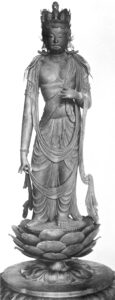
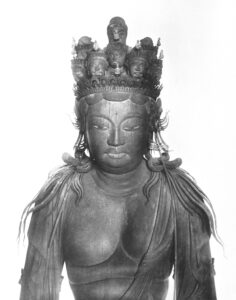
The lower ten heads represent the Ten Stages of the Bodhisattva Path which are the steps required to attain enlightenment. The 11th head, located at the very center in the highest position, represents the 11th stage of the path, Buddhahood. The head located at the uppermost point is identified as Amida Buddha. Kannon is considered an active emanation of Amida.
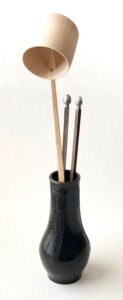
Kazari bi-shaku, 飾柄杓, handle-ladle, bamboo, kazari hi-bashi, 飾火箸, display fire-rods, copper and silver alloy, displayed in a shaku-tate, 杓立, ladle-stand, Kara-kane, 唐銅, Tang-copper, with silver gingko nut, gin-nan, 銀杏, silver-apricot, finials, Hō-un-sai, 鵬雲斎, ‘Phoenix’-cloud-abstain, XV, Iemoto, Urasenke.
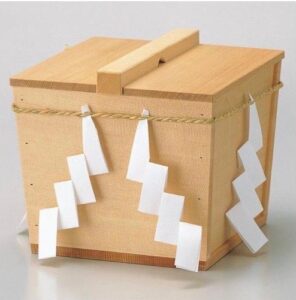
Tsurube, 釣瓶, suspend-bucket, sugi, 杉, cedar, with adornment of zigzag paper shi-de, 四手, four-hand, and straw shi-me-nawa, 注連縄, flow-along-rope, for Mei-sui Date, 名水点, Name-water Presentation. The bucket is carried from the Tea room using a hemp cha-kin, 茶巾, tea-cloth, as a rope.