Kakejiku and the Woodpecker in Chanoyu
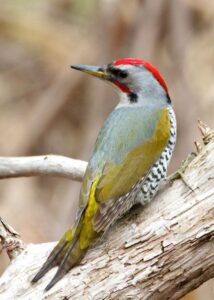
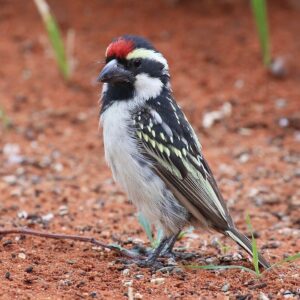
Ao-gera, 緑啄木鳥, green peck-wood-bird, Picus Awokera, endemic to Japan, can also refer to Taku-boku-chō, 啄木鳥, peck-wood-bird, woodpecker. ‘Go-shiki-dori’, 五色鳥,five-color-bird. The woodpecker has long held associations with the Buddha particularly as seen in the Jakarta Tales. Many stories exist celebrating the Buddha’s former lives when he manifested as a woodpecker. In Japanese culture and mythology, the woodpecker symbolizes protection, perseverance, and also good fortune. There is a strong connection with the five colors, as represented by both the five elements as well as the five principles that are seen in much of the underlying Buddhist and Taoist philosophies that are found in the Tearoom. There is a special connection with the kakejiku and the woodpecker as will be discussed further following an exploration of the scroll and its many parts, as well as its handling in the Tearoom.
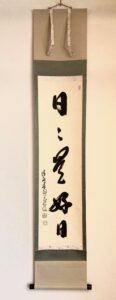
Kake-jiku, 掛軸, hang-scroll.
Hi-bi kore kō-jitsu, 日々是好日, Day-day is good-day. Buddhist read, nichi nichi kore kō nichi.
In Chinese, it can be read as ri ri shi hao ri, and jih jih shih hao jih. In Chinese, 好日, means ‘lucky day’.
Calligraphy by Ō-nishi Ryō-kei, 大西良慶, Great-west Good-delight, 1875-1983, chief priest of Kiyo-mizu-dera, 清水寺, Pure-water-temple, Kyōto.
Onishi Ryōkei was born in Nara in 1875, and died in 1983. The scroll os signed at left, Kiyo mizu dera hon zon ryō kei, with hanko, 清水寺本尊良慶, Pure water temple true lord Good-delight It is isn the style of an ichi-mon-ji, 一文字, one-letter-character, and has fū-tai, 風帯, wind strap, Kara-kusa kin-ran, 唐草金蘭, Tang-grass gold-brocade, on white cloth. Mounted on chū-mawashi, 中廻し, middle-surround – blue don-su, 緞子, damask-of. Ten-chi, 天地, heaven-earth, brown silk. Jiku, 軸, scroll, black-lacquered wood.
The expression is included in the Heki-gan-roku, 碧巌録, Blue-cliff-record. Case 6: Yun-men’s “Good Day,”
Yun-men, 雲門, Cloud-gate, giving instructions, said “I don’t ask you about before the fifteenth day; bring me a phrase about after the fifteenth day.” Yun-men himself answered instead of the monks, “Every day is a good day.” The great Chinese Zen priest, Yun-men, Cloud-gate, (864? – 949), in Japanese his name is known as Unmon.
Ōnishi Ryōkei stood as a preeminent and vibrant figure of twentieth-century Buddhism. For many years, he maintained a semi-hermitic existence within the peaks of Kyōto while presiding as the chief priest of Kiyo-mizu-dera, 清水寺, Pure-water-temple, on of the the most celebrated Buddhist temples in Japan. Each day, he traversed several miles by foot to reach the temple grounds. A man of profound scholarly and artistic skill, he was likewise known for his oratory skill. In his late eighties, he astonished his peers by taking a young bride and subsequently fathering two offspring. He remained vigorously engaged in his duties until his passing in 1983 at the age of 108—a number of profound spiritual significance within the Buddhist tradition.
Kakejiku parts identified in Japanese:
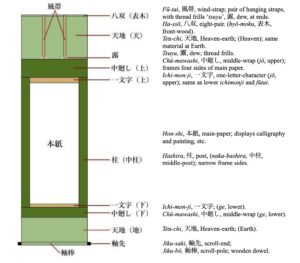
A hanging scroll, kake-jiku, 掛軸, is attached to a round dowel that is the jiku, 軸, scroll (jiku-bō, 軸棒, scroll-pole). The scroll is rolled and unrolled using the extension of the dowel called jiku-saki, 軸先, scroll-ends. The scroll hangs from a half-round wooden dowel, hyō-moku, 表木, surface-wood. It has the shape described as either han-getsu, 半月, half-moon, or ha-ssō, 八双, eight-pair. Prior to the middle Edo period, the hyōmoku was often triangular, hence, the Kanji, 八, is used for its visual form. This Kanji resembles a mountain, and/or the felicitous sue-hiro, 末広, ends-wide, symbolic of Infinity in Space. The upper area of the standard kake-jiku, is identified with heaven, ten, 天, the lowest area is identified with earth, chi, 地. Continuing with an analogy, the ‘mountain’ is above ‘heaven’. The principal dowel of the scroll is the jiku, 軸, which is necessarily round so that the scroll won’t be damaged or folded. The circular ends of the jiku/dowel are likened to the sun. In this circumstance with the sun below the moon suggests that the scroll is associated with the night.
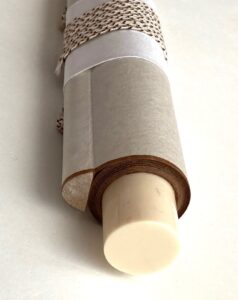
Rolled kake-jiku showing the jiku-saki, 軸先, scroll-ends. Of the countless variations of form and style, a standard jiku-saki, which is separate from the scroll’s dowel, measures 9 x 9 bu kane-jaku. The hassō is generally half the diameter of the jikubō.
Fine kakejiku ends may be made of materials such as wood coated in black or red lacquer, as well as shi-tan, 紫檀, purple/red sandalwood, Kara-ki, 唐木, Tang-wood; exotic non-Japanese wood, rosewood, ebony, blackwood, etc. Other materials include ceramic, glass, plastic, etc.
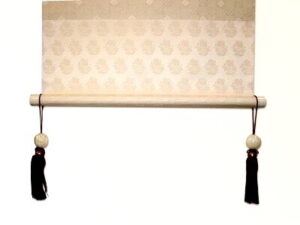
Hanging scrolls frequently have a pair of fū-chin, 風鎮, wind-weigh, hung from the scroll ends to help to secure it from the wind. However, the weight of the jiku dowel is regarded as heavy enough, and that the added fūchin can damage the scroll. This calls into question the purpose or need of the fūtai, 風, wind-straps, that are thought to frighten away birds should they get too close to the scroll.
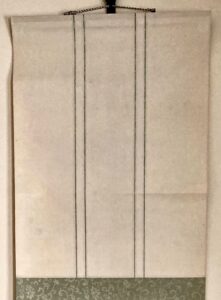
Some modest kakejiku do not have hanging pendant fūtai, but have fabric or paper strips pasted to the surface of the scroll in their stead. These are called oshi-fū-tai, 押風帯, pressed-wind-strap. Their presence emphasizes the importance of the ‘heaven’ area of the scroll being divided into three parts. There are many kakejiku that do not have divided ‘heaven’ areas. As with many topics, there are elaborate, complex aspects and classifications of hanging scrolls in Japan.
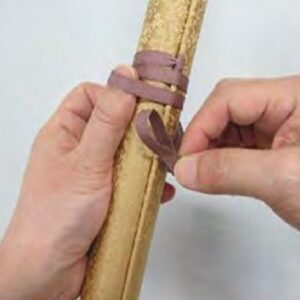
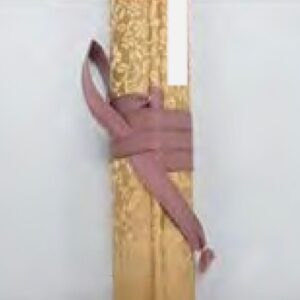
Maki-mono, 巻物, wrap-thing, hand-rolled scroll, represents the most ancient literary format in Japan. In this tradition, artistic calligraphy and paintings are mounted horizontally within a narrow, elongated structure. This style is defined by the process of unfolding the narrative from right to left, requiring the reader to rewind the preceding section to progress toward the following sequence. For some people, creating a unique bow knot is important, as a change in the way the knot was tied would indicate that the scroll had been tampered with.
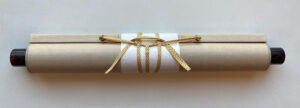
Kakejiku rolled for the ‘Jiku Kazari’, 軸荘, Scroll-presentation, of the scroll in the company of guests. The bow knot has nine individuated lines of the himo, 紐, cord, the central overlay of the cord is tucked into the form that looks like the Kanji for the number hachi, 八, eight. Kake-o, 掛緒, hang-cord, and maki-o, 巻緒, wrap-cord, are aspects of the braided cord band.
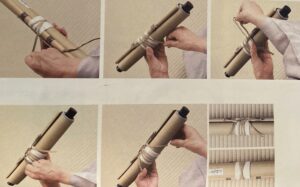
Tying the makio for a presentation of ‘Jiku Kazari’, 軸荘, scroll-adorn. This is presented with a special scroll that is unrolled and displayed in the tokonoma for a very short time, rolled up and taken from the room. Another scroll is displayed in its stead.
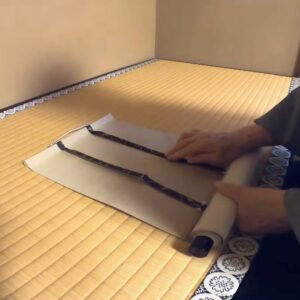
When unrolling the scroll (on the floor of the tokonoma), it is unrolled to reveal the ten, heaven section of the scroll. The fūtai are laid on the surface of the scroll. The fūtai folds are pressed with the right index finger; far right, near right, far left, near left: ‘N’.
In Buddhism, the finger of the right hand touching the ground is the mudra of gō-ma-in, 降魔印, slay-demon-seal. This was first enacted when the Buddha touched the earth showing his pre-eminence.
The gōmain is believed to have a metaphysical function of gathering wind and calming fire, to subdue internal Wind elements such as breath, distracting thoughts, and external disturbances. There may be some connection between the ‘wind’ aspect of the mudra and the ‘wind’ aspect of the fū-tai, wind strap.
A deeper meaning of fūtai, is the homonym, Fu-tai 不体, No-body, which is an important doctrine in Jō-do, 浄土, Pure-land, Buddhism. It means that salvation from the Buddha is established in the present moment rather than in death (losing one’s physical body). In this context, duality refers to the idea of dividing things into two opposing terms such as self and Buddha, delusion and enlightenment.
Of extreme importance is the teaching of ‘non-duality’, fu-ni, 不二, no-two, which transcends dualism and dualistic oppositions (such as delusion and enlightenment, life and death and nirvana) as taught throughout Buddhism.
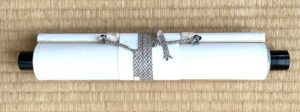
Kakejiku rolled for storage with the maki-o, 巻緒, wrap-cord, simply wound around the scroll with the end tucked under the Kake-o, 掛緒, hang-cord. The makio should wind around the scroll five times. The elaborate knot is tied for a ‘Jiku Kazari’ presentation of the scroll in the company of guests.
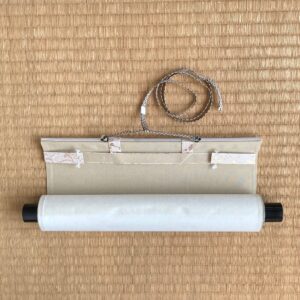
Kake-jiku, 掛軸, hang-scroll; showing the fūtai folded for storage.
The width of the scroll paper is 1 shaku kane (approximately 33cm). The number 33 is identified with Kan-non Bo-satsu, 観音菩薩, See-sound Grass-buddha.
The pair of kan, 鐶, metal rings, are placed to divide the hassō into thirds, approximately 33cm. The upper area of a kakejiku is called ten, 天, heaven, which in Buddhism is divided into thirds, the realms of Desire, Form, and Formless-ness. The width of the fū-tai, 風帯, wind-strap, is 5 bu, and the pair are placed just inside the pair of kan.
The length of the makio of the scroll pictured above is approximately 24 sun. The length of the makio depends on the girth of the rolled scroll.

Kakejiku fūtai are folded against the scroll just below the hassō. These folds when hanging down form the katakana character, ku,く, that may be identified with the Buddhist concept of Shi-ku, 四苦, Four-sufferings; the four kinds of suffering – birth, old age, disease, death. The shadow of the fūtai augments their relevance to ku.
In the philosophy of the Buddhist tradition, specifically seen within the Ten-bō-rin-kei, 転法輪経, Turn-principle-wheel Sutra, the concept of Shi-ku, 四苦, Four-sufferings; the four kinds of suffering – birth, old age, illness, and death serves as foundation for human experiences, understanding existence, and is an aspect of the First Noble Truth as espoused by the Buddha.
Shi-ka ha-kka, 四苦八苦, four-suffer eight-suffer, fūtai and their shadows. Birth, old age, illness, and death are not meant as a catalog of suffering, but serve as profound inquiries into the human condition, and the intrinsic dissatisfaction often found within temporary states.
Through the lens of interconnection and symbolism, we can observe that suffering arises from the difference between our desires and the impermanent nature of reality. Whether it is the distress of separation from the pleasant or the friction of connection with that which is unpleasant, each experience is a manifestation clinging to a particular state. This investigation reveals that shiku is a qualitative measurement of the unrest inherent in the fact that all things change. Here is an example, in poem form, by Zen Master Kobayashi Issa:
露の世は – Tsuyu no yo wa
露の世ながら – Tsuyu no yo nagara
さりながら – Sari nagara
As for the world of dew
even though it is [only] a world of dew,
and yet.
Modern Translation:
‘Dew evaporates, and all this world is dew… so dear, so refreshing, so fleeting.’
The Kanji for tsuyu, 露, dew, also can be translated as tears.
In Chanoyu, the dew on the garden path, ro-ji, 露地, dew-ground, or the steam rising from the kettle, both of which evaporate – could be seen as silent teachers. Just as dew vanishes with the emergence of the sun, the experiences within Tea can be precious and transitory. By embracing the transience of the passing moments, or the fading dew, there is the possibility of mentally transforming the inevitability of change into a profound appreciation for the brilliant clarity of the present moment.
The Zen master Dōgen Zenji, wrote that being in a human body is like being a “drop of dew on a blade of grass.” This teaching is not to encourage grief over our brief human existence, it can be seen as a visceral recognition of the transient beauty inherent in the temporary preciousness found, moment by moment, within appreciating our lives.
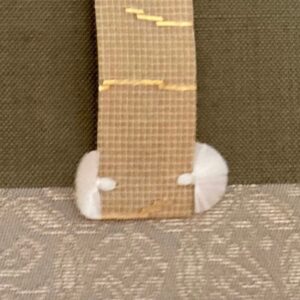
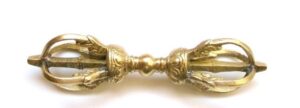
Left: fū-tai, 風帯, wind-strap, with ‘tsuyu’, 露, dew. Right: kon-gō-sho, 金剛杵, gold-strength-pestle, brass.
The white thread frills at the ends of the fūtai of the scroll are called tsuyu, 露, dew. The frills are at the bottom of the fūtai much like dew drops on the ends of blades of grass. The word dewdrop in Japanese is ro-teki, 露滴, dew-drop. A homonym for roteki is 蘆荻, reeds-rushes, (silver grass), which evokes images of approaching winter. The threads are purple if the scroll has the writing of the emperor.
The tsuyu on the scroll resemble the Buddhist weapon vajra, which in Japanese is kon-gō-sho, 金剛杵, gold-strength-pestle. The vajra is identified with the lightning bolts of Indra, king of the gods. He used them to destroy the demon Vritra, which was in the form of a maku, 幕, veil, that concealed the world. The vajra lightning bolts are seen as the red ribbons that hang in front of the veil curtain of a Tibetan thangha.
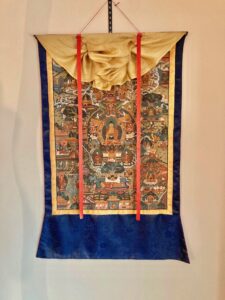
Thangka illustrating incidents in the life of the Buddha. India. In the picture above, the yellow silk veil has been lifted and secured with a string, and the two red ribbons remain hanging over the image. The hanging does not have a dowel at the bottom, so that the scroll is rolled up from the flat hassō at the top.
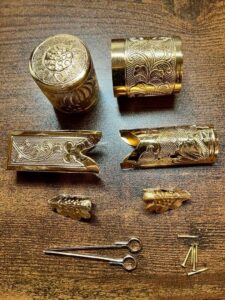
Buddhist scrolls frequently have the scroll ends covered in gilt metal called jiku-saki, 軸先, scroll-end, and kana-jiku, 金軸, gold-dowel. Many gilt components used in completing an elaborate scroll emphasize the lotus and other flower motifs.
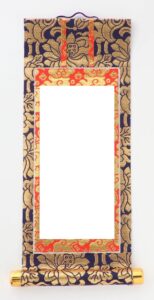
The mountings of Buddhist hanging scrolls are primarily based on the depictions of the hasu, 蓮, lotus. Kanji for lotus, hasu, ren, 蓮, is composed of kusakanmuri, 艹, grass, above ren, 連, lead. The lotus motifs are often associated with the Ryō-kai Man-da-ra, 両界曼荼羅, Both-realms Wide-weed-spread.
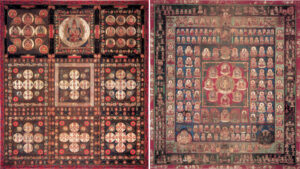
Ryō-kai Man-da-ra, 両界曼荼羅, Both-realms Wide-weed-spread, are based on the confluence of Ku-e, 九会, Nine-assembly. Left: Kon-gō-kai, 金剛界, Gold-strength-realm – square of nine squares. Right: Tai-zō-kai, 胎蔵界, Womb-treasure-realm – central lotus of eight eight petals. Both mandalas are identified with Dai-nichi Nyo-rai, 大日如来, Great-sun Like-become, the universe made manifest.
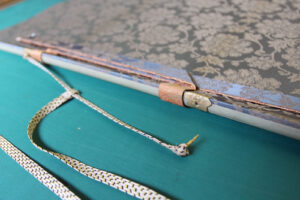
Top view of a scroll showing the kan eye-brad, makio and kakeo their relationship with the fūtai (folded) and zagane of the kakejiku.
The kakeo is the slack between kan. The full length of the makio depends on the girth of the rolled up scroll, as it should wind around the scroll a minimum of five times. The pair of kan, 鐶, eye-brad, may represent the bird’s pair of eyes. The pair of eye brads are connected by the kakeo. The makio is a separate cord that has a loop at one end that can be moved along the kakeo. Urasenke tradition, slides the makio toward ge-za, 下座, down-seat, opposite the toko-bashira, 床柱, floor-post
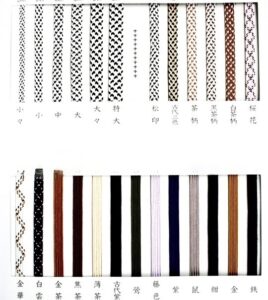
A hanging scroll utilizes a cord called a jiku-himo, 軸紐, scroll-cord. It is a flat braided ribbon that has a standard width of 2 bu kujira-jaku [weavers use kujira-jaku to make measurements]. The himo may be a solid color or, a braided pattern being a result of using two or three different colors of thread. Himo with mottled patterns are likened to the plumage of the woodpecker and are called taku-boku, 啄木, peck-wood.
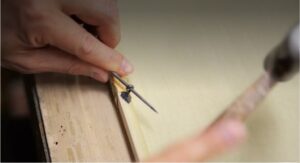
Kan, 鐶, metal ring, being hammered into the ha-ssō, 八双, eight-pair, securing the washer, za-gane, 座金, seat-gold (metal). A brad was used in early history because the screw as we know it had not been invented until the 15th century. Hammering in the kan enhances the association with the woodpecker.
A woodpecker is featured in ancient stories in the life of the Buddha. In a previous life, the Buddha was a woodpecker, named Kadiravaniya, Dwell acacia, living in a grove of hard wood acacia trees. In one story he removed a bone stuck in the throat of a lion. Later when he asked the lion for food, the lion refused him, revealing the lion’s lack of gratitude. In another story, he was visited by another woodpecker named
In a past life, Devadatta (the Buddha’s jealous cousin and nemesis) was reborn as a woodpecker named Kandagalaka. He lived comfortably eating soft insects from soft fruit and silk-cotton trees. Kandagalaka, Acacia, who lived in a soft wood grove. When visiting, Kadiravaniya shared insects he pecked from the acacia tree. Kandagalaka grew proud and believed he could forage the hard wood himself just as well as the Buddha could. On the very first peck, his bill broke, his eyes popped out, and his skull split open, killing him instantly.
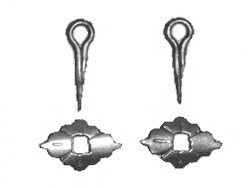
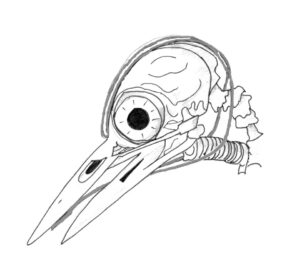
From left: a pair of ashi-zuri kan, 足摺鐶, foot-rub metal rings, eye brad, with a pair of za-gane, 座金, seat-metal, washers, in the form of hishi, 菱, diamond, hō-sō-ge, 宝相華, treasure-phase-flower (splendor), four-petal design motif. Right: drawing of woodpecker skull.
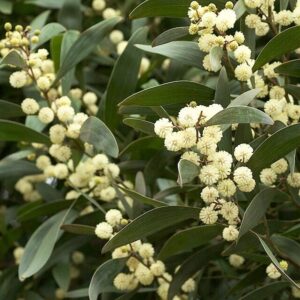
Kandagalaka’s name means ‘acacia dweller’. Khadira, acacia, (Acacia catechu or Senegalia catechu) is an ancient Ayurvedic medicinal tree widely used for its astringent and blood-purifying properties. Commonly referred to as the cutch tree, black catechu, or khair, its bark and heartwood are used to treat skin conditions, dental issues, and gastrointestinal ailments. and black acacia (Acacia melanoxylon).
Another intricate interconnection exists between woodpeckers, trees, and lightning – as after a lightning strike the damage to the tree causes an increase in insect infestation to the damaged area. The insects offer essential sustenance for birds, in particular, the woodpecker.
Trees struck by lightning are swiftly colonized by bark beetles and various insects, which find sanctuary within the weakened timber. While a severe strike might completely obliterate a tree, some strikes leave the tree standing in a process of slow healing. Should the tree endure after the lightning strike, woodpeckers frequently target these specific areas to excavate and find food within the quiet dead spots, which allows the tree to heal and return to its natural state, albeit with scarring.
The vajra, 金剛杵, kon-gō-sho, gold-strength-pestle, is identified with the celestial thunderbolt wielded by Indra, king of the gods, to destroy the demon that concealed the world. In the Buddhist tradition, it is said the Buddha took this weapon and bent the prongs inward, transforming a destructive force into a peaceful instrument. The term vajra, or diamond, alludes to an indestructible hardness and brilliant clarity. Within Shin-gon, 真言, True-word, Buddhism, it suggests the wisdom of truth that cuts through all obstacles. Primarily utilized during go-ma, 護摩, protect-burn, fire offerings, these implements frequently appear during the proceedings and there are often three of them, A single prong vajra, a three prong vajra, and five a prong vajra.
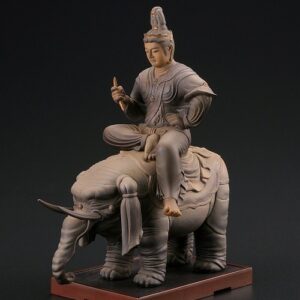
Tai-shaku-ten, 帝釈天, Emperor-explain-deva, Indra, king of the gods, is depicting holding a to-kko-sho, 独鈷杵, single-cobalt-pestal, which is the central ais of the vajra. The single axis is central to all vajra and represents both the central channel in the subtle body on a microcosmic level, as well as the central axis of Mt. Sumeru on a macrocosmic level.
The woodpecker’s rapid, rhythmic pecking echoes the striking sound of the Vajra. As recorded in the Rigveda and Mahabarata, among other tales, Indra’s celestial thunderbolt, was forged from the luminous bones of the sage Dadhichi to defeat the serpent demon, Vritra – who was determined to destroy the world. The veil that covers a thangka is identified with the curtain that was removed by Indra’s lightning bolts that are manifested in the fūtai which, for some people, can represent Indra’s Vajra lightning bolts.
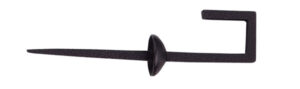
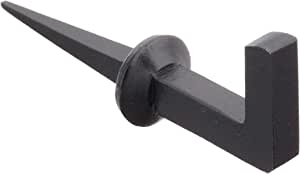
Left: jiku-kugi, 軸釘, scroll-hook, blackened steel with two angles that is driven vertically into the wooden beam at the center of the back wall of the tokonoma. Right: hana-ori-kugi, 花折釘, flower-fold-hook, blackened steel with one angle, that is driven into the trunk of wooden toko-bashira, 床柱, floor-post. The form of both hooks may suggest the lightning bolts of Indra, and the pointed nail being emblematic of the woodpecker’s bill, especially in that the nail is stuck in wood.
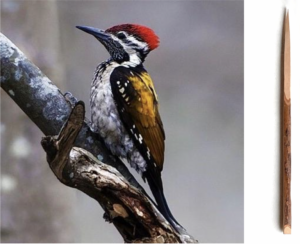
Left: woodpecker. Right: kuro-mo-ji, 黒文字, black-letter-character, black spicebush, Lindera umbellata Thunberg. ‘Kuromoji’ is also written with the Kanji, 烏樟, crow-camphor. Kuro-mo-ji, 黒文字, black-letter-character, black spicebush, Lindera umbellata Thunberg. ‘Kuromoji’ is also written with the Kanji, 烏樟, crow-camphor.
Of the eighteen possessions a Buddhist monk must have is first the yō-ji, 柳枝, willow-branch, toothpick. It is essential as it removes unwanted material from the mouth, which is sometimes connected to the Buddhist tale of the lion with a bone caught in its mouth that was extracted by the woodpecker. Kuromoji may be likened to a toothpick of sorts, or also as a singular aspect similar to the beak of a woodpecker, as it is used to retrieve food.
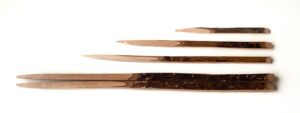
Kuromoji may be likened to a toothpick of sorts, though it is never used for that purpose. A kuromoji may also be seen as a singular form which is similar to the beak of a woodpecker as it is used to retrieve food.
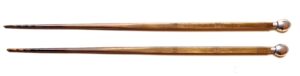
Hi-bashi, 火箸, fire-rods. Kazari hi-bashi, 飾り火箸, display fire-rods, with gin-nan, 銀杏, silver-apricot, gingko nut ‘heads’; choice of Hō-un-sai, 鵬雲斎, Phoenix-cloud-abstain. A pair of hi-bashi, 火箸, fire-rods, pick up and move pieces of sumi, 炭, charcoal, made from a kind of oak, kunugi, 椚. The action of using hibashi is likened to a bird feeding its young.
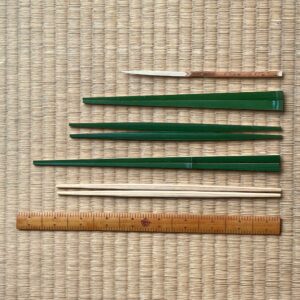
Hashi, 箸, rods: ao-dake, 青竹, green-bamboo, sugi, 杉, cedar; with ruler; kane-jaku, 曲尺, bend-span.
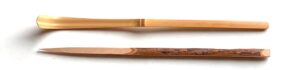
The woodpecker makes holes in tree trunks and branches, to get insects to eat. In Chanoyu, there are utensils that do similar functions. Among these, the most likely is the kuromoji pick to cut and spear sweets. In a similar manner, the cha-shaku, 茶杓, tea-scoop, measures matcha from a cha-ki, 茶器, tea-container, and transfers it to a cha-wan, 茶碗, tea-bowl.
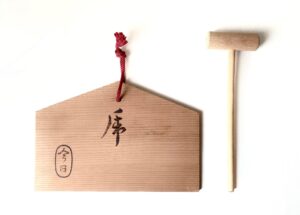
‘Ban-gi’, 板木, board-wood; cedar board with slanted top resembling an e-ma, 絵馬, picture-horse, with branded old cursive style Kanji for tora, 虎, tiger, and a sign of Kon-nichi, 今日, This-day, for Urasenke. It has a hole for a cord to hang the board. T-shaped ki–zuchi, 木槌, wood-mallet, L. 8, head L. 2.5, diameter .8 sun kane. Borrowed from Buddhism, the bangi outside an entrance is struck just one time by an arriving visitor. The single strike alerts the host of the arrival of a guest. The sound is the first thing at the start of a Chaji. One might think of the sound of the strike of a woodpecker, taku-boku, 啄木, peck-wood, in the forest.
For further study, see also: Kakejiku: Three Forms and Tokonoma and Imae