Incense and Chanoyu
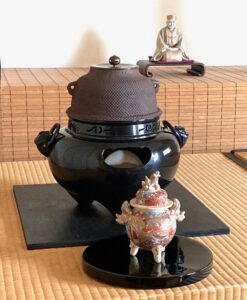
Ki-men bu-ro, 鬼面風炉, Demon-face wind-hearth, with loose rings, bronze, with kama, 釜, kettle, iron, and a ceramic kō-ro, 香合, incense-hearth, elaborately decorated ceramic, with dragon motif handles and lid knob, Satsu-ma–yaki, 薩摩焼, Salvation-polish-fired, Kyūshū. The kama has taken the place of the lid of the kōro which is usually perforated to allow the fragrance and smoke to be released. The furo can be seen primarily as a large incense burner that likely came from a Buddhist temple.
Incense, o-kō, お香, hon.-incense, has been greatly appreciated in Japan since ancient times. Dedication and practice is called Kō-dō, 香道, Incense-way. According to custom, one does not ‘smell’ incense, but ‘listens’ to it, which is called kō wo kiku, 香を聞く, incense to listen, and mon-kō, 聞香, listen-incense. There is, in Japanese, a profound wordplay on ‘kiku’, which means both listen, 聞, and chrysanthemum, 菊.
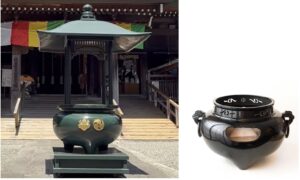
Left: jō-gō-ro, 常香炉, usual-incense-burner, located at Gu-myō-ji, 弘明寺, Increase-light-temple, in Yokohama. Right: Ki-men-bu-ro, 鬼面風炉, Demon-face-wind-hearth; Kara-kane, 唐銅, Tang-copper, bronze, with kama, 釜, kettle, tetsu, 鉄, iron, with futa, 蓋, lid, and tsumami, 摘み, pinch, knob. When looking at the furo relative to the jōgōro, it is as though the emblems of the temple, paulownia and triple comma crests were cut out leaving an opening that would become the hi-mado, 火窓, fire-window, of a furo.
There is a long history of the use of kō, 香, incense in Japan. It is said in the Ni-hon Shō-ki, 日本書紀, Japan-book-write-cronicle, that the first instance of fragrant wood was discovered over 1,400 years ago, in 595AD, during the reign of Empress Sui-koTen-nō, 推古天皇, Support-old Heaven-empress. It is reported that a piece of fragrant agarwood washed up on the shore in Awa-ji, 淡路, Fleeting-path, and was then presented to Empress Suiko and Prince Shō-toku Tai-shi, 聖徳太子, Holy-virtue Big-of. Prince Shōtoku is credited with knowing of offering incense as an aspect of Buddhist practice, which also arrived to Japan from China during Empress Suiko’s administration. At that time incense was primarily used as purification and offerings at Buddhist temples.
During the Heian period, incense was adopted by nobility and aristocrats for personal use in scenting letters and clothing. This became well known throughout Japanese culture through the Tale of Genji in which specific scents were used to define emotion, personas, romance, and character. In the Kamakura and Muromachi Periods, incense was used by samurai for similar purposes, applying it to armor and helmets. It was during this time that the art of kō-dō,香道, incense-way, was developed. This practice became an art form of both appreciating and identifying various ingredients that were blended together to create kō.
In the Edo period the appreciation of incense evolved further into what is known as Gen-ji-kō, 源氏香, Source-clan-incense. In the refined practice of Genji-kō, 54, or alternatively, 52, specific, geometric patterns called Gen-ji Kō no Zu, 源氏香の図, Origin-clan Incense ’s Pictures, are used to represent combinations of scents. These patterns correspond with specific chapters from the Tale of Genji. The patterns are known as the Gen-ji-ko-no-zu, and have become renowned as the Gen-ji-mon, 源氏紋, Source-clan-crest, and are seen in many aspects of ceramics, lacquerware, and other utensils used in Tea presentations.
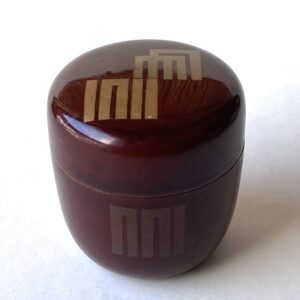
Chū-natsume, 中棗, middle-jujube, maroon-lacquered, covered tea container with various motifs of Genji Kō no Zu, 源氏香の図, Genji incense’s designs. The motif on the front of the container is identified with the Matsukaze chapter of the Genji Monogatari. There are 54 total rectilinear emblems representing chapters of The Tale of Genji and are based on Heian-period incense practices. The Gen-ji mon motifs are all used as an aspect of incense appreciation and ‘listening’.
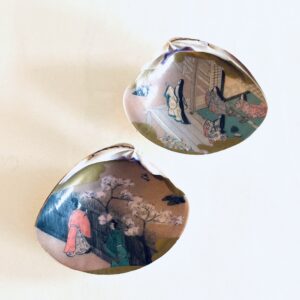
Kō-gō, 香合, incense-gather, natural hamaguri, 蛤, clam, shell with printed images of a scene in chapter, Waka Murasaki, 若紫, Young Purple, of the Genji Mono-gatari, 源氏物語, Origin-clan Thing-narrate, when Genji sees for the first time, the child Murasaki. This style of hamaguri kōgō is of particular note in that it can be used during a Tea presentation to contain incense for either the fu-ro, 風炉, wind-hearth, and the ro, 炉, hearth, sunken in the floor of the Tearoom. Sets of clamshells were part of a wedding trouseau, and were part of a matching contest called kai-awase, 貝合わせ, shell-gather.
In Chanoyu, there is the critically important Ri-kyū Hyaku-shu, 利休百首, Rich-quit Hundred-head, one hundred poems on the nature, procedures, and utensils written by Sen no Rikyū. Several of these are on the subject of building the charcoal fire and incense for both furo and ro.
風炉の時炭斗菜籠にかね火箸ぬり香合に白檀をたけ
Fu-ro no toki sumi-tori sai-ro kane hi-bashi nuri kō-gō ni byaku-dan wo take
Wind-hearth ’s time charcoal-measure vegetable-basket metal fire-rods lacquered incense-gather in white-sandalwood to burn.
炉のうちは炭斗ふくべ柄の火箸陶器香合ねり香と知れ
Ro sumi-tori fukube e no hi-bashi tō-ki kō-gō neri-kō to shire
Hearth charcoal-measure gourd handled-fire-rods ceramic-container incense-gather knead-incense know.
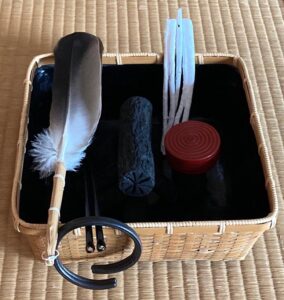
Left: sumi-tori, 炭斗, charcoal-measure, sai-rō, 菜籠, vegetable-basket, for fu-ro, 風炉, wind-hearth. Right wing ha-bōki, 羽箒, feather-brush.
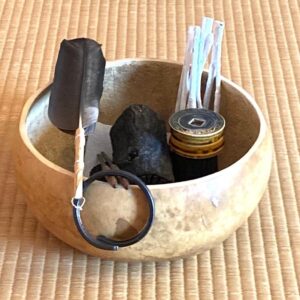
Right: sumi-tori, 炭斗, charcoal-measure, fukube, 瓢, gourd, for ro, 炉, hearth. Left wing ha-bōki, 羽箒, feather-brush.
The cha-dō-gu, 茶道具, tea-way-tools, in both sumi-tori, 炭斗, charcoal-measure, are sumi, 炭, charcoal, ha-bōki,羽箒, feather-brush, hi-bashi, 火箸, fire-rods, a pair of kan, 鐶, metal rings, kō-gō, 香合, incense-gather.
In Chanoyu, especially during a formal gathering during both furo and ro season, the host sets three shitabi into the ash bed before the formal charcoal procedure, and a small piece of incense is added when the shitabi are placed.
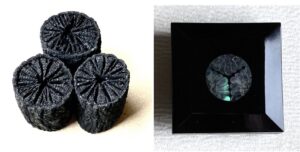
Left: three pieces of charcoal comprise the shita-bi, 下火, down-fire, for the fire in the portable fu-ro, 風炉, wind-hearth, and the ro, 炉, hearth, sunken in the floor of the Tearoom. The firing of the charcoal, which is a kind of oak called kunugi, 椚, creates fissures in the wood grain that are likened to the chrysanthemum; kiku-zumi, 菊炭, chrysanthemum-charcoal. When burned, this charcoal has no discernible fragrance that interferes with the fragrance of the incense.
Right: kō-gō, 香合, incense-gather, square, black-lacquered, covered box with an inlaid mother-of-pearl design of mitsu wari-giku, 三割菊, three divide-chrysanthemum. This motif is a familiar ka–mon, 家紋, family-crest.
With both the charcoal and the possible presence of a chrysanthemum design on a kōgō, there is the suggestion of word play on the sound of the word ‘kiku’ which means both chrysanthemum,菊, and listen, 聞. For many, this emphasizes the import role of the presence of incense in the Tearoom.
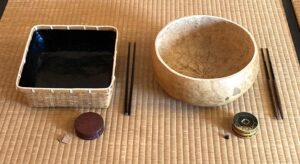
During the presentation of building a charcoal fire in the furo, two pieces of byakudan are put into the fire, leaving one piece in the wooden, and possibly lacquered, container for the guests to see. Incense that is used with the ro is a called neri-kō, 練香, knead-incense, which is a blend of aromatics and charcoal dust. According to Rikyū, nerikō is put into a small, ceramic, covered container. Ceramic is used, because the nerikō is slightly damp. When building the charcoal fire in the presence of the guests, a small piece of nerikō is put in the kōgō, and subsequently is put into the fire. The ceramic kōgō is empty when given to the guests to examine.
It should be remembered that with nearly all general characteristics of utensils, there are exceptions. Variations of the kōgō include seashell, metal, etc. An exceptional kōgō may have an accompanying tray, bon, 盆. There are various ways in which the kōgō is handled depending on its form, provenance, and age.
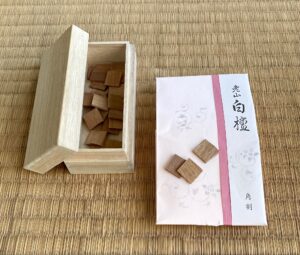
Byaku-dan, 白檀, white-sandalwood. Pieces of byakudan used in Chanoyu are approximately 5 bu kane-jaku square, and are kept in a small wooden box in the mizu-ya, 水屋, water-house, or with commercial paper kō-tsutsumi, 香包, incense-wrapper. Byakudan is used with fu-ro, 風炉, wind-hearth, according to the tradition of Sen no Rikyū, and three pieces are held in a covered lacquered container.
Sandalwood is mentioned in various sutras, and in some Buddhist traditions, sandalwood is considered to be of the padma, lotus group and attributed to A-mi-da Nyo-rai, 阿弥陀如来, Praise-increase-steep Like-become, Sandalwood scent is believed by some to transform one’s desires and maintain a person’s alertness while in meditation. It is also one of the most popular scents used when offering incense to the Buddha.
The furo was one of the original means of heating water for tea, and byaku-dan, 白檀, white-sandalwood was the preferred incense, having a long-time presence in Buddhist and other offerings. Byakudan/sandalwood is closely associated with Buddhism. The body of the Buddha had the scent of sandalwood. After the Buddha’s death, the fuel for his cremation fire was sandalwood. The Kanji dan, 檀, sandalwood, is composed of moku, 木, tree, and tan, 亶, truly, which is also part of the Kanji for dan, 壇, altar, which implies that it has been sacred from an early stage in the development and practice of teachings from the Buddha as well as the progression of Zen Buddhist practice.
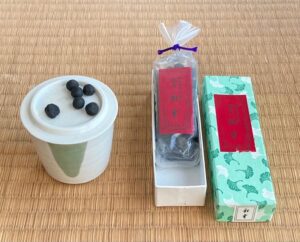
Neri-kō, 練香, kneaded-incense, is a blend of aromatics and charcoal dust held together with honey. The dense paste is formed into small balls approximately 2 bu kujira-jaku. This method is typical of traditional Asian medicines. As it is a blend of ingredients, fragrances differ greatly, and poetic names are given to specific blends. According to Sen no Rikyū, nerikō is used with the ro, 炉, (sunken) hearth. When building the charcoal fire in the presence of the guests, a piece of nerikō is held in a ceramic container. Nerikō is formed into a shi-men-tai, 四面体, four-side-body, tetrahedron, that measures .24 bu kujira-jaku. Because it is wet, nerikō should be kept in an air-tight container. Nerikō is available widely, and is sold in various kinds of containers: pictured are a bag with neriko in a box and a ceramic, covered jar.
In many ancient and current practices of the Taoist and Buddhist philosophies that have influenced the study and practice of Chanoyu, the ceramic jar is featured prominently as a container for beneficial plant ingredients many of which are closely associated with both purification, healing, and the ‘Elixir of Immortality’.
Depending on the type of wood or blended plant ingredients, the medicine of incense may positively influence the functions of the mind and memory, the respiratory system, heart, and circulation, as well as help generate emotional equilibrium and benefit the internal metabolization of thoughts, memories, and prayers. Throughout history, healers observed the efficacy of plant smoke as a therapy, incorporating incense into profound systems of natural medicine and healing.
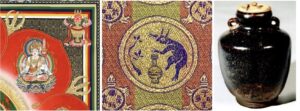
Left: detail of Dai-nichi, 大日, Great-sun, at the center top square of the Tai-zō-kai Man-da-ra, 胎蔵界曼荼羅, Womb-keep-world Wide-weed-spread, showing the proximity of the Bosatsu (pictured is an image of Fu-gen Bo-satsu, 普賢菩薩, Universal-wisdom Grass-buddha), and one of the four hō-byō, 宝瓶, treasure-bottle vessels of sacred water, and adorned with flowers in each corner. The vessel depicted in the mandara is one of the eight sacred symbols in Buddhism.
Middle: detail from a fabric inspired by the ancient Tai-ma Man-da-ra, 当麻曼荼羅, Right-hemp Wide-weed-spread; the form of the usu, 臼, mortar, a bottle containing the elixir of immortality which is similar to the urns in the Taizōkai Mandara.
Right: ceramic cha-ire, 茶入, tea-receptacle, mimi-tsuki, 耳付き, ears-attached, with mottled brown glaze, Se-to–yaki, 瀬戸焼, Rapids-door-fired; H. 3.2 sun kane-jaku. The chaire is a container for powdered koi-cha, 濃茶, thick-tea, which is symbolic of various Elixirs of Life: Vedic soma, Hindu amrita, Buddhist kan-ro, 甘露, sweet-dew, Taoist jin-dan, 金丹, gold-elixir (cinnabar), etc.
While jars often can contain ingredients used in creating blended incense, in the Tearoom incense is generally contained in the kōgō generally made of ceramic during the ro season and woods during the furo season. An exception to this is during a more formal presentation of incense appreciation.
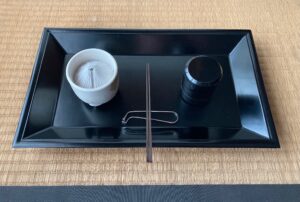
Kō-bon, 香盆, incense-tray; black-lacquered wooden tray with slanted gallery; 12 x 7 sun kane-jaku. Kiki-gō-ro, 聞き香炉, listen-incense-hearth; white glazed ceramic cup with three feet, and scattered gold flecks, with the Kanji, ten, 典, to celebrate the 10th anniversary of the founding of a New England group practicing the Way of Incense, by Makoto Ya-be, 誠矢部, Truth Arrow-guild, Boxford, Mass.; H. 2.2 sun kane-jaku. Kasane kō-gō, 重香合, tiered incense-gather; black-lacquered three-tiered wooden stacked containers; H. 1.8 sun kujira-jaku. Kō-bashi, 香箸, incense-sticks; blackened bamboo sticks; L. 6 sun kane-jaku; gin-yō basami, 銀葉挟, silver-leaf clamp, silver tongs, L. 3 sun kane-jaku.
Kōbon may be presented in the Tearoom, or anywhere, at almost any time or for any reason. Just for pleasure. In the realm of Chanoyu, Tea masters have created procedures that include various aspects of Japanese culture, including arranging flowers, and different ways of preparing tea. Incense plays a role in some of these occasions. This would be one of those moments when kōbon would be presented. Rikyū felt that a rainy day was an ideal time for Tea, however, rather than leaving the Tearoom for the naka-dachi, 中立, middle-standing, when it is raining, guests might stay in the Tearoom and arrange flowers for the tea and present kōbon.
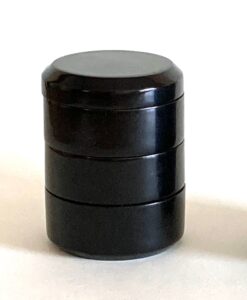
Black-lacquered kasane kō-gō, 重香合, stack incense-gather; composed of three tiered containers, and lid. Used in the presentation of incense appreciation, kō-dō, 香道, incense-way. In Japan, incense is ‘listened to’ rather than smelled, which is called mon-kō, 聞香, listen-incense.
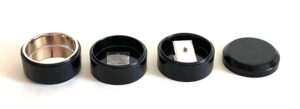
Kasane kō-gō, 重香合, stack incense-gather un-stacked; from left: the bottom tier with metal liner for burnt incense and used gin-yō, 銀葉, silver-leaf; second tier with a sheet of un-mo, 雲母, cloud-mother, mica, edged in silver gin-yō, 銀葉, silver-leaf; top tier with a small piece of kō-moku, 香木, incense-wood, and paper kō-tsutsumi, 香包, incense-wrapper; lid.
The kasane kōgō contains all that is needed to prepare a kōro for incense appreciation. Regardless of whether the incense being offered is wood or if it is blended, the piece of incense that is heated is always wrapped in a kōtsutsumi. While the koro with burning charcoal within an ash bed is always prepared in the mizuya prior to the kōbon being brought into the tea room, the mica plate and the incense are placed within the presence of the guests. Depending on the circumstance of the gathering, either the host or a guest may prepare the final presentation of the kōro.
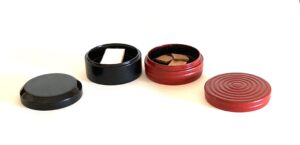
Left: top tier and lid of kasane kō-gō, 重香合, stack incense-gather; Right: kō-gō, 香合, incense-gather. Lids removed showing paper wrapper, kō-tsutsumi, 高包, incense-wrapper, for small pieces of kō-boku, 香木, incense-wood, in kasane kōgō, and three pieces of byaku-dan, 白檀, white-sandalwood, in the red kōgō. Two of the pieces of byakudan are placed in the charcoal fire of the furo. The shu-nuri, 朱塗, cinnabar-lacquered kōgō is carved with nine and five concentric rings. This kōgō was made for use in Buddhist temples to hold crumbled pieces of aromatic woods for offerings. This style of kōgō tends to be available in many sizes to suit the particular offering style of a Buddhist temple.
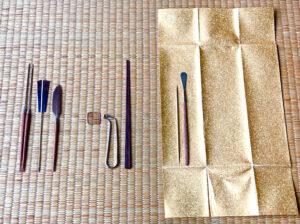
Kō-dō-gu, 香道具, incense-way-tools. From left: hi-bashi, 火箸, fire-rods; hai-osae, 灰押, ash-press; ha-bōki, 羽箒, feather-brush; gin-yō, 銀葉, silver-leaf, gin-yō basami, 銀葉鋏, silver-leaf scissor; kō-bashi, 香箸, incense-rods, gilded-paper tato-gami, 畳紙, fold-paper, with steel uguisu, 鶯, bush warbler, spike; kō-saji, 香匙, incense-spoon. The wooden handles are made of kuwa, 桑, paper mulberry, wood.
Most of the above tools are only used in the mizuya, with the exception of the ginyō, which is placed in the kasane kōgō, and the kōbashi and and ginyō basami, which are placed on the kōbon prior to the tray being brought into the Tearoom.
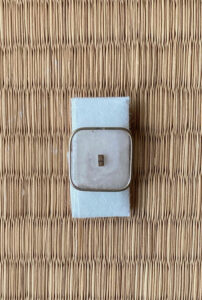
The picture at right is of a tiny piece of incense wood placed on a ginyō, mica sheet, set on a folded pieced of paper kō-tsutsumi, 香包, incense-wrap. The wrapper can be made of a sheet of kai-shi, 懐紙, heart-paper. The large paper folder, just as the very small incense paper folder, is composed of nine ‘squares’ implying Infinity in Space. The pictured piece of incense is kyara, 伽羅, attend-spread, a very special kind of jin-kō, 沈香, submerged-incense.
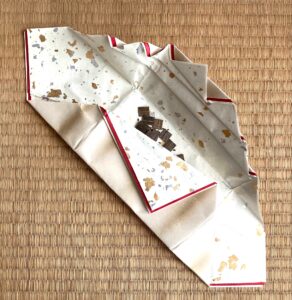
Pieces of jin-kō, 沈香, submerged-incense, in an elaborate multi-layered kō-tsutsumi, 香包, incense-wrap. Jinkō wood is cut into squares just as with byaku-dan, 白檀, white-sandalwood, approximately 5 bu kane-jaku. Generically called agarwood, it is rarely ‘burned’ in the furo in the Tearoom, but is part of a procedure of incense presentation called kō-bon, 香盆, incense-tray. The illustrated squares of wood would be cut into tiny pieces, about the size of a half-grain of rice. The incense is not actually burned, but heated on a sheet of mica placed over a piece of burning charcoal in an incense burner. This type of exotic fragrant wood, which is closely associated with Buddhism, can be exceedingly expensive, and is becoming more difficult to obtain. There are several kinds of jinkō called by names that often indicate their geographical origin. The most celebrated jinkō is called kyara, 伽羅, attend-spread.
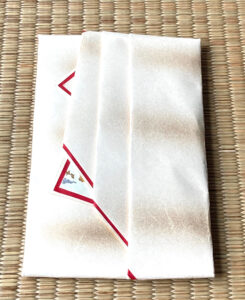
Paper envelope for incense: three sheets of paper folded eleven times: unfolded 8.8 x 7.8 sun kane-jaku. The number 11 is identified with the Jū-ichi-men Kan-non, 十一面観音, Ten-one-face Grass-buddha.
Jū-ichi-men Kan-non, 十一面観音, could also be translated as Eleven-face-perceiver-of-sounds, and is a Japanese bo-satsu, 菩薩, of compassion, widely worshipped in Mahayana and Esoteric Buddhism to protect, heal, and relieve suffering. Representing one of the thirty-three aspects of the deity known in Sanskrit as Avalokiteshvara, this deity is characterized by eleven small heads atop their own, representing advanced stages of enlightenment, ultimate wisdom, and watchful care and listening over all directions.
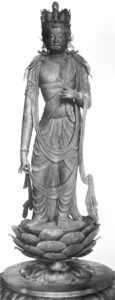
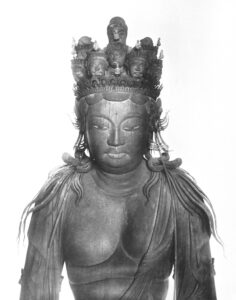
Juichimen Kannon from Ho-kke-ji, 法華寺, Method-splendor-temple, Nara, Japan. Said to be carved of a single block of kaya, 榧, Japanese nutmeg tree (Torreya nucifera). Nutmeg is both a single wood, and a common ingredient in nerikō that is used in incense appreciation.
The lower ten heads can also represent the Ten Stages of the Bodhisattva Path, which are the steps required to attain enlightenment. The 11th head, located at the very center in the highest position, represents the 11th stage of the path, Buddhahood. The head located at the uppermost point is identified as Amida Buddha. Kannon is considered an active emanation of Amida.
The Sino-Japanese term Kan-non, 観音, See-sound, can also be translated as watchful listening, and is often interpreted as ‘The One Who Sees and Hears All’. This is the task of the compassionate Kan-non, to witness and ‘listen’ to the prayers and cries of those in difficulty in the earthly realm, and to help them achieve salvation. Another Japanese name for Kannon is Kan-ze-on, 観世音, the One Who Constantly Surveys, 観, kan, the World, 世, ze, listening for the sounds, 音, on, (of suffering). Over time the name has been shortened to Kannon.
The eleven folds of the paper used to hold precious aromatic woods for incense appreciation (pictured above) may hold significance for those who associate ‘listening to’ incense with Kannon Bodhisattva who also ‘listens’ with compassion and wisdom to the essences of the prayers and experiences of sentient beings throughout the world.
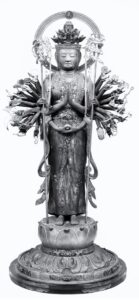
Senju Kannon from the extraordinary temple of San-jū-san-gen-dō, 三十三間堂, Three-ten-three interval way. The statue is carved from hinoki, 檜, Japanese cypress. As the name suggests, Sanjūsangendō is known to be representative of the 33 manifestations of Kannon.
Many older statues and buildings throughout Japan were made of cypress and the wood is highly valued for its durability. Hinoki is also a celebrated fragrance known for its crisp, woody, and citrus-like scent. This aroma is often identified with the atmosphere of traditional Buddhist temples and o-furo, お風呂, hon.-wind-hearth (soaking baths). Characterized by its calming and purifying properties, hinoki is used to foster an alert mind, and reduce stress. It can also bring the experience of shin-rin-yoku, 森林浴, forest-woods-bath, indoors – allowing those who appreciate its scent to mindfully rest in a natural state.
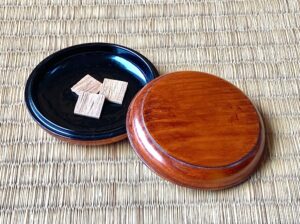
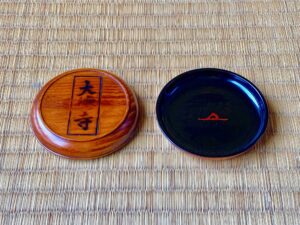
Kara-hitsu Kō-gō, 唐櫃香合, Tang-coffer Incense-gather; round, clear-lacquered wooden container, with black-lacquered interior; diam. 2.5 sun kane, made by Mae-hata Shun-sai, 前端春斎, Before-edge Spring-abstain, II. Inverted lid with the red lacquer ka-o, 花押, flower-seal, of the Kan-chō, 管長, Control-long, chief abbot, Na-kumo Rō-shi, 看雲老師, Watch over-cloud Old-master, of Daitokuji.
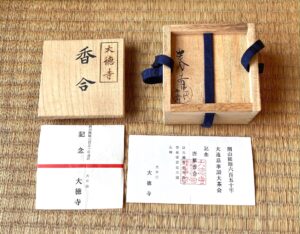
The kōgō was made for the 650th anniversary of the founding of Daitokuji by Dai-tō Koku-shi, 大燈国師, Great-lamp Country-master, in 1315 – 1319? Made of wood from the original structure of the San-mon, 三門, Three-gate, of Daitokuji, that was unused in its major reconstruction and restoration in 1971. The kōgō is made of the recycled cypress wood of the original structure, and honors the sacred qualities embraced by Zen Buddhist philosophy.
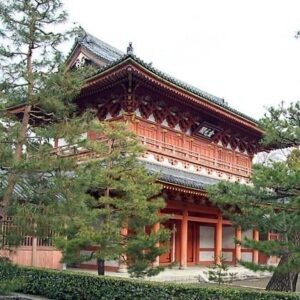
The first floor of the great three entrance gate at Daitokuji was completed in 1529, and in 1589, Sen no Rikyū made a major change. The upper story was designed and commissioned by Rikyū for his father’s 17th memorial. The second story is named, Kin-mo-kaku, 金毛閣, Gold-hair-pavilion; the Buddha is said to have had golden hair. Within this worship hall are the statues of Rikyū and sixteen Ra-kan, 落款, Spread-China, Buddhist arhats, disciples of the Buddha.
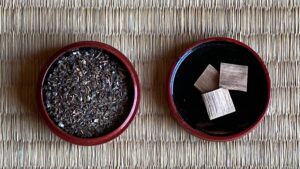
Because Buddhist images were carved from the timber of precious woods, both the statue and the wood from which it is carved are considered sacred – so much so that the chips and sawdust that is created in the rendering of an image are saved and put into containers on altars, offered to deities, and appreciated by incense ‘listening’ in formal settings including the Tearoom.