Horse Tale in Tea
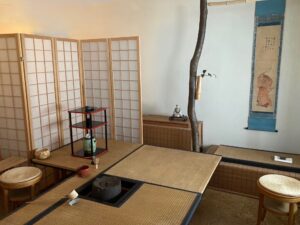
Ga-ran-dō, 伽蘭洞, Help-orchid-cave, with utensils for the beginning of the Uma-doshi, 午年, Horse-year, 2026. January first, as it corresponds to the ‘old’ lunar calendar, is the 12th day of the 11th lunar month. The Gan-jitsu, 元日, Origin-day, of lunar New Year is February 17th.
After Bodhidharma’s death, his body was embalmed and placed in a coffin according to Buddhist rituals. In the 12th month of the lunar calendar, he was solemnly reburied on Mount Xiong’er, and a stupa was built in his memory at Dinglin Temple in Shanxian County, Henan Province.
This is one of the reasons why the hanging scroll with its image of Daruma tokonoma, kake-jiku, 掛軸, hang-thing, is displayed.
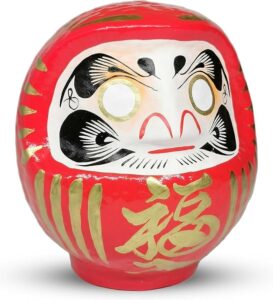
Daruma nin-gyō, だるま人形, Daruma person-form, made of papier-mâché, with a concealed weight that causes it to always end upright. The Kanji fuku-iri, 福入, fortune-enter, is written in gold on his body. His eyebrows represent tsuru, 鶴, cranes, which live a thousand years, and his moustache represent kame, 亀, turtles, which live ten thousand years. Hence the Daruma doll is present at happy times.
The customary year-end Daruma Ichi, だるま市, Daruma-market, held at En-mei-ji, 延命寺, Prolong-destiny-temple, on December 28. Hari-bote, 張りぼて, stretch-form; papier-mâché dolls in the stylized form of Daruma are sold in a wide range of sizes. The dolls are taken home, and with prayers for a new year in good health and safety for everyone, and with a goal in mind, the doll’s left eye is painted in. When the goal is achieved his right eye is painted, with gratitude. Un-painted eyes indicate the eyelid is closed, before enlightenment, with open-eyedness.
The doll is customarily returned to the temple or shrine on February 3rd, the following year, and burned in a sacred fire: Daruma ku-yō, だるま供養, Daruma offer-service. This is concurrent with Setsu-bun, 節分, Season-divide, the last day of winter. Daru-ma Ku-yō, 達磨供養, Attain-polish Offer-nurture, memorial, is an annual event held on Setsubun when Daruma dolls are burned at Buddhist temples, in thanks for blessings. Burning the Daruma dolls may be likened with realization of one’s intention, which in turn can be associated with the Realization, or Nirvana, and subsequent cremation of the Buddha.
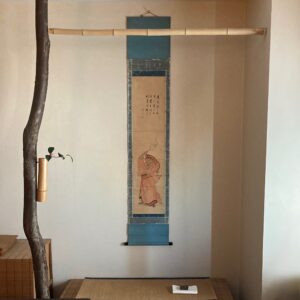
Figure of Daru-ma, 達磨, Attain-polish, standing and waving a whisk, ho-ssu, 拂子, rid-of. He is depicted smiling and wearing a full-length red robe that partially covers his head. The white hair whisk is held aloft. It is unusual to depict Daruma in action, whereas he is usually shown seated and contemplative.
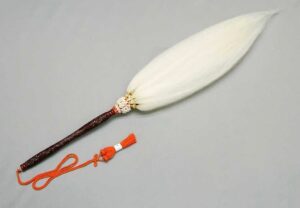
The ho-ssu, 拂子, whisk-of, is a fly whisk with a wood handle and the long tail hair usually the hair of a horse, though sometimes hossu are also crafted of cow, yak, etc, to shoo away insects and other pests without injuring them. It is an emblem of a Buddhist priest or monk of high rank. It is symbolic of ridding one’s mind of bothersome thoughts and ideas. Daruma is acting as would one of the vengeful Buddhist deities called Dharmapala, Daru-ma-ha-ra-ō, 達磨波羅王, who defend and guard Buddhist followers from danger and enemies. The Kanji for Ha-ra-mitsu, 波羅蜜, Wave-spread-secret, pāramitā; perfection; is equated with perfection of Buddhist practices or attaining enlightenment. Omotesenke displays a hossu for certain Tea occasions.
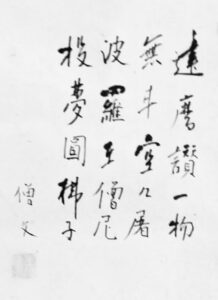
Calligraphy begins in the upper right quarter. Text: vertical lines from upper right.
Daruma san ichi-motsu, 達磨讃一物, Attain-polish (Daruma) title One thing
Mu-to sora- zora-to, 無斗空々屠, No measure empty-void slaughter
Ha-ra–ō sō ni, 波羅王僧尼, Wave-net-king monk nun
Tō-yume en ho-ssu, 投夢圓拂子, Discard-dream-circle whisk-of.
Signed Sō-bun, 僧文, Monk-word.
The hossu is an attribute of Bodhidharma, a legendary Buddhist monk, the fly whisk symbolizes the sweeping away of mental distractions and ignorance. In the translation of hossu as ‘flywhisk’ the word ‘fly’is implied. We are the fly. The word ‘hossu’ is a homonym for 法主, law-master, high priest in Buddhism.
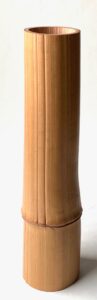
The simple bamboo cylinder and its measurements identified with 8 and Infinity, evokes ‘Shaku-hachi’, 尺八, Measure-eight, one of the three bamboo hanaire created by Rikyū at Odawara. Although the bamboo is no longer living, it will, under certain conditions, be vital forever. Similarly, when the Buddha entered Nirvana, the withered trees suddenly bore flowers. In a similar way, the bamboo of the hanaire is aged and treasured. When a flower is placed in the container, life begins anew.
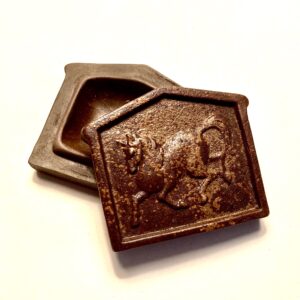
Kō-gō, 香合, incense-gather, in the form of an e-ma, 絵馬, picture-horse, with an image of an uma, 馬, horse, Bi-zen-yaki, 備前焼, Provide-before-fired, by Ki-mura Tō-hō, 木村陶峰, Tree-town Ceramic-peak; H. 1.6 sun kane-jaku.
An e-ma, 絵馬, picture-horse, is often a small wooden plaque offered at Shintō shrines. The pentagonal board has a hole for a cord for hanging it. The wooden plaque is cut so that it has five corners, go-kaku, 五角, which is wordplay on 合格, gather-status, success. The shape has its function: the top edge is cut with an angle that repels water, rather like a roof on a building. The ema is hung outside in the weather. A person would purchase an ema at a shrine, write a prayer, a request, thanks, etc., and ask the deity for help. The ema is then attached to a rack at the shrine, or taken away as a souvenir.
Once, the horse itself was the offering to the shrine. In time, pictures of horses were offered, and then small wooden boards with horses and various other animals, flowers, pictures of all sorts, etc.
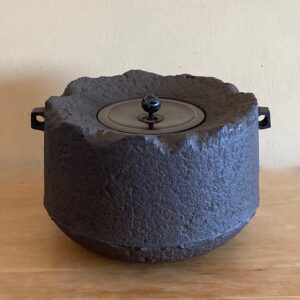
Kama, 釜, kettle, ‘timeworn’ tetsu, 鉄, iron, ya-hazu, 矢筈, arrow-nock, with sunken shoulder, block kan-tsuki, 鐶付, metal ring-attach; diam. 8.2 sun kane-jaku, with Kara-kane, 唐銅, Tang-copper, futa, 蓋, lid; by Kawa-be Ken-ichi, 川邊憲一, River-edge Law-one, Kashi-hara–shi, 橿原市, Oak-field-city, Nara.
The block-form kan-tsuki, 鐶付, metal ring-attach, may allude to the white blocks in the wisteria ash bed of certain furo. The form of the ash bed was created as a way to honor the importance of Hai-gata Yama, 灰形山, ash-form mountain, located in Ari-ma, 有馬, Have-horse. This area was of particular interest to Hideyoshi and Sen no Rikyū. The irregular rim of the kama may evoke Ro-kkō-san, 六甲山, Six-shell-mountain, range of mountains in the Arima area.
The steam drifting out of the vent holes in the kama rim also may evoke the steam escaping from the hot springs of Arima.
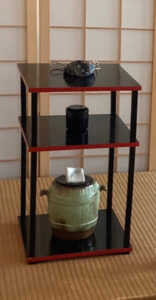
Kō-kō-dana, 更好棚, again-chose-shelf, ni-ju-dana, 二重棚, two-tier-shelf, with four posts, and lacquered black throughout with shelf edges trimmed in tsuma-gure, 爪紅, nail-red, choice of Gen-gen-sai, 玄々斎, Mystery-mystery-abstain, XI Iemoto, Urasenke. According to the old traditional calendar, Gengensai was born in year 1810, which corresponded with the zodiac sign for the year Kanoe-Uma, 庚午, Metal-Horse. The year 2026, a Horse Year, and the 216th anniversary of Gengensai’s birth.
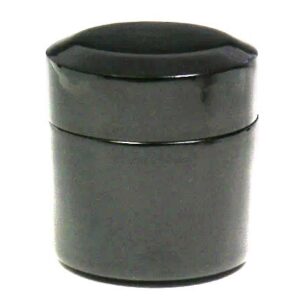
Cha-ki, 茶器, tea-container, cylindrical form with mitered top and bottom edges named ‘Fubuki’, 吹雪, blow-snow, lacquered black throughout; H. 1.8 sun kujira-jaku.
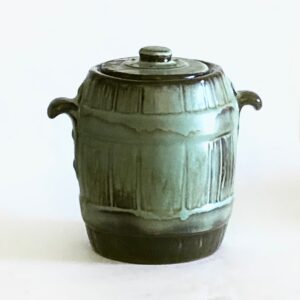
Covered vessel in the form of a barrel, with wing handles, terra cotta, with green glaze, Frankoma; h. 516cm. Cracker jar used as a mizu-sashi, 水指, water-vessel.
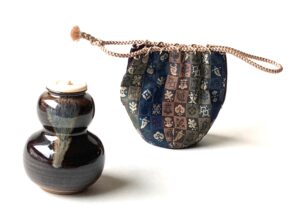
Cha-ire, 茶入, tea-receptacle; brown ceramic hisago, 瓠, bottle gourd, by Ban-dai Ki-zan, 万代㐂山, Ten thousand-generation Joyous-mountain, Kyōto, with ivory lid and silk, drawstring shi-fuku, 仕覆, work-cover, with a pattern of ‘Ichi-matsu Takara Don-su’, 市松宝緞子, City-pine Treasure Damask-of. The bottle gourd-shape jar is one of the oldest and most revered chaire in Japan.
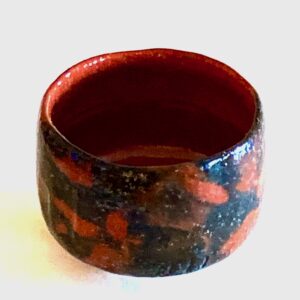
Cha-wan, 茶碗, tea-bowl, ceramic, aka-raku, 赤楽, red-pleasure, with black accents and suna-gusuri, 砂薬, sand-glaze, H. 2.2 sun kane-jaku, Mura-ta Tō-in, 村田陶隠, Town-field Ceramic-seclusion, Yama-shina, 山科, Mountain-department.
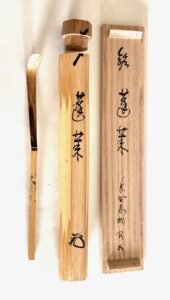
Cha-shaku, 茶杓, tea-scoop; bamboo naka-bushi, 中節, middle-node, crafted by Kage-bayashi Sō-toku, 影林宗篤, Shadow-grove Sect-kind; L. 6 sun kane-jaku. The chashaku is named ‘Hō-rai’, 蓬莱, Mugwort-goosefoot, the mythic realm in which the gods gather. The name was given by Matsu-naga Gō-zan, 松長剛山, Pine-long Strong-mountain, abbot of Kō-tō-in, 高桐院, High-paulownia-sub temple, Dai-toku-ji, 大徳寺, Great-virtue-temple, Kyōto. Hōrai is the name of the temple’s Tearoom which was a favorite of Ennōsai, 円能斎, Circle-art-abstain, XIV Iemoto of Urasenke. Coincidentally, the bamboo artist’s name, toko, 篤, is composed of the Kanji for bamboo, take, 竹, and horse, uma, 馬.
Tomo zutsu, 共筒, self-tube, bamboo, inscribed Hōrai, Mugwort goosefoot, with the abbot’s ka-ō, 花押, flower-seal, a stylized number of his generation as abbot.
Box lid inscribed from the top; mei, 銘, inscription, Hōrai, 蓬莱, Mugwort-goosefoot, Murasaki-no, 紫野, Purple-field (area of Daitokuji), Kō-tō, 高桐, High-paulownia, Gō-zan, 剛山, Strong-mountain.
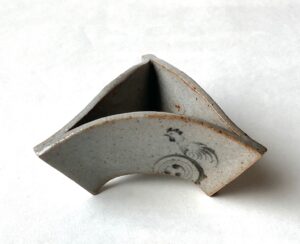
Three-sided futa-oki, 蓋置, lid-place, in the shape of sen-men, 扇面, fan-face, with a design of a niwatori, 鶏, chicken, on a drum. On another side is the design of a shi-me-nawa, 注連縄, flow-along-rope, with paper streamers, all are emblems of Shintō. Illegible stamp: w. 3 sun kane-jaku. The object is suitable as a futaoki, however, its original intended use is unknown.

Ken-sui, 建水, build-water, dried, natural gourd.
The bowl is the bottom section of a bottle gourd, hyō-tan, 瓢箪, gourd-rice basket. In Taoism, the double chamber of the bottle gourd represents a container for water and a container for rice / food, the little that one needs to live a modest life.
For further study, see also: New Year Collection