Buddhist Deities and the Horse Zodiac
In Asia, the year 2026 is identified with the Asian zodiac sign of the Horse – in Japanese, Hinoe Uma-doshi, 丙午年, Fire’s elder brother-Horse year. Each of the Jū-ni-shi, 十二支, Ten-two-branches (animals), is modified by the In and Yō aspects of the Go-gyō, 五行, Five-transitions, Earth, Water, Fire, Metal, and Wood, called Ji-kkan, 十干, Ten-stems. The two systems together are called E-to, and Kan-shi, 干支, stem-branch. These systems are associated with aspects of times, days, months, years, etc.
In Chanoyu, the fully expressed Tea gathering called a Cha-ji, 茶事, Tea-matters, is presented at noon, which, in Japanese, is the Shō-go Cha-ji, 正午茶事, True-horse Chaji. One reason for this may be that in many Buddhist temples, monks are served the largest meal of the day around noon.
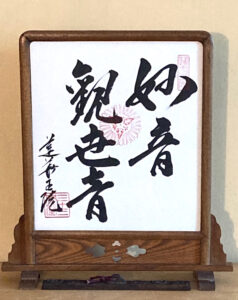
Shiki-shi, 色紙, color-paper, with calligraphy written by an as-yet un-named Buddhist mon, Myō-on Kan-ze-on, 妙音観世音, Wondrous-sound See-world-sound, revering Sen-ju Kan-non Bo-satsu, 千手観音菩薩, Thousand-hand See-sound Grass-buddha, at San-jū-san-gen-dō, 三十三間堂, Three-ten-three-bay-hall, more formally named, Ren-ge-ō-in, 蓮華王院, Lotus-flower-king-institute, Kyōto.
One of Japan’s most beloved deities is Kan-non Bo-satsu, 観音菩薩, See-sound Grass-buddha, the Buddhist Goddess of Mercy. Kannon is manifested in thirty-three different forms, several of which are in female form.
Buddhist deities are frequently associated with animals, or rather, certain animals are identified with various Buddhist deities. Kannon is specifically identified with the Asian zodiac sign of the Ne, 子, Rat. However, one of the thirty-three manifestations of Kannon is Ba-tō Kan-non, 馬頭観音, Horse-head See-sound.
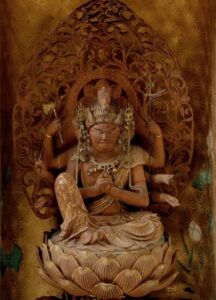
Ba-tō Kan-non, 馬頭観音, Horse-head See-sound, also known as Ba-tō Myō-ō, 馬頭明王, Horse-head Bright-king, as the teaching vehicle belongs to both the Kannon and Myō-ō subdivisions. This is the wrathful body of A-mi-da Nyo-rai, 阿弥陀如来, Praise-increase-steep Like-become, Buddha of Compassion. Amida is accompanied by Sen-jū Kan-non Bo-satsu, 千手観音菩薩, Kannon Bosatsu, and Sei-shi Bo-satsu, 勢至菩薩, Strength-attain Grass-buddha.
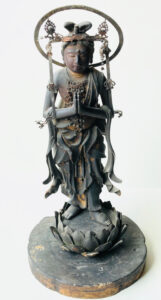
Figure of Sei-shi Bo-satsu, 勢至菩薩, Strength-attain Grass-buddha, gilt-wood, with hands together, Muromachi period, Japan; H. 8 sun kane-jaku. Metal ornamental crown is a later addition.
Sei-shi Bo-satsu protects the sign of the Horse.
Mahasthamaprapta, ‘He who has obtained the highest strength’ or ‘Great Power’, Bodhisattva represents wisdom and power, he is often depicted holding a lotus flower. He is the right-hand attendant of Amida Buddha, helping sentient beings to escape suffering and attain rebirth in Goku-raku Jō-do, 極楽浄土, Extreme-pleasure Pure-land. Renowned for his ‘Universally illuminating wisdom light’, he possesses supreme power to avert calamities of bloodshed and warfare.
Seishi is seldom depicted with horses, but is the guardian of these born in Asian zodiac sign for Uma-doshi, 午年, Horse-year. The actual horse animal is written with the Kanji for uma, 馬, whereas the Asian zodiac sign is written with the Kanji uma, 午. The Chinese origin of the Kanji is for ‘pestle’. The Kanji is also read go, which implies ‘noon’, as in shō-go, 正午, correct-horse, ‘12’ (high) noon. Shō-go Cha-ji, 正午茶事, ‘High’-horse Tea-matters, is the fully formed Tea gathering with seki-iri, 席入, seating-entry, at Noon.
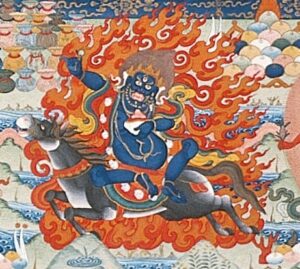
Zō-chō-ten-nō, 増長天王, Increase-length-heaven-king, the Shitennō who protects the south. In parts of Asia, Zōchōten is known as Virudhaka, sprouting grain, and is often depicted riding a horse, lion, or dragon, representing his role as a protector and ruler of the winds. As king of the Kumbhandas, he is sometimes associated with horse-headed, shape-shifting lesser beings. He is considered auspicious for those born under the sign of the Horse, in Japanese, Uma-doshi, 午年, Horse-year.
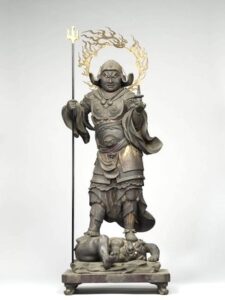
Bi-sha-mon-ten-nō, 毘沙門天王, Attend-sand-gate-heaven (Deva), commender of the Shitennō, the leader of the Shichi-fuku-jin, 七福神, Seven-fortune-gods, and directs the Shi-ten-nō, 四天王, Four-heaven-kings. Use of the term ten, 天, heaven, refers to the Sanskrit term deva for a male deity, and devi for a female deity.
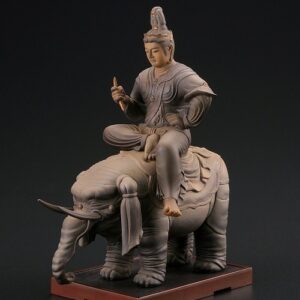
The king of the gods is Tai-shaku-ten, 帝釈天, Emperor-explain-heaven (Deva). Known by many names including Indra, he lives in the Tō-ri-ten, 忉利天, Grieve-advantage-heaven, the Trayastriṃśa heaven on the crest of Shumisen, and the elephant is his vehicle.
In Hinduism, Uchchaihshravas, Sanskrit: उच्चैःश्रवस्, sometime spelled Uccaiḥśravas. In Sanskrit Uccaiḥśravas is a compound of उच्चै, uccaíḥ, loudly, and श्रवस् , śrávas, fame, glory. Uccaiḥśravasis a seven-headed flying horse, created during the churning of the ocean. It is considered the best of horses, as prototype and king of the horses. Uchchaihshravas is often described as a vahana, a vehicle or steed, of Indra.
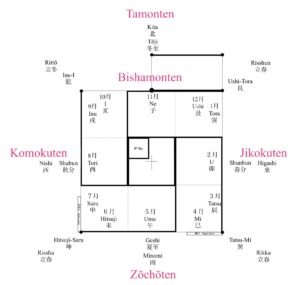
Diagram of a yo-jō-han cha-shitsu, 四畳半茶室, four-mat-half tea-room, showing the locations of the Shi-ten-nō, 四天王, Four-heaven-king
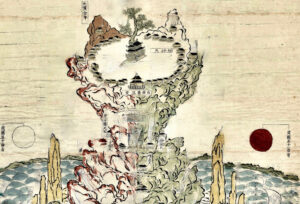 Color print illustration of idealized Shu-mi-sen, 須弥山, Necessarily-increase-mountain. Note the ‘red sun’ identified with the East, and the ‘white moon’ in the West. The temples of the four Heavenly Kings are located on the smaller montain paeaks below the main temple, thir kaji can be faintly read from bottom to top in small outlines near their respective temples.
The Shitennō live on the slopes of Shu-mi-sen, 須弥山, Necessarily-increase-mountain, the idealized center of the Hindu, Buddhist and Jain worlds. Also called Mount Sumeru, the earthly representation of the sacred mountain is Kailash in Tibet.
Bishamonten is also manifested as one of the Shitennō, in the guise of Ta-mon-ten–nō, 多聞天王, Multi-listen-heaven-king. ‘Listening’ is an attribute of Kannon.
Kan-tei, 鑑禎, Exemplar-omen, had a dream wherein he was instructed to go north, on his way he became disoriented and lost. While Kantei was dreaming, a Shintō god named Kibune Myōjin, 貴船明神, Noble-boat Bright-god, instructed him that in the morning he was to look up in the eastern sky. Upon waking Kantei saw a white horse wearing an empty saddle. Kantei followed the horse for the remainder of his journey to what has become known as Kura-ma-yama 鞍馬山, Saddle-horse-mountain. When Kantei set up camp on the mountain he was attacked by an oni, 鬼, demon. He hid in the hollow of a tree and began praying to Bishamonten, the guardian of the North. In gratitude for his salvation, he built a small hermitage named that later came to be known as Kura-ma-dera, 鞍馬寺, Saddle-horse-temple.
According to legend, after the capital of Japan moved from Nara and Nagaoka to Kyō-to, 京都, Capital-metropolis, the powerful Fujiwara clan moved to the city. In 796, Fujiwara no Isendo, Fuji-wara I-sen-do, 藤原伊勢人, Wisteria-field That-strength-person, who wished to worship Kannon Bosatsu, received a message in a dream and was guided by a white horse, ao–uma, 白馬, to climb Kura-ma Yama, 鞍馬山, Saddle-horse Mountain. There, he discovered the thatched hut hermitage that Kan-tei, 鑑禎, Exemplar-omen, had built to worship Bishamonten, and was further told that Bishamonten and Kannon Bosatsu are one. Bishamonten at Kuramadera was the protector of Hei-an Kyō, 平安京, Level-peace Capital, and subsequently, Kyōto.
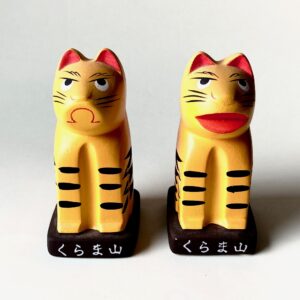
At Kuramadera, there are two guardian tigers, A-Un Tora, 阿吽, Ah Un Tigers, with open and closed mouths manifesting receptive and penetrative, In and Yō, 陰 and 陽, Yin and Yang aspects. Legend has it that Bishamonten descended on Kurama Yama with a tora, 虎, tiger, during the Tora no koku, 寅の刻, Tiger’ s time, 3 to 5 am, 虎の時間, Tiger’s Time-interval, 1 to 3 am. on the Tora no hi, 虎の日, Tiger’s day, within the Tora no tsuki, 寅の月, Tiger’s Month, according to the lunar kyū-reki, 旧暦, old-calendar.
As guardian of the north, Bishamonten, in China, is often depicted on temple murals outside the main door. He is also thought of as a god of wealth. As such, Vaiśravaṇa is sometimes portrayed carrying a kind of citron, the fruit of the jambhara tree, which is a pun on another of his names from Sanskrit, Jambhala.
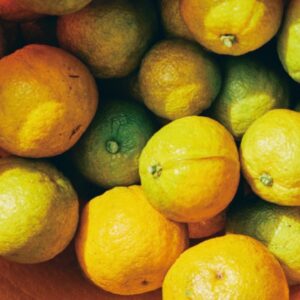
The fruit is in Japanese is a variation on his name, jabara, ジャバラ, jabara (Citrus jabara); a type of Japanese citrus; a cross between the yuzu with a pomelo-hybridized mandarin; it is a cross between the yuzu, 柚, and a pomelo-hybridized mandarin (Citrus nobilis) that arose naturally in Wakayama Prefecture, Japan. The yuzu may evoke the Buddhist sect of the Yū-zū Nen-butsu, 融通念仏, Dissolve-through, and the opening of the ro in winter. The fruit helps distinguish Bishamonten iconically from depictions of Vaisravana, who is also referred to as Kuvera, god of wealth.
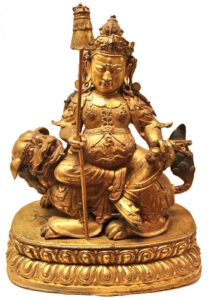
Bishamonten is known by many different names depending on the country and language. He is sometimes depicted as corpulent and covered with jewels, as Vaisravana, Kuvera, Kubera, etc. His left leg is generally pendant and may be supported by a lotus flower on which is a conch shell. His mount is a yuki-jishi, 雪獅, snow-lion.
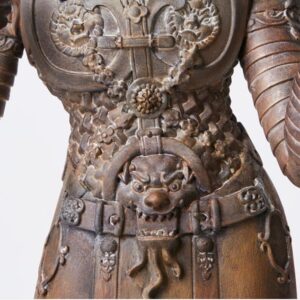
Detail of a figure of Bishamonten showing a creature biting his belt. The beast likely a is likely a manifestation of the yuki-jishi, 雪獅, snow-lion, which is the vehicle of Bishamonten. The creature/lion represents power and vitality and is a guardian of the hara, 腹, abdomen. This area corresponds with what is referred to in Sanskrit as Manipura and in Taoist philosophy it is associated with the lower dantian. In English this area is sometime referred to the bottom most of the three energy ‘cauldrons‘, it is referred to as the lower ‘elixir field‘ and sometimes known as the lower ‘cinnabar field‘’, which in Japanese is referred to as Tan-den, 丹田, Red-field. This is the lower ‘cauldron‘ used to store vital energy, ki, 気. In all three systems this area is associated with power, personal essence, and an essential life force. In Japan the hara is particularly known as the area for cultivating a rootedness, grounding, and maintaining a strong center of gravity.
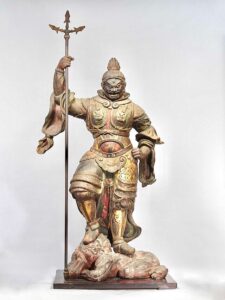
Figure of Zō-chō-ten, 増長天, Increase-lead-heaven (Deva), Virudhaka, guardian of the south and those born under sign of the Horse – Uma-doshi, 午年, Horse-year. He is depicted standing on an earth imp called a ja-ki, 邪気, wicked-spirit, as do the other three of the Shitennō.
This statue was originally enshrined at Kō-fuku-ji 興福寺, Revive-fortune-temple, as part of a set of the Shi-ten-nō, 四天王, Four-heaven-kings (Deva), along with Jikokuten (now at the Miho Museum, Shiga), Kō-moku-ten (at Kōfuku-ji, Nara), and Ta-mon-ten, 多聞天, Many-listen-king (at the Nara National Museum).
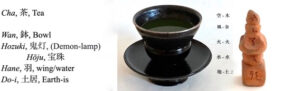
Tenmoku and dai, kanji from left are the principles which are Chi, 地, Earth, Sui, 水, Water, Ka, 火, Fire, Fū, 風, Wind, Kū, 空, Void and on right are the five elements the Go-gyō, 五行, Five-transitions: mo, ka, don, sui, indicating the relationship to the Gorintō. Ceramic Go-rin-tō, 五輪塔, Five-principle-tower, inscribed with the Sanskrit characters, by Henry Mittwer, Kyōto
In offering Tea to Buddhist deities it may be important to consider the five element theory as the dai, 台, stand and tenmoku, may closely relate to the gorintō and the elements that are present on Earth as well as their spiritual counterparts found in the principles of the gorintō These principles are present in many of the teachings of the Buddha and the deities that have been explored in this article.
Throughout the world, departed spirits are remembered through offering. In Japan, and elsewhere, water is the most familiar offering. At Urasenke, Tea is offered to Sen no Rikyū and other ancestral spirits as well as deities. Buddhist hotoke, butsu, 仏, composed of hito, 人, person, and 厶, self. Shintō kami, shin, 神, composed of shime, 示, show, and mosu, 申, say.
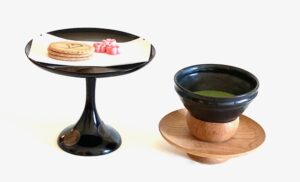
Left: two kinds of hi-ga-shi, 干菓子, dry-sweet-of, (raku-gan and sen-bei) on folded paper presented on a pedestal taka-tsuki, 高坏, high-cup, as offered to a ki-nin, 貴人, noble-person.
Right: serving of usu-cha, 薄茶, thin-tea, in conical cha-wan, 茶碗, tea-bowl, ‘ten-moku’-form, ceramic, with mottled black glaze, by Makoto Yabe, on a paulownia wood dai, 台, stand, as offered to a ki-nin.
Raku-gan, 落雁, alighting-geese, ume no hana, 梅の花, ‘plum’s flower, Kame-ya Kiyo-naga, 亀屋清永, Turtle-house Pure-lengthy, and ‘Fu no yaki Sen-bei’, ふのやき煎餅, Wheat gluten-fired Toast-mochi, with branded a Sō-tan Gin-ko, 宗旦銀杏, Sect-dawn Silver-apricot, ginkgo leaf, designed by Sen To-mi-ko, 千登三子, Thousand Ascent-three-child, wife of Hō-un-sai, 鵬雲斎, ‘Phoenix’-cloud-abstain, XV, made by Sue-tomi, 末富, Posterity-abundant, Kyōto.
Offerings of Tea are most often in the manner of ki-nin, 貴人, noble-person, when the cha-wan, 茶碗, tea-bowl, is raised on a dai, 台, stand – dai-ten-moku, 台天目, support-heaven-eye. This may be deemed the most formal having originated in ancient China, the ‘original’ teabowl. Such bowls and stands were part of the offerings to Buddhist deities.