Daruma’s Eyes in Chanoyu
According to traditional folklore, the discovery of tea is attributed to Bodhidharma, known in Japan as Daruma. Daruma is a legendary 5th to 6th century Indian monk revered as the 28th Indian Patriarch in a direct line of transmission stretching back to Gautama Buddha. Bodhidharma is widely recognized as the First Patriarch of Chan (Zen) Buddhism in China and Japan.
It is said that the historical figure known as the monk Bodhidharma had been renowned for practicing men-peki, 面壁, face-wall, a form of seated silent meditation. Legend holds that he meditated facing a cave wall for nine years in the area near the monastery of Shaolinzi, Shō-rin-ji, 少林寺, Small-grove-temple, in China.
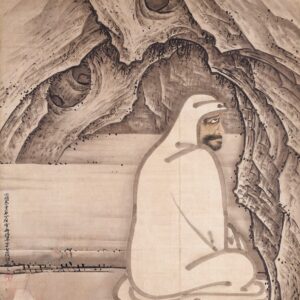
Adaptation of ink painting by Se-sshū Tō-yō, 雪舟 等楊, Snow-boat Quality-willow, 1496, Muromachi period, Japan. Showing Daruma practicing menpeki.
A famous legend states that after unexpectedly falling asleep, and becoming deeply upset, Bodhidharama severed his eyelids. Upon falling to the earth, his eyelids sprouted into the world’s first tea plants. Other stories posit that Bodhidharma brought tea to China during his journey from India.
From its origins in India, Zen Buddhism established itself in China through Bodhidharma during the early 6th century. In the 9th century a Buddhist monk within the esoteric Shingon tradition named Kūkai traveled from Japan to China and brought back tea seeds and a stone mill, usu, 臼. However it was three centuries later, and six centuries after Bodhidharma, that Myō-an Ei-sai, 明庵栄西, Bright-hermitage Splendor-west, 1141–1215, journeyed to Song dynasty China to study the Linji tradition. The Linji, Rin-zai-shū, 臨済宗, Confront-settle-sect, school directly descended from Bodhidarma’s original Chan teachings. Upon returning in 1191, Eisai established the Rinzai lineage, formally founding Zen Buddhism within Japan.
Eisai advocated tea for health, authoring Ki-ssa Yō-jō-ki, 喫茶養生記, Drink-tea Health-life-record, which firmly positioned tea as an essential aid for Zen monks maintaining focus during extended zazen meditation.
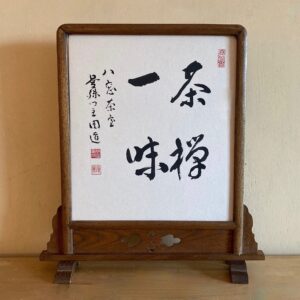
Shiki-shi, 色紙, color-paper; ‘Cha Zen Ichi Mi,’ 茶禅一味, Tea Zen one-taste, by Matsu-naga Gō-zan, 松長剛山, Pine-long Strong-mountain, abbot of Kō-tō-in, 高桐院, High-paulownia-sub temple, Dai-toku-ji, 大徳寺, Great-virtue-temple, Kyōto. The standing wooden frame is made of kuwa, 桑, mulberry.
In Chanoyu, there is an expression, ‘Cha Zen Ichi Mi’, 茶禅一味, Tea Zen One Taste. This phrase is an example of the balance of different conditions. Tea is a physical, tangible thing, which is a manifestation of the principle of In, 陰, Receptive, physical, etc. In Buddhism, all things are In. Whereas Zen is non-physical, intangible experience, which is the principle of Yō, 陽, Penetrating, positive, etc. Tea of Cha-no-yu, 茶の湯, Tea’s Hot water, is made of dry, powdered, energy-filled tea leaves, Yō, that is blended with hot water, In.
Rikyū’s Tea teacher, Take-no Jō-ō, 武野 紹鴎, War-field Help-gull,1502-1555, who also studied with Dai-rin Sō-tō, 大林 宗套, Great-grove Sect-cover, 1480-1568, abbot of Dai-toku-ji, 大徳寺, Great-virtue-temple, Kyōto, is often credited with the phrase. While the phrase has roots back with earlier figures like the Chinese monk Yuanwu Keqin, and the Japanese Tea master Mura-ta Shu-kō, 村田珠光, Town-field Jewel-bright, the expression was solidified for Jōō by his Rinzai Zen teacher’s gift of writing. Dairin Sōtō gave a calligraphic verse to Takeno Jōō, which explicitly created the phrasing ‘Cha Zen ichi-mi’ and heavily strengthened the spiritual bond between Chanoyu and Zen practice.
While the practice of Chanoyu is primarily approached as a secular tradition, the use of Zen phrases and Buddhist temple inspired implements in the Tearoom is widespread. Much of this can, ultimately, be attributed to the influence and insight of Bodhidharma/Daruma.
In Japan, the memorial celebrating the life of Daruma is known as Daru-ma-ki, 達磨忌, Attain-polish-memorial. Many observances are commonly held on October 5th. This date is derived from the fifth day of the tenth lunar month, traditionally the anniversary of Bodhidharma’s death. However, there are some temples that hold the memorial on other days, including November 5th, as the date originated according to the lunar Kyū-reki, 旧暦, Old-calendar, the date of which changes from year to year. Notable temples holding Daruma-ki ceremonies include En-gaku-ji, 円覚寺, Circle-memory-temple, Kama-kura, 鎌倉, sickle-warehouse, Ei-gen-ji, 永源寺, Eternal-origin-temple, Shi-ga, 滋賀, Nourish-joy, and Shō-rin-zan Daru-ma-ji, 少林山達磨寺, Little-grove-mountain Attain-polish-temple, Taka-saki, 高崎, High-cape, and Hō-rin-ji, 法輪寺, Principle-wheel (Dharmachakra) temple.
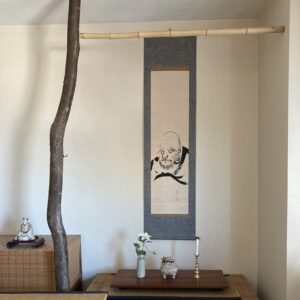
Tokonoma with utensils for a Daruma Memorial Tea. Kake-jiku, 掛軸, hang-scroll, with brushed picture of Daru-ma, 達磨, Attain-polish. Kō-ro, 香炉, incense-hearth, Kara-ji-shi, 唐獅子, Tang-lion-of, Shino-yaki, 志野焼, Aspire-field-fired. Flower in ceramic hana-tate, 花立, flower-stand, ceramic sake bottle, from Kami-ga-mo Jin-ja, 上賀茂神社, Upper-joyous-luxuriant God-shrine. Polished brass hi-tate, 火立, fire-stand, candlestick.
Hanging a scroll of Daruma in a place of prominence is common in many Daruma-ki events. When a scroll of Daruma is placed in a tokonoma, it may evoke the idea of looking into the cave in which Daruma sat in meditation for nine years. When a person sits in front of the tokonoma looking at a depiction of Daruma, that person can see themself mirrored as Daruma.
Because Daruma-ki is honored during the 10th month, in the many practices of Chanoyu this means that Nakaoki is often the arrangement used to present Tea. While there are many choices for toriawase, 取り合わせ, take-gather, the various tools for Tea, in some schools the do-bu-ro, 土風炉, earth-wind-hearth, is an essential aspect in the Nakaoki presentation.
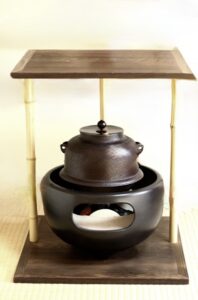
The mayu-buro, 眉風炉, eyebrow wind-hearth, is an ideal choice for use with the Go-gyō dana, 五行棚, Five-transitions shelf (stand), as it is an earthenware bowl that is then lacquered.
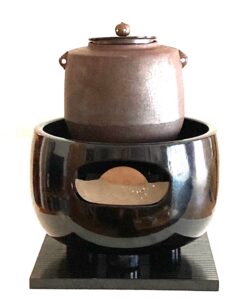
Mayu buro, black-lacquerred earthenware, with three feet and ovoid hi-mado, 火窓, fire-window, shin kuro, 真黒, true-black, (this furo is also classified as a do-bu-ro, 土風炉, earth-wind-hearth) by Yama-moto Sō-un, 山本崇雲, Mountain-origin Revere-cloud. Choice of Sen no Rikyū. Diam. 1 shaku kane-jaku.
Shiki-ita, 敷板, spread-board, with graduated scoring, called ara-me ita, 洗目板, rough-interval board; black lacquered wood 9.5 shaku square: designed to evoke waves on the sea. The mae-kawarake, 前土器, fore-earth-container, is a low-fired ceramic, from I-se Jin-gū, 伊勢神宮, That-strength God-palace.
Kama, 釜, kettle; tetsu, 鉄, iron, of form called kata-tsuki, 肩付き, thrust-shoulder, with design of egret, shira-sagi, 白鷺, white-egret, with bronze lid, by Taka-hashi Kei-ten, 高橋敬典, High-bridge Respect-rule, Yama-gata, 山形, Mountain-shape. National- treasure, Nin-gen Koku-hō, 人間国宝, Person-space Country-treasure.
This choice of brazier is ideal for a number of reasons, and can recall the famous doburo by Sō-tei Zen-go-rō, 宗汀 善五郎, Sect-shore Goodness-five-son, made for the daruma-dō kama. Sōtei was a prominent Japanese potter and the 6th generation head of the famous Eiraku Zengorō family line, the craftsmen of pottery preferred by the Sen family, and related Tea practitioners. To see an image of the doburo made for the daruma-dō kama, see link below.
The daruma-dō kama was originally a kō-ro, 香炉, incense-hearth, that was placed within the Daru-ma-dō, 達磨堂, Attain-polish-hall, erected by the Zen master Sei-gan Sōi at Kō-tō-in, 高桐院, High-paulownia-sub temple of Dai-toku-ji, 大徳寺, Great-virtue-temple in Kyōto.
In the Edo period, Kaku-kaku-sai, 覚覚斎, Realize-realize-purified-one, sixth head of the Omotesenke lineage, deeply favored the robust elegance of the vessel, adapting it to serve as a tea kettle, kama.
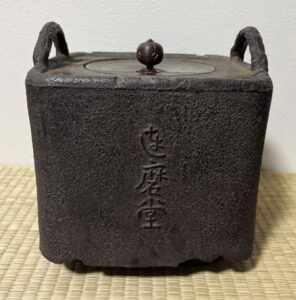
The kama displays bold, expressive brushwork writing out ‘Daru-ma-dō’, 達磨堂, Attain-polish-hall, across the central form of the vessel. See link below for a view of the Daruma-dō doburo crafted by Sōtei Zengorō.
While the brazier known as the mayuburo is often thought to reference an ‘eyebrow’, during a Daruma-ki event the presence of the mayuburo could also bring to mind the Daruma-dō kama and/or the lore of Daruma removing his eyelids, which are said to have become Tea leaves.
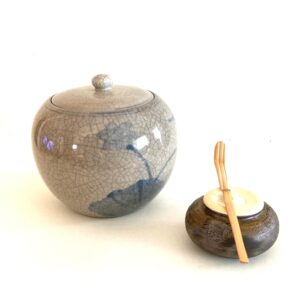
Mizu-sashi, 水指, water-indicate, ceramic sphere with underglaze blue design of egrets and lotus, Korea.
Cha-ire, 茶入, tea-receptacle, settled spherical form called ‘dai-kai’, 大海, great-sea, Bi-zen yaki, 備前焼, Provide-fore fired, by Ki-mura Tō-hō, 木村陶峰, Wood-town Ceramic-peak, Imbe. A daikai chaire is preferred for preparing koicha using the go-gyō dana. It is modeled on the jar brought by Eisai from China containing the first ‘true’ tea seeds. Eisai brought not only tea seeds from China, but Zen as well. He wrote the seminal ‘Kissa Yōjōki’, which focuses on the importance of the Go-gyō, 五行, Five-transitions, and In and Yō, both of which are at the heart and significance of the go-gyō dana.
Cha-shaku, 茶杓, tea-scoop, bamboo naka-bushi, 中節, middle-node, by Nishi-kawa Bai-gen, 西川楳玄, West-river Plum-mystery, Kyōto; named ‘Ichi-i’, also read ‘Ichi-ro’, 一葦, One-reed Daruma. The name is a reference to the reed on which Bodhidharma crossed the Cháng-jiāng, 長江, Long-river, Yang-tze. Ichi-ro Daru-ma, 一葦達磨, One-reed Attain-polish, has been a popular subject in art for centuries throughout Asia.
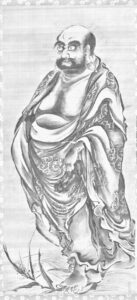
Painting ‘Zen getsu /Ashi-ba Daruma-e’, 禅月/芦葉達磨図, Zen-moon / Reed-leaf Daruma picture, by Yō-kawa mo, 養川模, Nurture-river copy, Tōkyō National Museum collection: image of barefoot Bodhidharma holding one of his shoes, crossing the Yangtze river on reed.
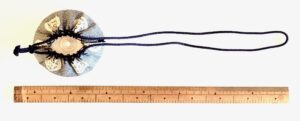
Shi-fuku, 仕覆, serve-cover, for the Bizen yaki dai-kai chaire pictured above, with a design of hō-rin, 法輪, law-ring, ‘Ito-ya futsū’, 糸屋風通, Thread-house Wind-through, has a naga-o, 長緒, long-cord, that is one shaku kujira-jaku, which is doubled thus forming an unbroken circle excluding the end braid, of approximately 1.9 shaku kujira, or 24 sun kane-jaku.
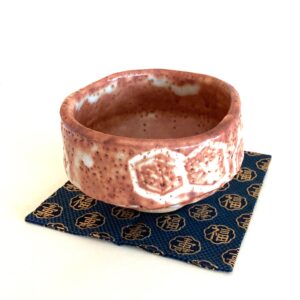
Cha-wan, 茶碗, tea-bowl; ceramic kutsu-gata, 沓形, shoe-shape, beni-Shi-no yaki, 紅志野焼, rouge-Aspire-field fired, with a design of hexagons, evoking the long-lived turtle, and cross-hatching, by Naka-jima Masa-o, 中島正雄, Middle-island Right-male, Shino. The bowl is pictured presented on a ko-buku-sa, 古袱紗, old-cloth-wrapper, with a woven pattern of ‘fuku ju’ kin-ran, 福寿金襴, Fortune-longevity gold brocade, by Tatsu-mura, 龍村, Dragon-town, Kyōto.
The choice of a kutsu chawan references the tale of Daruma crossing the Yangtze River with one shoe. The design of hexagons representing the long-lived turtle as well as the choice of kobukusa with the Kanji for kotobuki, 寿, longevity, reference the idea that Daruma lived a long life of 150 years.
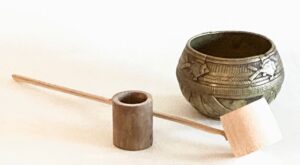
Ken-sui, 建水, build-water, brass, rice measure, with fish and geometric patterns, India. An item from India references Daruma’s origin prior to his arrival in China. Fuki-nuki futa-oki, 吹抜蓋置, blow-through lid-place, also called a ‘wa’, 輪, ring, circle, aged bamboo, is a vague reference to the figure of an Enso, popular in many Zen schools.
Within the Tearoom, there is the opportunity for the material and the spiritual to unite. The taste of Tea transcends physical flavor to embody the flavor of life itself—an experience unlocked only through attentive awareness and stillness of heart. Ultimately, ‘Cha Zen Ichi Mi ’ reveals that Ultimate Reality is not separate from daily life, it can be fully present, and one can be awake to this presence, while in the act of sharing Tea.
For further study, see also: Nakaoki Collection, Setstubun and Otafuku Collection, Horse Tale in Tea and Tokonoma and Imae

Link to see the Sōtei Daruma-dō doburo