Nakaoki: Center of Change
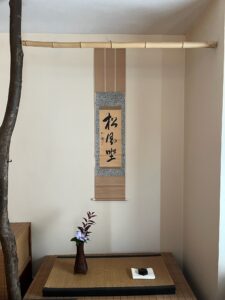
Tokonoma: kake-jiku, 掛軸, hang-scroll, with calligraphy, ‘Shō-fu-za’, 松風坐, Pine-wind-sit; kago hana-ire, 籠花入, basket flower-into, and hexagonal, lacquered wood kō-gō, 香合, incense-gather, displayed on a pack kai-shi, 懐紙, heart-paper.
This excerpt on the hanging scroll frequently brings to mind an expanded Zen teaching, kan-za shi-te shō-fū o ki-ku, 閑坐聴松風, quiet-sit hear-pine-wind, ‘sitting peacefully, listening to pine breeze’, encouraging one to release extraneous thoughts and remain fully attentive to the immediate experience. Shōfu can also be read as matsukaze, which in the context of Chanoyu, also refers to the sound of water boiling in a kettle over the charcoal fire.
A Tea presentation of Naka-oki, 中置, Middle-place, refers to the placement of the portable brazier, fu-ro, 風炉, wind-hearth. The utensils displayed in the tokonoma are related to naka-oki may feature the hanging scroll, or to a kō-ro, 香炉, incense-hearth. Incense is burned in the furo, which fills the room as would an incense burner. The absence of an incense burner, which would be displayed in the center of the tokonoma, emphasizes its Yō or positive aspects.
An essential feature in Japanese homes was a central fire kept burning in a hearth called an i-ro-ri, 囲炉裏, enclosed-hearth-back. The fire was typically made with wood. A kettle of water was often integral with this hearth, and was the center of household activities, especially in cold weather.
In Chanoyu, 茶の湯, tea’s hot water, mizu, 水, is heated in an iron kama, 釜, kettle, over a sumi-bi, 炭火, charcoal-fire, burning in a portable brazier, fu-ro, 風炉, wind-hearth, or a sunken hearth, ro. Water is transformed into yu, 湯, hot-water. The original furo has the kama sitting on an upright collar of the furo which gives the furo its name kiri-awase, 切合せ, cut-together, and kiri-kake, 切掛け風炉, cut-hang on. Such furo/kama appear to be a single unit.
The earlier closed furo concealed, to a great degree, the light of the burning charcoal thus rendering it ‘hidden’. This presents a bit of a puzzle. The hidden fire may be symbolic of something greater.
Within certain texts of Shu-gen-dō, 修験道, Discipline-testing-way, the fire ritual go-ma, 護摩, protect-spirit, is described as having an internalized dimension in which the fire inside the body is the offering that burns the passions inhibiting the achievement of enlightenment. Three modes of inner fire are distinguished: one in which the thirty-seven Buddhas reside in the heart where fire burns continuously, fueled by thoughts; a second in which the practitioner’s own breathing becomes the smoke venting and the bodily organs become brazier, fuel, and flame; and a third linked to contemplative alchemy. The outer ritual of striking flint is, in this understanding, a visible gesture pointing to an inward reality that is always already present.
In time, and by choice, for Chanoyu, the closed-in furo was at times replaced by a large bowl, which utilized a trivet, go–toku, 五徳, five-virtues, to support the kama. Such bowls have various names according to their form and function, like the ceramic mayu bu-ro, 眉風炉, eyebrow wind-hearth, which has an ovoid hi-mado, 火窓, fire-window, at the front.
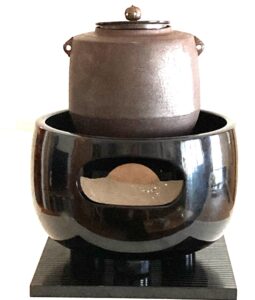
Mayu bu-ro, 眉風炉, eyebrow wind-hearth, with kata-tsuki kama, 肩衝釜, shoulder-thrust kettle, on an ara-me ita, 荒目板, rough-eye board. The mayu buro is an ideal choice for use with the Go-gyō dana, 五行棚, Five-transitions shelf (stand), as it is an earthen ware bowl that is then lacquered.
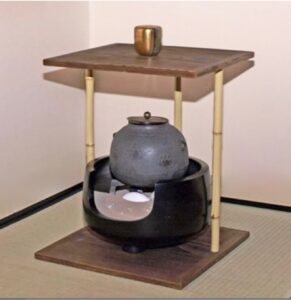
Go-gyō dana, 五行棚, Five-transitions shelf (stand), scorched cedar wood and three bamboo posts, by Ko-bayashi Kō-sai, 小林幸斎, Little-grove Joy-abstain. Choice of Gengensai. All measurements are made in kane-jaku, 曲尺, bend-span, approximately one linear foot.
Ten-ita, 天板, heaven-board: 1 shaku 2 sun square, thickness 4 bu. The size of the tenita is the same as that of the furo nagaitia cut in half.
Ji-ita, 地板, earth-board: 1 shaku 4 sun x thickness 4 bu; 14 sun square is the size of the opening of the ro; it is as though the jiita is the floor board that has been cut to allow the opening for the ro.
The three bamboo hashira, 柱, posts, are symbolic as well as structural: the post toward the guest has two fushi, 節, nodes, this even number reflects In, 陰; the left post has three nodes, this odd number reflects Yō, 陽, the back post has one node and reflects the Tai-ji, 太極, the Great-ultimate, singular in its designation. There is a curious homonym with fu-shi, 不死, no-death, immortality. Also, fushi, 伏, bow (down), as in Fushimi Inari Taisha, 伏見稲荷大社, shrine dedicated to the god of agriculture.
A connection may exist between the size of Kyō-tatami, the placement of the gogyō dana, and the and Rai-go, 来迎, Come-meet, the arrival of Amida and his 25 Bosatsu processional. Kyō-tatami is measured as 2.5 shaku kujira-jaku. This equals one sun for each Bosatsu with Amida at the center of the procession, which is where the furo kama is placed during Nakaoki.
Gen-gen-sai, 玄々斎, Mystery-mystery-abstain, XI Iemoto, created the Go-gyō dana, 五行棚, Transition-transition shelf, to display a furo / kama, as they manifest the Go-gyō. The Go-gyō are five physical elements: Moku, Ka, Do, Gon, Sui:
Moku, 木, Wood, associated with the Spring.
Ka, 火, Fire, associated with the Summer.
Do, 土, Earth, associated with the Center.
Gon, 金, Metal (Gold), associated with the Autumn.
Sui, 水, Water, associated with the Winter.
The Go-gyō-dana, 五行棚, Five-transitions-shelf, encompasses all five elements through in the upper and lower boards which envelop the cosmological principles of go-gyō, 五行, five-transitions: Wood in the wooden boards, Fire within the burning charcoal, Earth expressed through the do-bu-ro, 土風炉, earth-wind-hearth-brazier, Metal present in the kettle, and Water held inside the simmering kettle.
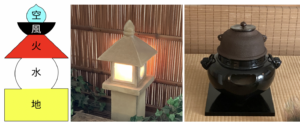
Left: stylized diagram of the Go-rin-tō, 五輪塔, Five-ring-tower; monument of the immortal soul with Kanji for the Go-rin, 五輪, Five-principles.
Middle: ceramic tō-ro, 灯籠, lamp-basket. The ceramic lantern was designed by Palmer and constructed and fired by Steven Murphy, Boston.
Right: ki-men bu-ro, 鬼面風炉, demon-mask wind-hearth. Ki-men-bu-ro, 鬼面風炉, Demon-face-wind-hearth; Kara-kane, 唐銅, Tang-copper, bronze, with kama, 釜, kettle, tetsu, 鉄, iron, with futa, 蓋, lid, and tsumami, 摘み, pinch, knob. The furo is half-filled with hai, 灰, ash to support a sumi-bi, 炭火, charcoal fire. Black lacquered shiki-ita, 敷板, spread-board.
The stone lantern is composed of five parts that represent the Go-rin, 五輪, Five-rings, principles. which reflects the principles found in both the Gorintō and the portable brazier.

Starting from the bottom:
In this version of the conception of the meaning of the Five Principles, the principle of Earth is represented by the plinth of the lantern compared to the square shiki-ita, of the furo. The square shape represents Earth.
The principle of Water in the light basket stone is represented by the fluid that maintains the lamplight compared to the water in the kama as well as the trigram for Water, ☵, that is drawn into the ash bed prior to laying the charcoal.
The principle of Fire in the lantern is represented by the pyramidal ‘roof’. A triangle pointing upwards represents Fire, compared to the kama which maintains heat from the charcoal fire.
The principle of Wind/Metal in the lantern is represented by the half-moon, or bowl (which holds the hōju) compared to the lid of the kama. Wind needs movement as well as the change from In to Yō in order to exist. When handled, the kama lid manifests this physical change.
The principle of the Void is represented by the flaming jewel at the top of the lantern compared to the tsumami on the lid of the kettle. The Void is undifferentiated In and Yō. Hot water, yu, 湯, may be seen as the Void.
The conception of the meaning of the Five Elements that are manifest specifically in the gogyō dana is: the stand itself represents the Wood element, the kettle represents the Metal element, the burning charcoal represents the Fire element, the water in the kettle represents the Water element and the clay brazier represents the Earth element.
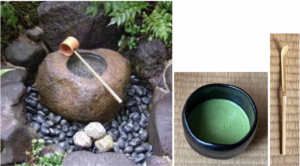
Left: tsukubai, 蹲踞, crouch-down, with natural stone chō-zu-bachi, 手水鉢, hand-water-bowl, with cedar hi-shaku, 柄杓, handle-ladle, in the ro-ji, 露地, dew-ground, of a Tea house. Ladle L. 16 sun kane-jaku.
Center: cha-wan, 茶碗, tea-bowl, kuro-Raku, 黒樂, black-Pleasure, containing frothy usu-cha, 薄茶, thin-tea.
Right: bamboo cha-shaku, 茶杓, tea-scoop; naka-bushi, 中節, middle-node; L. 6 sun kane-jaku.
The water from the chōzubachi is not to be drunk, but solely to ‘purify’ the hands and mouth before drinking tea. Tea from the chawan is drunk to nourish the body and refresh the mind. One should have ready a towel to dry their hands – such as a te-nugui, 手拭い, hand-wipe.
The measurement of the hishaku at the chōzubachi measuring 16 sun kane-jaku may relate to the number 16 found in the teachings of the Buddha. In Buddhism, the number 16 most notably connects to purification through the 16 Defilements of the Mind. These in Pali, are referred to as Cittassa Upakkilesa, translated into the Japanese they are called kokoro-no-zui-bon-nō, 心の随煩悩, Heart-of-all-worldly desires, or kokoro no ku, 心の垢. These worldly desires are outlined by the Buddha in the Vatthupama Sutta (The Simile of the Cloth). In Buddhism, water and a cloth are powerful symbols of purity, clarity, and are used as similes for the washing away of mental defilements such as greed, hatred, and delusion.
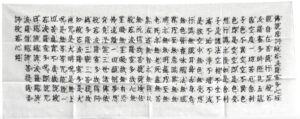
Te-nugui, 手拭い, hand-wipe, cotton fabric with a printed design of the Han-nya Shin-gyō, 般若心経, Wisdom Heart-sutra. Hannya is a transliteration of the Sanskrit word Prajñā, meaning Wisdom. The measurements of a standard size tenugui is 22 x 8.8 sun kujira-jaku.
The Buddha used the example of a stained or dirty cloth to explain that a mind clouded by impurities cannot take in pure spiritual color or wisdom, whereas an undefiled, purified mind is ready for liberation and peace. These spiritual disciplines remain intimately connected to, and are elucidated through, allegories of cloth-dyeing and reflections on sacred river cleansing.
A tenugui is an essential component of the guests’ accessories for a gathering, as it is required during purification at the tsukubai.
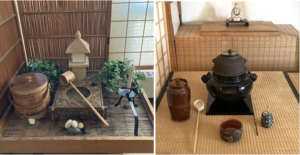
Left: interior adaptation of a tsukubai, 蹲踞, crouch-down, area of physical and spiritual purification; ceramic tō-ro, 灯籠, lamp-basket, ceramic chō-zu-bachi, 手水鉢, hand-water-bowl, with cedar hi-shaku, 柄杓, handle-ladle; wooden te-oke, 手桶, handle-bucket; metal te-shoku, 手燭, hand-(candle)lamp. In an exterior setting, each of the utensils would be placed on specific stones which, in the interior setting, are indicated by five small colored stones placed near the utensils. Yellow mae-ishi, 前石, fore-stone – Earth; white yu-oke-ishi, 湯桶石, hot water-bucket-stone – Water; red te-shoku ishi, 手燭石, hand-candle stick stone – Fire; black chōzubachi-ishi – Wind/Metal; (not visible) green tō-ro-ishi, 灯籠石, lamp-basket-stone – Wood/Void.
As a practical point, at the tsukubai, the teishu takes the hishaku with the right hand, and ladles water from the chōzubachi, and pours some water into the left hand. The ladle is transferred to the left hand and pours water into the right hand, again into the left hand and sips some water from the left hand. The water is not drunk, but is spit onto the (white) stones. The teishu empties the chōzubachi with the ladle casting the water around the area. The basin is replenished with fresh water poured from a te-oke, 手桶, handle-bucket, and the ladle is laid across the basin.
Right: utensils for preparing koi-cha, 濃茶, thick-tea; centered bronze fu-ro, 風炉, wind-hearth, and iron kama, 釜, kettle, placed on a square, black-lacquered shiki-ita, 敷板, spread-board; slender, ceramic mizu-sashi, 水指, water-indicate, with dark amber glaze; small, fabric covered cha-ire, 茶入, tea-receptacle; black and red glazed cha-wan, 茶碗, tea-bowl; bamboo hi-shaku, 柄杓, handle-ladle, and bamboo cha-shaku, 茶杓, tea-scoop.
The utensils in the roji have their parallels with the utensils used to prepare Tea. An important relationship is the five-part garden lantern and the five aspects of the kettle and portable hearth. The re is also the relationship between the two water vessels and their importance with other utensils used in preparing Tea wich also have parallels. The open fire of the metal candlestick could be compared ti the physical energy of the tea concealed in the chaire. The earthen water basin can be seen as a reflection of the tea bowl.
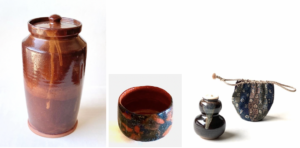
Hoso mizu-sashi, 細水指, slender water-indicate; terra cotta, cylindrical vessel with self-lid, and amber glaze, by R. Jesem, 1994, Old Sturbridge Village, Massachusetts; complete height, 9 1/2 inches (8 sun kane-jaku.) Such wares are recreated in the style of ‘red ware’ pottery in the colonial period of Massachusetts.
Cha-wan, 茶碗, tea-bowl, ceramic, aka-raku, 赤楽, red-pleasure, with black accents and suna-gusuri, 砂薬, sand-glaze, H. 2.2 sun kane-jaku, Mura-ta Tō-in, 村田陶隠, Town-field Ceramic-seclusion, Yama-shina, 山科, Mountain-department.
Cha-ire, 茶入, tea-receptacle; brown ceramic hisago, 瓠, bottle gourd, by Ban-dai Ki-zan, 万代㐂山, Ten thousand-generation Joyous-mountain, Kyōto, with ivory lid and silk, drawstring shi-fuku, 仕覆, work-cover, with a pattern of ‘Ichi-matsu Takara Don-su’, 市松宝緞子, City-pine Treasure Damask-of. The bottle gourd-shape jar is one of the oldest and most revered chaire in Japan.
All things are a manifestation of both In and Yō, 陰陽, Yin and Yang, negative, receptive, and positive, penetrative, and quite often the nature of the object will change from one aspect to its opposite. Almost every container is a manifestation of the aspect of In, receptive, such as a cha-wan, 茶碗. The mizu-sashi, 水指, water-indicate, fresh water vessel is In but changes to Yō when covered with a lid. The kama is In and changes to Yō when the lid covers it. The kama no futa, 釜の蓋, kettle’s lid, is kept ajar to allow steam to be released so that it changes back to In as it can be entered. If kept closed, Yō, pressure will build until the vessel explodes and naturally changes to In. The practice of In and Yō is called On-Myō-dō, 陰陽道, Yin-Yang-way. This is all part of the ancient Chinese of ‘I Ching’, in Japanese Eki-kyō, 易経, Change-sutra. It cannot be over-emphasized of the importance of one of Rikyu’s names was ‘Sō-eki’, 宗易, Sect-change. He was known as Sen Sōeki from his late teens.
The physical shape of the hisago chaire can be seen to serve as a sacred microcosm reflecting the dualistic principles of the universe. The upper sphere of the chamber embodies Yō, 陽, positive, active celestial light, whereas the lower sphere of the chamber corresponds to In, 陰, receptive, terrestrial substance. At their intersection, the narrow waist represents the Tai-ji, 太極, Great-ultimate, acts as a portal through which primordial energy is refined into cosmic harmony. In utilizing a gourd vessel, the tei-shu manipulates a miniature model of the cosmos, bridging the metaphysical and material realms within the tearoom.
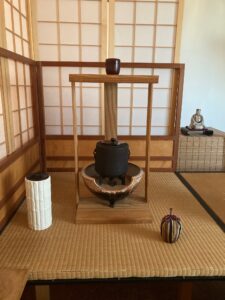
Tana, 棚, shelf, wood slats, baseboard and upper shelf supported on three posts, by Palmer. Fu-ro, 風炉, wind-hearth, ‘beni-bachi’, 紅鉢, rouge-bowl, form, ceramic bowl with three feet and crescent hi-mado, 火窓, fire-window, with black and white glazes in the style of Ori-be, 織部, Weave-guild, diam. one shaku kane-jaku; by William Sōei Thrasher, Wellesley, Massachusetts. Tsutsu-gama, 筒釜, cylinder-kettle, tetsu, 鉄, iron, vessel with horizontal scoring, and bronze lid, H. 5 sun kane-jaku, Japan. Natsume, 棗, jujube, lacquered tea container, H. 1.8 .sun kujira-jaku. Cha-ire, 茶入, tea-receptacle; low fired ceramic jar with ash glaze by Makoto Ya-be, 誠矢部, Truth Arrow-bureau, Boxford, Massachusetts. With ivory lid, and shi-fuku, 仕覆, work-cover, drawstring silk bag with pattern Ao-ki kan-tō, 青木間道, Green-tree Interval-way,White glazed ceramic ‘bamboo’ hoso mizu-sashi, 細水指, narrow water-indicate, by Janice Palmer, West Palm Beach, FL , with black-lacquered lid.
This picture shows a Nakaoki Tea presentation using an improvised ‘Go-gyō-dana’, 五行棚, Five-virtues-shelf. The essential aspect of the display stand is to feature the kama and the furo. The furo should be made of ceramic or earthenware, do-bu-ro, 土風炉, earth-wind-hearth, as it embodies the element of Earth, which is one of the Go-gyō. The other four elements: Wood – shelf; Fire – charcoal; Metal – kettle; Water – hot water.
Perhaps what is even more relevant to Chanoyu is the purpose of the tana, with its upper shelf identified with heaven: ten-ita, 天板, heaven-board. The baseboard is called the ji-ita, 地板, earth-board. The tenita provides a prominent place to display a tea container; either a chaire for koicha matcha, or an usuki for usucha matcha. In the above photograph, a Rikyū-gata chū-natsume, 利休形中棗, Rikyū-style middle-jujube, tea container is displayed on the tenita. In more formal Tea presentations, the chaire may be displayed on the tenita.
The gogyō dana is inspired by the instructural gyō-dai-su, 行台子, transitional-support-of; a more formal display stand which is also called take-dai-su, 竹台子, bamboo-support-of. The daisu identifies the nature of each utensil necessary to prepare Tea, through the application of the two arrangements of the trigrams of the Ekikyō.
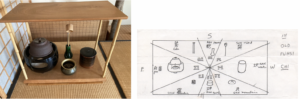
Take dai-su, 竹台子, bamboo support-of, is made of kiri, 桐, paulownia, composed of rectangular baseboard, ji-ita, 地板, earth-board, and an upper shelf, ten-ita, 天板, heaven-board, supported by four take bashira, 竹柱, bamboo posts. Utensils for preparing tea are displayed on the jiita which is identified with the ‘old’ arrangement of trigrams from the Ekikyō. The furo / kama is displayed on the trigram for Fire, the mizusashi is on the trigram for Water. North is identified with the front of the jiita, and is identified with the trigram for Kon, 坤, Earth, and is the location of the ken-sui, 建水, build-water. The trigram Kon also locates the teishu in the North.
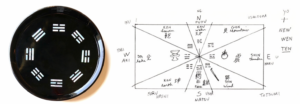
Ha-kke bon, 八卦盆, eight-divination signs tray; black-lacquered wood with inlaid ‘trigram’ designs in ao-gai, 青貝, blue-shell, mother-of-pearl; diam. 8.8 sun kuira-jaku. The tray is placed on the ten-ita, 天板, heaven-board, of the take daisu, and exhibits the ‘new’ arrangement of trigrams with ao-gai designs. The trigram for Fire is located at the bottom (North) of the tray, which identifies the nature of the chakin and the chasen. The trigram for Water is at the far side of the tray, and establishes the South.
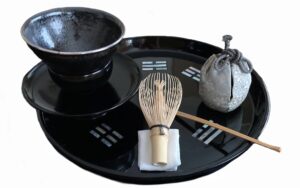
Image of the hakke bon set with utensils as depicted in the diagram above with the dai-tenmoku chawan on the trigram Da, for Lake, ☱, the chaire on the trigram Shin, for Thunder,☳, the chashaku on the trigram Son, for Wind, ☴, the chashaku is angled so that the tip of the tea scoop points towards Ken, Heaven, ☰, and the chakin and the chasen rest on the trigram Ri, for Fire, ☲.
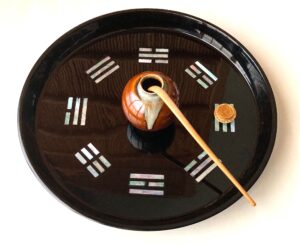
The above photograph shows the original, central location of the chaire before the start of the tea preparation. The lid of the chaire is placed in the East on the trigram for Shin, 震, Quake, Thunder, which is where the chaire is placed after its purification. The chashaku is placed across the trigram for Son, 巽, Wind, Southwest, after it is purified. The trigram for Wind is opposite the trigram or Ken, 乾, Dry, Heaven, Northwest. In this image the chashku is placed as such only to show its original position, this is not to indicate its placement during the Tea procedure. This image is provided as a context for showing the change that occurs regarding trigram representation and association during a Tea presentation. The hakke bon and the Ekkikyō provide near endless opportunities to study the nature of change both in the Tearoom as well as in the natural world.
Autumn is a profound season of change, particularly in Japanese culture. October, in Japan is called Jū-gatsu, 十月, Tenth-month, and its older more traditional name is Kan-na-zuki, 神無月, God-no-month. It is the time when the myriad of Shintō deities assemble at Izumo Tai-sha, 出雲大社, Out-cloud Great-shrine, in Shimane Prefecture. This leaves the countless shrines throughout Japan without their deities. The Buddhists however remain in their altars. At Izumo, the old name for the month is Kami-ari-zuki, 神在月, God-are-month.
Although the shrines may be godless, there are important festivals in October that are dedicated to certain Shintō deities in Japan. The gods Daikoku and Ebisu, who are deified at Izumo, are venerated elsewhere in Japan. Such as Tō-ka E-bi-su, 十日恵比寿, Ten-day Joy-like-longevity, Autumn Grand Festival (Daikoku Festival) is held in early October in Fukuoka, Japan. Also, Ebisu is venerated in Tōkyō in late October. Inari, the god of agriculture, including Tea, is worshipped at the Ina-ri Tai-sha, 稲荷大社, Rice plant-carry Great-shrine, in Fushi-mi, 伏見, Down-see, near Kyōto.
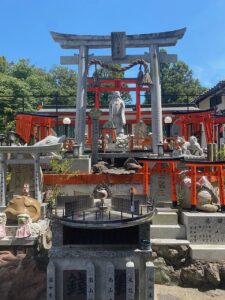
Shrine and offerings dedicated to Inari Ō-kami, いなり大神, ‘Rice plant’ Great-god, at Fushimi.
The Iemoto of Urasenke dedicates Ken-cha-shiki, 献茶式, Offering-tea-rite, at Fushi-mi Ina-ri Tai-sha, 伏見稲荷大社, Down-look Rice plant-carry Great-shrine, this event is held annually on October 24. The Tea offering is to Ina-ri Ō-kami, 稲荷お神, Rice plant-carry Great-god, the Shintō deity of rice, agriculture, business prosperity, and general abundance is generally held on the eve of Inari’s annual Nuki-ho-sai, 抜穂祭, Harvest-rice plant-festival. The Nukihosai festival includes Ka-gura, 神楽, God-music, in which dancers holding freshly harvested rice stalks and sacred sickles perform the harvesting dance. The ripened rice stalks come from the sacred rice fields within the shrine grounds. The harvested rice straw is burned at the Fire Festival and the rice stalks are then offered by the emperor to the Shintō gods during the seperate Nii-name-sai, 新嘗祭, New-taste-festival.
There are many comparisons that can be made between the presentation of Tea during Nakaoki which mirror aspects of the harvest season. In standard Tea gatherings, the furo and mizusashi are set side-by-side. During Nakaoki, however, the host repositions the furo directly to the middle of the tatami mat while placing a slender, tall mizusashi to its left. This structural division between fire and water mirrors the agricultural separation of harvested rice grain from its stalk and husk during autumn threshing and winnowing. Much like farmers using wind to blow away light husks while retaining the heavy grain, Nakaoki intentionally isolates the utensils to honor each element in its moment of transition.
The ash prepared within the brazier for Nakaoki is distinct. Rather than utilizing the smooth, meticulously sculpted gray ash typical of summer, hosts introduce wara-bai, 藁灰, straw-ash, blackened ash produced from burning leftover straw of newly harvested rice. Slender, carbonized strands of straw are arranged across the hearth bed, forging a tangible link between the countryside harvest and the intimate setting of the tea room.
October stands as the most wabi (rustic, simple, and solitary) month in the Tea tradition, reflecting the surrounding autumn landscape. Fields are left bare and muddy after green rice paddies are cleared, marked only by wooden drying racks. To evoke this quiet bareness, Nakaoki incorporates simple, textured, or imperfect Japanese-style utensils, such as rustic or chipped and repaired tea bowls, and other utensils.
This period coincides with Kannazuki, the ‘Month of No God’, when Shintō kami depart local shrines to gather at Izumo Taisha. It aligns with Tōkanya (Ten-Day-Night), a festival on the 10th night of the 10th lunar month where farmers send the rice paddy deities (ta-no-kami, 田の神, ) back to the mountains following the harvest. In light of the deities’ departure, the Nakaoki arrangement centers the fire as an altar-like focal point, offering Tea and incense in homage to the unseen spiritual realm and the completed agricultural cycle.
Additionally, Nakaoki incorporates implements crafted from dried bottle gourds, hyōtan, such as a gourd kensui or a small gourd vessel for sweets, or gourd shaped containers for holding tea. In East Asian cosmology, the two-chambered gourd symbolizes the complete vessel of sustenance—one chamber holding water and the other storing harvested grain. Integrating gourd items into the Nakaoki arrangement quietly pays tribute to the traditional harvest vessel.
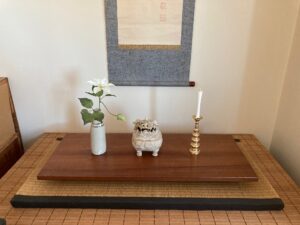
The arrangement of utensils for Nakaoki are derived from the Buddhist altar, and the formal setting in a tokonoma for Tea. The three implements are a combination of three Buddhist ‘mitsu-gu-soku’, 三具足, three-tool-foot: a flower vase, an incense burner, and a candlestick.
The burning ember of wick of a candle or oil lamp wick is called ka-shin, 花芯, flower-wick. Which is the name of a flower’s center, the pistil. This is one reason why flowers are not displayed at night when there is an oil lamp and candle burning in the Tea room. The incense burner is always placed in the center of the tokonoma.
On a deeper, metaphysical level, moving the furo to the center mimics Buddhist altar layouts, where the central incense burner sits directly in front of the deity. By centering the fire, the host creates a sacred axis in the Tearoom. According to traditional esoteric cosmology, In and Yō theory, Five Elements theory, etc., shifting the water to the left and fire to the center shifts the host’s orientation to a position completely subservient to the guests and the divine, heightening the spiritual purity of the gathering.
October is the final month of the ‘Tea Year’ – before the sunken floor hearth is opened in November, Robiraki, 炉開, and before the celebration of the arrival of shin-cha,新茶, new Tea during Kuchikiri, 口切, Mouth-cut, meaning cutting open the paper wrapped mouth of the jar containing the new Tea.
October is celebrated as the season of Nagori, 名残, which means ‘remnants’ or ‘the sorrow of parting’. Nakaoki serves as the ultimate expression of wabi-sabi—finding beauty in imperfection, aging, and decline, which also indicates the start of a new cycle. It is both an ending, and an anticipation of a new beginning in what will soon be expressed through profoundly changing the location of Water to the center of the tatami, and moving Fire towards the center of the yojōhan. Nakaoki is an expression of a world in flux.