Chasen and Sugi-ita
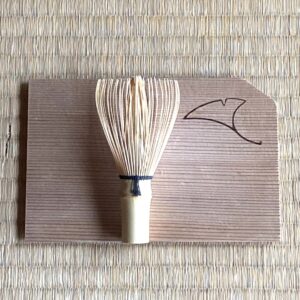
Cha-sen, 茶筅, tea-whisk, placed on a sugi-ita, 杉板, cedar-board.
Cha-sen, 茶筅, tea-whisk, take, 竹, bamboo, with kuro-ito, 黒糸, black-thread; L. 3 sun kujira-jaku. The diameter of the bamboo tube is 6 bu kujira, with a circumference of 2 sun kujira. Although the number and style of the tines, ho, 穂, varies according to the uses and traditions, a standard number of tines is 80.
The length of each of the flared tines is approximately 1.8 sun kujira. The diameter of the circle of tines is 1.5 sun kujira, its circumference is approximately 4.712 sun kujira. The fushi is intact so that the handle end could contain water. This is an aspect of In, 陰, Negative/receptive, and Yō, 陽, positive/penetrative. The tines penetrate the tea and water, which is Yō. This corresponds with the In aspect of the handle as a container. The black thread separates the outer ring of tines from the inner ring of times. It also keeps water away from the handle. The little, thread ‘tail’ establishes the front, shō-men, 正面, correct-face, of the whisk.
The chasen has measurements using the kujira-jaku, 鯨尺, whale-span. However, there are instances that the kujira-jaku measurement has symbolic significance when transferred to the more familiar kane-jaku. The kane-jaku is 8/10ths the length of the kujira-jaku. Transposing the number 4.712 sun kujira-jaku to kane-jaku the number is 5.89. As the figure is approximate, it is likely that the true number is 5.9. The number in Japanese, 五九, can be read goku, which is highly symbolic, especially in Buddhism. Goku-raku, 極楽, Extreme-pleasure, refers to the western paradise of Amida, the Buddha of Mercy. The word go can mean five, 五, an honorific, 御, protect, 護, etc.
The sugi-ita, is more formally called a sugi mei-mei-ita, 杉銘々皿, cedar name-name-dish. At Urasenke, the board is for serving hi-ga-shi, 干菓子, dry-sweet-of, and is often presented to a guest as a souvenir.
The back right corner of the board has been removed, and has been branded with a motif of an i-chō no ha, 銀杏の葉, silver-apricot ’s leaf, also ginkgo.
The size of the board is 5.8 x 3.8 sun kane-jaku. The number 8, hachi, 八, is symbolic of Infinity in Space. The number 5, go, is manifest in many groups of like content or form; such as Go-gyō, 五行, Five-transitions, physical elements, Earth, Water, Fire, Metal, and Wood, and Go-rin, 五輪, Five-rings, five principles, Earth, Water, Fire, Wind, and Void. Collectively, the elements and principles manifest a sixth aspect of Shiki, 識, Consciousness.
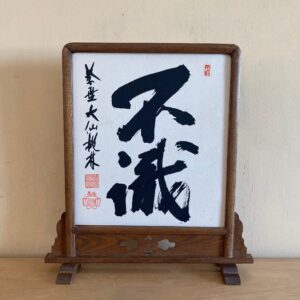
Shiki-shi, 色紙, color-paper, with calligraphy, ‘Fu-shiki’, 不識, No-consciousness, written by O-zeki Tō-rin, 尾関桃林, Tail-barrier Peach-grove, abbot of Dai-sen-zen-in, 大仙禅院, Great-hermit-Zen-temple, a sub-temple of Dai-toku-ji, 大徳寺, Great-virtue-temple, Kyōto. Signed: Murasaki-no Dai-sen Tō-rin, 紫野大仙桃林, Purple-rice field Great-hermit Peach-grove, and red ink stamps for the temple and the author.
A major homonym of shiki, 敷, spread, is shiki, 色, color, as for the word shiki-shi, 色紙, color-paper, which are pasteboard ‘squares’ for writing and pictures, like the shikishi above. The Kanji on the shikishi is another homonym, shiki, 識, consciousness, in the expression uttered by Daruma, ‘Fu-shiki’, 不織, consciousness.
The standing frame is made of kuwa, 桑, paper mulberry. Japanese monks are called Sō-mon, 桑門, Mulberry-gate.
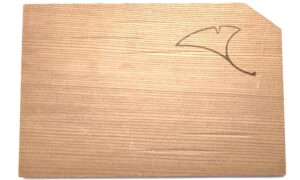
The board, called a mei-mei-sara, 銘々皿, inscribe-inscribe-dish, which held okashi, that was a souvenir of a major Chanoyu celebration at Urasenke in Kyōto. L. 4.6 sun kujira. Right edge L 2.5 sun kujira. Upper edge 3.9 sun kujira. Left edge L. 3 sun kujira. Ginkgo leaf brand – L. 1.5 sun kujira-jaku.
The board’s measurements of 3.8 x 5.8 are composed of numbers that are highly symbolic: 8, 3 and 5. The numbers 3 and 5 add up to 8, which is the number of Infinity in Space. The chamfered corner measures one sun kane-jaku, which when added to the top edge of 5 sun kane, the total length of the top edge is 6 sun kane. The number 6 is symbolic of Infinity in Time. The right edge is chamfered so that the length of the edge is 3.2 sun kane. Adding one sun from the chamfer, the total measurement of the right edge is 4.2 sun kane.
The Sutra of Forty-two Chapters, Chinese: 四十二章經, is often regarded as the first Indian Buddhist sutra translated from Indian texts into Chinese.
As a complete rectangle, the sugi-ita has four corners and four sides which is an aspect of In. Four can be divided equally in half which is also In, as two can be divided equally in half. By removing a corner of the rectangle, the shape has five corners and five sides, which is an aspect of Yō. This changes the nature of the board from In to Yō.
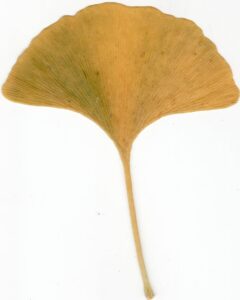
The ginkgo leaf, ichō-no-ha, 銀杏の葉, motif is an emblem identified with Urasenke, 裏千家 and Omotesenke, 表千家. The tree is one of the oldest on earth. It is also called maidenhair. Its leaf resembles a folding fan, sen-su, 扇子, fan-of, that is the shape of the Japanese number eight, hachi, 八, which is symbolic of infinity: sue-hiro, 末広, ends-wide. The form of the ginkgo leaf and its striations resembles a two-dimensional chasen.
Ginkgo leaves often spin as they fall, and the chasen mimics the leaves. Sōtan planted the great ginkgo tree that shades the Yū-in, 又陰, Again-retire, tea hut that he built following the principles of his grandfather, Rikyū. It is believed that Sōtan’s ginkgo tree rained down protecting the hut against the raging fire of 1788, that destroyed much of Kyōto city.
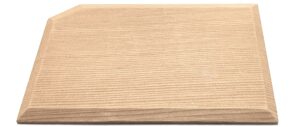
Sugi-ita showing the reverse side and the bevel, men-tori, 面取り, face-take, so that it is easier to pick up the board.
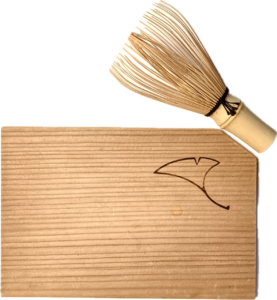
The length of the chamfered corner of the sugi-ita is equal to the handle of the chasen, from the end to the fushi, 節, node – 1 sun kane-jaku.
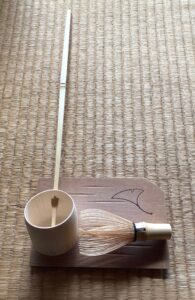
A sugi-ita width is equal to the length of a chasen that whisks a bowl of tea, and the diameter of a sashi-toshi hi-shaku, 差し通うし柄杓, between-pass handle-ladle, that measures the amount of water for a bowl of tea.
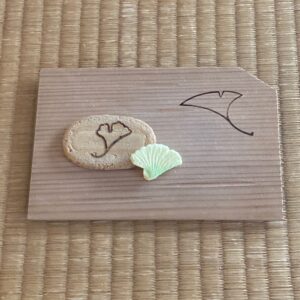
Sugi-ita with Urasenke higashi. Single serving of both higashi: rakugan in the shape of a ginkgo leaf, and wheat fu-no-yaki, 麩の焼き, gluten-’s-toasted, with a branded ginkgo leaf motif, designed by Sen To-mi-ko, 千登三子, Thousand Ascend-three-child, wife of Hōunsai. Regardless of the manner in which the single serving of sweets is presented on an usu-ita, 薄板, thin-board, the rakugan is eaten first.
The ichō (Ginkgo biloba), ginkgo leaf, is a design motif as a symbol of Urasenke, and, particularly, of Sen Sō-tan, 千宗旦, Thousand Sect-dawn, Rikyū’s grandson, the founder of the three Sen families. The nuts of the ginkgo are called gin-nan, 銀杏, silver-apricot, which is taken from its Latin name. Ginnan are greatly enjoyed nuts, but followers of the Sen families do not eat them until after the rites of Sō-tan-ki, 宗旦忌, Sect-dawn-memorial, traditionally held on November 19 every year. The okashi served at the memorial are ginnan mochi.
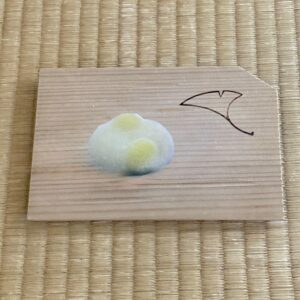
‘Ginnan Mochi’ on a sugi-ita, 杉板, cedar-board.
Japan’s mountainous forest terrain has provided it with an abundance of a variety of trees and plants. Perhaps the most important is the cedar tree; sugi, 杉, Cryptomeria japonica, known as Japanese cedar. The cedar symbolizes longevity, sacred presence, and divine connection in Japan.
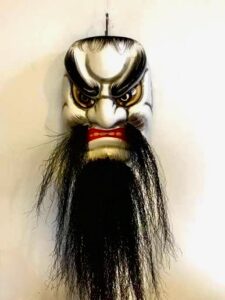
Sugi trees are planted at Shintō shrines and Buddhist temples as sacred bridges, yori-shiro, 依代, due to-eras, where divine spirits reside. According to the ancient chronicle Nihon Shoki, the storm deity is Su-sa-no-o-no-Mikoto, 素戔嗚命, Elementary-damage-cry’s lord, nose-born brother of Ama-terasu, 天照, Heaven-bright, the Shintō sun goddess. Susanoo created the Japanese cedar out of the hairs from his beard. Japanese mythology links Cryptomeria japonica directly to facial hair, recording that the tree sprouted from Susanoo’s beard. Other iconic trees arose from different parts of the god’s body, including chest hair (hinoki, 檜, cypress) and eyebrow hair (kusu, 楠, camphor tree). The Kanji for sugi, 杉, is composed of ki, 木, tree, and sen, 彡, three (hairs or light rays).
In Izanagi’s flight from seeing his dead wife, Izanami, decaying in the netherworld, he was pursued by Yo-motsu-shiko-me,黄泉醜女, Yellow-springs Ugly-woman, Izanagi took the head-dress, kuro-kazura, 黒鬘, black wig, from his head, and threw it to the ground where it turned into a bunch of budō, 葡萄, grapes. The Yomotsushikome started to eat them but kept chasing the fleeing Izanagi. Izanagi broke a tine from the comb that he wore in his right hair bun, and as he threw it to the ground it became take-no-ko, 竹の子, bamboo shoots, prompting Yomotsushikome to stop and eat them, enabling Izanagi to flee.
A homonym of take/bamboo is take, tate, 建, build, erect, establish, etc. In Chanoyu, tate means to whisk a bowl of foamy tea: usu-cha wo tate, 薄茶を點, thin-tea to offer/to whisk.
The name ‘Take’ included in the alternative name or divine title of Susanoo-no-Mikoto emphasizes strength, bravery, or power.
The meaning and origin of take, 建, is a kind of honorific or epithet that describes something powerful, strong, and brave. In the Ko-ji-ki, 古事記, Old-matter-record, Susanoo is also called Take-haya Susano-no-Mikoto, 建速素戔嗚命, and the name is prefixed with words that express powerful force, such as Take, 建, Build, and Haya, 速, Quickly. His name emphasizes the meaning of ‘a god who rages and rampages with fierce force’, ‘a god with great power’.
The annual festival associated with Susanoo-no-Mikoto is the San-ka-sai, 鑚火祭, rub sticks-fire-festival held every October 15 at Kuma-no Tai-sha, 熊野大社, Bear-field Great-shrine, of the Izumo region, where Susanoo is enshrined, and fires are ritually kindled. The Kumano Taisha Sanka-sai fire festival marks the origin where Susanoo-no-Mikoto is believed to have first produced fire using sacred wood drills; hi-kiri-usu, 火鑽臼, fire-rub-mortar, and hi-kiri-kine, 火燧杵, fire-rub-pestle.
After slaying the giant serpent, Susanoo built a palace in Izumo Province and married Kushinadahime. The residence became Kushi-da Jin-ja, 櫛田神社, Comb-field God-shrine, in Fuku-oka-shi, 福岡市, Fortune-hill-city. Due to war and mishap, the shrine has been rebuilt several times.
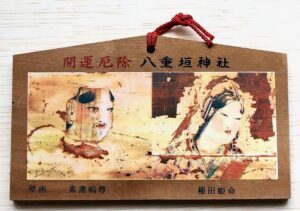
E-ma, 絵馬, picture-horse, with two color print images of Susanoo and Kushinadahime, aslo known as Ina-da-hime-no-mikoto, 稲田姫命, Rice-field-princess-lady, from Ya-e-gaki Jin-ja, 八重垣神社, Eight-tier-fence God-shrine. The pentagonal shape of the ema evokes the five cornered sugi-ita.
Many famous Japanese shrines, such as Ya-saka Jin-ja, 八坂神社, Eight-hills God-shrine, in Kyōto, enshrine both Susanoo and Kushinadahime. One of the shrine’s main features is the thousand-year-old ginkgo tree: Kushi-da-ginkgo, 櫛田銀杏. It was a tine of Kushinada’s comb with which Susanoo killed the Great Snake.
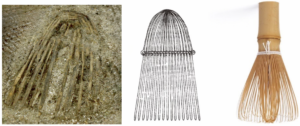
An ancient wooden upright comb excavated from the Kamezuka Site in Anjo City, Aichi Prefecture. It is believed to date from the period spanning the late Yayoi period to the early Kofun period. Drawing of intended construction of the comb. Formal chasen with white thread. The comb is flat, whereas the chasen is three-dimensional.
The comb unearthed from the site is not coated with lacquer to conceal the inside, but rather has a decorative finish, leaving the cord visible. This suggests that the cord that holds the comb in place was woven in with the intention of being visible from the beginning.
In Japanese mythology, Susanoo is identified with one of the the most famous swords, the Kusanagi no Tsurugi, 草薙の剣, Grass-mow ’s Sword. It is a treasure that he obtained from its tail of when he slew the Ya-mata-no O-rochi, 八岐大蛇, Eight-branch Great-snake, a giant serpent with eight heads and eight tails. The sword is also known as the Ama no Mura-kumo no Tsurugi, 天叢雲剣, Heaven’s thicket-cloud ’s Sword, Susanoo dedicated this sword to Amaterasu, the sun goddess, which became one of the Three Sacred Treasures of the Japanese Imperial Family, and is enshrined at Atsu-ta Jin-gū, 熱田神宮, Heated-field Shrine-palace, in Nagoya.
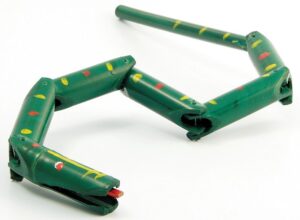
I-se no take-hebi, 伊勢の竹蛇, That-strength ’s bamboo-snake, seven segmented pieces of painted bamboo, made in the area of Ise, as a souvenir having visited the shrine of Amaterasu. The toy is inspired by the Chinese toy made for the zodiac sign Mi, 巳, Snake, and, in Japan, could evoke thoughts of the Great Snake killed by Susanoo.
Before Susanoo was banished to the Middle World, he acquired silk worms and five grains: kome, 米, rice, kibi, 黍, millet, mugi, 麦, wheat, azuki, 小豆, small-bean, and dai-zu, 大豆, large-bean, soy beans and adzuki beans, 小豆. With those he landed on a mountain in Izumo, 出雲, out-clouds, in the southwestern part of Japan by the Sea of Japan. In many ways, he is credited with bringing foods of sustenance to Japan, as well as the fire needed to cook them.
One of the popular sweets served during a Tea gathering is neri-yō-kan, 練り羊羹, knead-sheep-stew, a sweetened azuki bean gel.
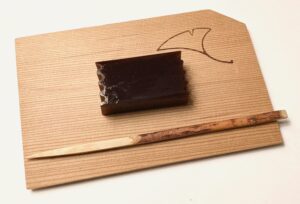
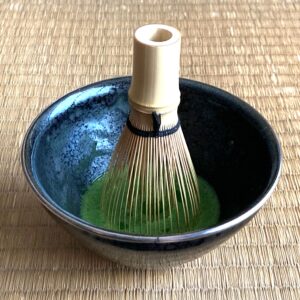
Sugi-ita with a single serving of neri yōkan and a kuro-mo-ji, 黒文字, black-letter-character, wooden pick, with a black-glazed ceramic Ten-moku cha-wan, 天目茶碗, Heaven-eye tea-bowl, of tea prepared with a chasen.
For Further Study, see also: Chasen Collection, Natsume Chasen Chashaku, and Chanoyu: Spirts of Winter and Spring