
Celestial Guardians, Fragrance, and the Cosmos
V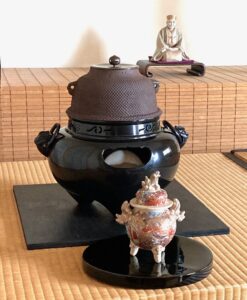
Ki-men bu-ro, 鬼面風炉, Demon-face wind-hearth, with loose rings, bronze, with kama, 釜, kettle, iron, and a ceramic kō-ro, 香合, incense-hearth, elaborately decorated ceramic, with dragon motif handles and lid knob, Kin-ran-te, 金襴手, Gold-brocade-hand-hand, Satsu-ma–yaki, 薩摩焼, Salvation-polish-fired. ‘Satsuma’ ware inscribed Dai-ni-ppon Hayashi Yasushi-zō, 大日本林安造, Great-sun-origin Grove Calmly, were produced in the Satsuma-style during the Meiji era and exported overseas.
The kama has taken the place of the lid of the kōro which is usually perforated to allow the fragrance and smoke to be released. The furo with its ‘dragon’ demon features may be seen primarily as a large incense burner that likely came from a Buddhist temple.
Incense burners featuring the Chinese dragon, long, 龍, represent traditional decorative ritual vessels that embody the essence of sovereign might, auspicious fortune, and the domain of water. In the historical context of the imperial throne, the presence of the dragon motif on these censers served as a manifestation of supreme protection and the absolute power of the Emperor.
Though dragons are identified with realms of water, celestial rains, and the majesty of the imperial throne, the shi-shi, 獅子, lion, often emerged as the preeminent sentinel for the hallowed thresholds of Buddhist sanctuaries. Within these sacred monastic and domestic settings, using the kōro naturally favored the protective and purifying iconography of the lion, frequently depicted resting its paw upon a cosmic orb or a mystical, wish-granting hō-ju, 宝珠, treasure-jewel.
The shift from the dragon to the shishi on traditional incense burners mirrors the profound cultural integration of Buddhism, moving from indigenous imperial imagery toward protective, divine ‘animals’ that relish the presence of smoke. Because lions were not indigenous to the lands of China, their introduction as both living beasts and philosophical concepts occurred through the expansion of diplomatic and mercantile exchange along the Silk Road during the Han Dynasty. This happened alongside the spread of Buddhism from India to China and Japan.
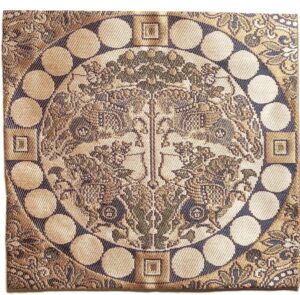
Kō-buku-sa, 古帛紗, old-cloth-gauze, silk square of doubled fabric with a pattern of ‘Shi-ten-nō shi-shi-kari mon-nishiki’, 四天王獅子狩紋錦, Four-heaven-kings lion-of-hunt crest-brocade. Variation of fabric treasured at the Shō-sō-in, 正倉院, True-warehouse-temple, Nara.
The fabric design may represent aspects of the Fear East as the Babylonian Empire was symbolized by a winged lion, which was a major historical enemy conquered by the Achaemenid Persian Empire under Cyrus the Great.
Throughout the vast duration of Sasanian governance, spanning four centuries, the Persians served as the preeminent cultural force along the Silk Road. Their distinct aesthetic, manifested through pivotal commerce and ceremonial offerings—most notably the textiles and metallurgy crafted within imperial ateliere – evolved into a universal visual language, traversing the globe from Japan to the European continent. The shishi representing the essence of sovereignty, might, and the guardianship of hallowed grounds, emerged as a pervasive theme in both precious metalwork and silk. This motif appears either as the fallen beast bestowing honor upon the noble huntsman or as the vigilant sentinel protecting the heart of the empire.
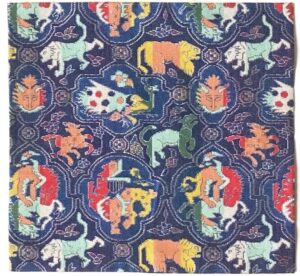
Kō-buku-sa, 古帛紗, old-cloth-gauze, silk square of doubled fabric with a pattern of ‘shi-kami chō-jō bun-nishiki’, 獅噛鳥獣文錦, lion-bite bird-beast motif-brocade, animals including golden and light blue lions. Based on fabric that was part of a jin-ba-ori, 陣羽織, battle-feather-weave, jacket worn by Toyo-tomi Hide-yoshi, 豊臣秀吉, 豊臣秀吉. Bountiful-retainer Excel-good luck; a treasure of Kō-dai-ji, 高台寺, High-support-temple, Kyōto.
Within sacred spaces, lions served as fierce sentinels of the Dharma, making them the natural choice for guarding ritual domains. During the Song Dynasty (960–1279 CE), as Buddhist thought permeated the aesthetic and ritual life of the era, ceramic and bronze vessels began to combine or replace dragon motifs with the majestic presence of these guardian lions.
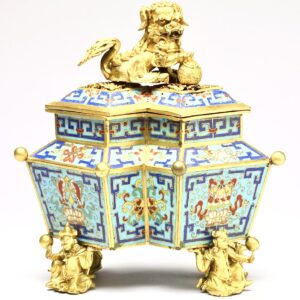
Chinese cloisonné enamel and gilt-bronze incense burner from the Qing dynasty, featuring a Buddhist lion finial and figural supports.
Eastern natural philosophy bridged these two icons, the dragon and the lion, through Suan-ni, 狻猊, the fifth son of the Dragon King. Described as a fabulous creature with lion-like features that loves the scent of burning incense and rising smoke, Suanni became the quintessential motif for the lids of these vessels, where the aromatic smoke dramatically billows through its bared teeth and nostrils.
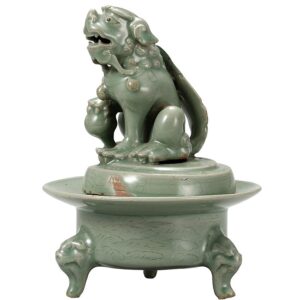
Celadon incense burner with lion-form cover, a 12th century masterpiece from the Goryeo Dynasty of Korea, and designated as South Korean National Treasure.
By the sixth century, the spread of Buddhism further popularized these figures, leading to the creation of stone and bronze sentinels to guard imperial dwellings and hallowed tombs. The original Persian term, šēr, was transliterated into Old/Middle Chinese as shī, 獅, earlier written as 師. The Chinese shī, 獅, eventually became shizi, 獅子, meaning lion. As the motif of the shishi migrated toward Japan and the edges of East Asia, it carried the echoes of its original pronunciation.The Kanji for lion, shi-shi, 獅, is composed of the Kanji ken, 犭, dog, and shi, 師, expert, teacher, master, model, exemplar.
Within the cultural lexicon of ancient civilizations and foundational mythologies, the lion manifests as the ultimate union of imperial mastership, royalty, courage and divine guardianship, thus establishing its enduring reputation as the preeminent sentinel and king of the animal realm and symbolic protector within sacred human realms.
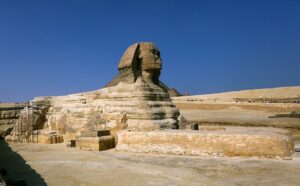
The Great Sphinx at Giza, Egypt. The stone mass may have originally had the head of a lion, lioness, or a dog known as Anubis.
It is believed that the sphinx was created between 2600 and 2500 BCE. Within the architectural lexicon of ancient Egypt, the lion-bodied sphinx manifests as the ultimate union of imperial mastership and divine wisdom.
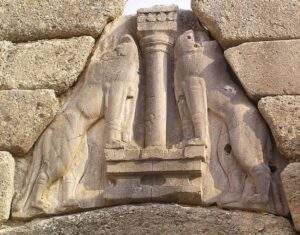
Lion Gate, stone lintel entrance; 1250 BCE, Mycenae, Greece. Within the cultural lexicon of ancient Greece, the lion manifests as the ultimate union of imperial mastership, sovereign might, and divine guardianship, acting as a potent sentinel of heroic virtue. Transmitted from Near Eastern motifs during the Bronze Age, this iconographic theme emerged as the preeminent representation of supreme mastership, most notably manifested in the vigilant sentinels of the Lion Gate at Mycenae. Sculptures and reliefs of these mythic-like animals were pervasive themes for the hallowed thresholds of gates, sanctuaries, and sacred terraces—such as those found upon the island of Delos—where they served as fierce spiritual guardians of the primordial dwelling.
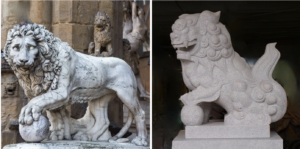
Left: ancient Roman lion at the Loggia dei Lanzi in Florence dates from the late 2nd century AD. Carved from white marble, it depicts an upright male lion with one paw resting on a sphere. Right: contemporary stone Karajishi, China: based on ancient Chinese models.

A pair of stone lion sculptures in front of the New York Public Library, New York, were modeled by sculptor Edward Clark Potter and carved by the Piccirilli Brothers. They were unveiled in 1911. Mayor Fiorello LaGuardia of New York City bestowed the informal designations of ‘Patience’ upon the left sentinel and ‘Fortitude’ upon the right during the era of the Great Depression. He remarked that these virtues embodied the resilient spirit of the citizenry of New York. Within the architectural lexicon of the United States, the iconographic theme of the lion is utilized on government and public edifices to manifest a state of majesty, security, and the sense of enduring strength.
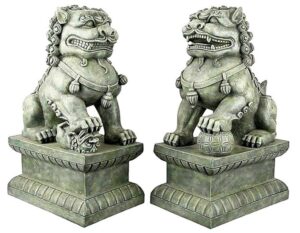
Pair of Kara-ji-shi, 唐獅子, Tang-lion-of; ceramic figures.
The pair are observed from right to left: the shishi on the right has his mouth open, A-gyō, あ行, Ah-transition, In, 陰,Receptive, the shishi on the left has his mouth closed N-gyō, ん行, N-transition, Yō, 陽, Positive. Together, the open and closed mouths represent the sounds of AUM, the sound that can lead to enlightenment.
In, 陰, receptive and Yō, 陽, postive philosophy can be seen as strongly present in the representation of Japanese shishi. They are traditionally arranged in pairs, the female lion is often depicted with a cub, embodying the qualities of nurturing energy and the cycle of life. In contrast, the male rests his paw upon an ornate ball, signifying worldly authority and cosmic unity, thus manifesting a state of societal balance.
This symbolic tradition traveled through Korea and Okinawa before reaching Japan, where these ancestral guardians evolved into the familiar temple figures sometimetime refferred to as koma-inu, 狛犬, lion-dogs.
Metaphorically the kara jishi serves as a celestial sentinel and spiritual anchor, acting as the vigilant protector of hallowed thresholds and sacred altars in a variety of spaces. This includes being positioned before or held within the hon-den, 本殿, main-dwelling, the hallowed inner sanctum of Japanese Shintō shrines.
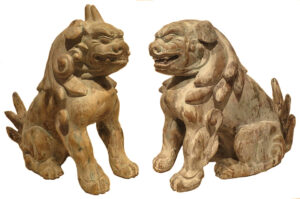
Pair of painted, carved wood sculptures – Left: Koma-inu, 狛犬, Korea-dog. Right: Kara-ji-shi, 唐獅子, Tang-lion-of; approximate H. 52 cm – 1.8 shaku kane-jaku; 14th-15th century, Japan. Such figures have been dubbed Foo-dogs.
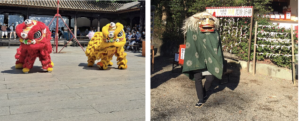
Left: shi-shi-mae, 獅子舞, lion-of-dance; two humans wearing highly colorful costumes, and who dance at auspicious occasions, China. Right: shishimae a human wearing a lion costume, shown dancing at a shrine, Japan. Note the spirals on the green fabric, representing the creature’s curly fur.
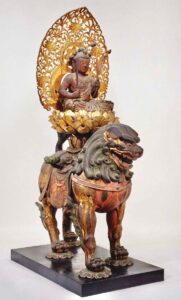
Mon-ju Bo-sa-tsu, 文殊菩薩, riding upon the back of a shi-shi, 獅子, lion-of – an Important Cultural Property held at Han-nya-ji, 般若寺, Wisdom-temple. This figure was produced at the behest of Bun-kan, 文観, the personal Buddhist monk of Emperor Go-Dai-go, 後醍醐, 14th century.
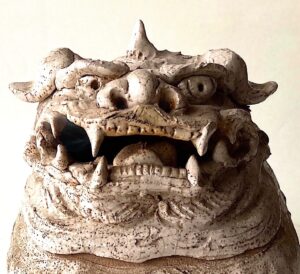
The Karajishi kōro pictured above on the left has a horn on the top of its head, which is a feature of the Komainu, as shown on the head of the Komainu figure above on the right.
The Komainu has origins in the Chinese Pulao, (Jpn. Ho-rō), 蒲牢, Bulrush-prison; a dragon-dog, loves to roar and scream. Through the cultural transmission of Buddhist ritual implements during the Nara and Kamakura eras, Japan embraced the synthesis of sacred incense traditions and the majestic iconography of the shishi. Japanese artisans meticulously adapted these continental forms into elegant kō-ro, 香炉, incense-hearth, establishing the lion’s presence upon the vessel’s lid, or used the entire lion form as the burner itself, as a means to utilize the potent sentinel’s ability to repel malevolence while honoring the divine nature of the fragrance.
Artisans in Japan crafted the kōro with a hollowed form and intricate openings at the mouth. When the charcoal and fragrant incense are ignited within, the aromatic smoke ascends to drift through the bared teeth or nostrils of the shishi. This arrangement evokes the divine illusion of a sentinel breathing forth celestial clouds, manifesting a kinetic spiritual presence that static dragon motifs on traditional vessels cannot emulate.
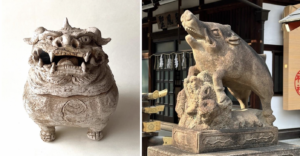
Left: ceramic kō-ro, 香炉, incense-hearth, in the form of a ‘Kara Ji-shi’, 唐獅子, Tang lion-of, Shino-yaki, 志野焼, Aspire-field-fired, by Mae-kawa Den-kō, 前川電光, Fore-river Lightning-light. Right: stone figure of an inoshishi, 猪, wild boar, with open mouth, at Go-ō Jin-ja, 護王神社, Protect-king God-shrine, Kyōto. One of a pair, which is located on the right when facing the main shrine hall.
There is a strong association in Japan between the protective nature of shishi and inoshishi as guardians of sacred spaces.
In the legend Wake no Kiyomaro (in Kanji Wa-ke no Kiyo-maro, 和気清麻呂, Harmony-spirit Pure-hemp-spine), a Nara-period aristocrat establishes the wild boar as a potent guardian. Following political exile and a brutal assault upon his tendons, Kiyomaro was escorted to Usa Jingū by a spectral legion of 300 ino-shishi, 猪, wild-boar. This mysterious intervention not only provided protection, but also granted the miraculous restoration of his physical mobility. After Kiyomaro’s death, he was deified as the Shintō kami, Goō Daimyōjin, Great Protector of the Emperor.
Goō Jinja in Kyōto is renowned for its unique presentation of sacred sentinels. This shrine replaces the somewhat customary shishi, with a pair of stone inoshishi guardians.
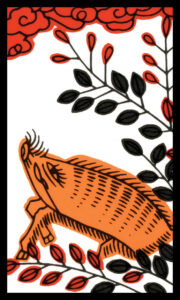
One of the cards of the game of Hana-fuda, 花札, Flower-card; from the four card suit for the 7th month, which features hagi, 萩, bush clover. The card is named ‘Hagi ni inoshishi’, 萩に猪, Bush clover in boar. The bush clover blooms in mid-July. The Kanji for hagi is composed of kusa, 草, grass, and aki, 秋, autumn. Hagi is one of the aki no nana-kusa, 秋の七草, autumn’s seven grasses.
‘Cho-totsu mō-shin’, 猪突猛進, Boar-thrust, is an ancient adage that features the boar, which means to be completely absorbed in one thing and to charge forward with tremendous force. Boars nest in hagi shrubs, and are auspicious because of their high fertility and the resulting prosperity of their descendants. The boar is venerated at Goō Jinja, west of Kyōto’s imperial palace. The shrine was a favorite of Daisōshō Hōunsai Hansō Sōshitsu XV, Urasenke, who was born in a Boar-year.
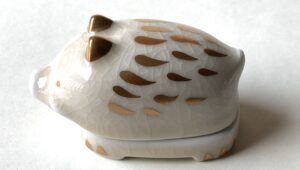
Kō-gō, 香合, incense-gather: Inoshishi, 猪, wild boar; ceramic covered container in the form of boar, with clear glaze and gilt ornamentation, un-signed, L. 2.4 sun kane. Gift of Shio-tsuki Ya-e-ko, 塩月弥栄子, Salt-moon Increase-splendor-child, sister to Daisōshō Hōunsai XV.
There is a familiar association between inoshishi and A-mi-da Nyo-rai, 阿弥陀如来, Praise-increase-steep Like-become, Buddha of Compassion. Amida Nyorai serves as the personal hon-zon, 本尊, origin-revered, or zodiac guardian deity for those individuals born during the Year of the Boar, I-no-shi-shi, 亥, Wild Boar.
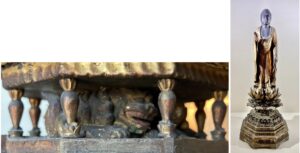
Lion with open mouth crouching in the base of a votive figure of A-mi-da Nyo-rai, 阿弥陀如来, Praise-increase-steep Like-become, Buddha of Compassion.
The open mouth form of the shishi kōro can be said to find its counterpart in an incense container strongly identified with summer in Japan, the ka-yari-buta, 蚊遣り豚, mosquito-repel-pig wich utilizes ka-tori-sen-kō, 蚊取り線香, mosquito-take thread-incense.


Left: katori senkō holder in the form of a kayari buta. Ban-ko-yaki, 萬古焼, Ten thousand-old-fired, ceramic ware. The kayari buta is a ceramic container open at the front and rear with a suspended coil of katori senkō releases wafts of smoke through the openings in the container.
Right: Chrysanthemum plant used to craft katori senkō coils. This represents a traditional Japanese method of repelling insects, by crafting incense coils from the desiccated blossoms and foliage of the jo-chū-giku, 除虫菊, repel-insect-chrysanthemum. This botanical source is scientifically identified as Tanacetum cinerariifolium, a particular variety of chrysanthemum, also referred to in the vernacular as the painted daisy or Dalmatian pyrethrum.
The standard katori senkō has a diameter of approximately 4 sun kane-jaku. The kayari buta has a standard diameter, tsū-jō, 通常, through-usual, of approximately 6 sun kane-jaku.
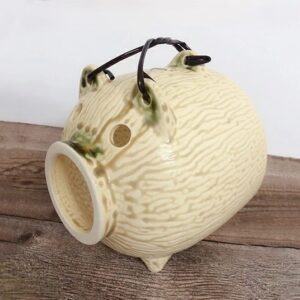
Ka-yari-buta, 蚊遣り豚, mosquito-repel-pig, white ceramic with streaked glaze, ki-Se-to-fu, 黄瀬戸風, yellow-Rapids-door-style. Note the Y-handle, which keeps the handle ready to be picked up. The pig’s two ears and one tail make it an easy choice for the Y-handle application. The ceramic pig may get hot, so a readily available handle is preferred.
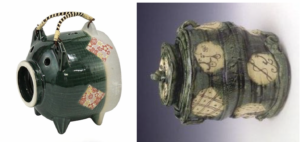
Left: ka-yari buta, ceramic and glaze in the style of Ori-be-yaki, 織部焼, Weave-guild-fired. Right: mizu–sashi, 水指, water-indicate, ceramic vessel with self-lid, Ori-be-yaki, laid on its side to show its similarity to the form of the mosquito pig.
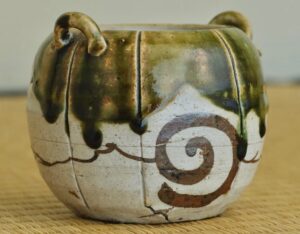
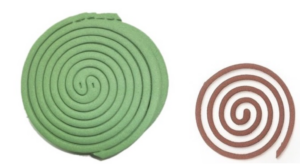
Left: katori senkō (double coil), to repel mosquitos. Right: uzu-maki sen-kō, 渦巻線香, spiral-wrap thread-incense, for the enjoyment of fragrance and fumigating properties.
The spiral repellent is turning counter-clockwise, like the much older spiral incense hō-rin, 宝輪, treasure-ring,
Molded katori senkō is commercially available in double interlocking coils that are separated to create two individual spirals. Each coil has four spirals. There are several styles, sizes, and materials that are used in making mosquito repellants. The fine incense hō-rin, 宝輪, treasure-ring, from Shō-yei-dō, 松栄堂, Pine-splendor-hall, is available as a single spiral as its fragility makes it easy to be broken.
When the doubled coil is separated, the single coil more fully represents the balance of In and Yō. The In, physical coil, and the Yō, the empty coil-like space within.
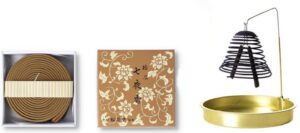
Left: uzu-maki sen-kō, 渦巻線香, spiral-wrap stick-incense, named ‘Shichi-ya-kō’, 七夜香, Seven-night incense, classified as ‘Goku-hin’, 極品, Extreme-goods, by Shōyeidō, Kyōto. The fragrance combines patchouli, cloves, and sandalwood. Each coil burns for approximately twelve hours. The packaging of Shoyeido’s Seven Night Incense has a pattern of vining clematis, which gets its name from the Greek klēmatís (κληματίς), meaning a climbing plant.
Shichi-ya-kō is burned during wakes and other funeral services to ensure a continuous stream of fragrant smoke around the bedside of the deceased. This practice of masking the smell of decay is the true origin of burning incense.
A time when people may make use of incense coils is during summer is the O-bon, お盆, Hon.-tray, season. It is a significant observance during the summer months, dedicated to honor and remember ancestral spirits. The formal designation, U-ra-bon, 盂蘭盆, is rooted in the Sanskrit Ullambana, which conveys the image of ‘hanging upside down’, a metaphor for the profound distress of souls in the afterlife. To offer solace and honor these lineages, household Butsu-dan, 仏壇, Buddha-altar, are adorned with seasonal flora and climbing vines, such as the clematis, serving as earthly offerings of tranquility. Clematis comes from the Greek klēmatís, κληματίς, signifying ‘a climbing plant’ or vine. Obon is a lunar event that corresponds with the full seventh moon. In preparation for Obon, seven days before, which corresponds with the seventh day and night of the seventh moon, the event now known as Tanabata. During this time the home is purified, often through utilizing ancient rites, including the offering of flowers and incense. While the date for Obon has moved due to the solar calendar there are many people who continue to observe the event in accordance with the lunar month.
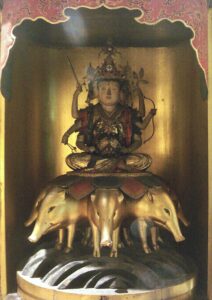
The familiar ka-yari buta, 蚊遣り豚, mosquito-repel pig, is often said to be modeled after the inoshishi, 猪, wild-boar, an animal believed to ward off the threat of fire. Through the lenses of Japanese and Buddhist syncretism, the inoshishi is recognized as the hallowed familiar of Ma-ri-shi-ten, 摩利支天, Polish-benefit-heaven, the primordial Goddess of Light. In her manifestation as a solar deity and sentinel of celestial radiance, she is traditionally depicted standing atop or escorting a fierce wild boar, a beast that embodies both protective strength and the essence of the sun.
Within the historical tapestry of Japan, Marishiten was venerated by samurai and travelers alike, who sought her intervention to secure triumph upon the field of battle and protection across perilous landscapes. In the Taoist tradition, she is honored as Dō-mu Yuan-jun, 斗母元君, Dipper-mother Original-lord, recognized as the primordial progenitor of the celestial stars and the sovereign of the Big Dipper. Within the syncretic lineages of Buddhism, she manifests as an emanation of Dai-nichi Nyo-rai, 大日如来, Great-sun Like-become, also known as Vairocana, endowing her with profound spiritual mastership over invisibility and absolute liberation.
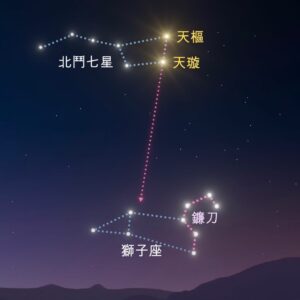
In Japanese, the constellation Leo is known as Shi-shi-za, 獅子座, Lion-of-seat. Pictured here with the Big Dipper pictured above the constellation of Leo.
The North Star and Big Dipper are called Hoku-tō Shichi-sei. 北鬥(斗)七星, North-fight(dipper) Seven-stars.
The astrological sign of Leo is prominent from July 23–August 22, however the actual physical star constellation is blocked by our star, the sun. Leo’s lion pattern was recognized by ancient civilizations in the Tigris-Euphrates River valley around 4,000 BCE. The Greeks connected the lion pattern with the Nemean Lion slain by their mythical hero, Heracles. The 2nd century astronomer Claudius Ptolemy cataloged Leo (Latin for lion,) establishing it in Western astronomy. Leo was established as one of the 88 official modern constellations by The International Astronomical Union.
In many systems of the cosmic order, the Lion is traditionally governed by the Sun. Pairing this solar shishi with the Moon manifests a potent symbol of universal equilibrium, representing the sacred union of day and night, gold and silver, or the interplay between Yō, 陽, action, and In, 陰, receptivity. Summer serves as the ultimate season of the sun, the peak of maximum Yō, where the intensity of heat eventually leads to the coolness of autumn.
In Japanese folklore and the rhythms of the ancient lunar calendar, the inoshishi, 猪, wild boar, and the radiance of the Full Moon, are deeply intertwined through the evocative iconography of autumn. The eighth month of the lunar cycle marks the essential bridge into the harvest season, where the image of a boar resting amidst bush clover, beneath the heavy, luminous moon serves to celebrate the eternal shifting cycles of the natural world.
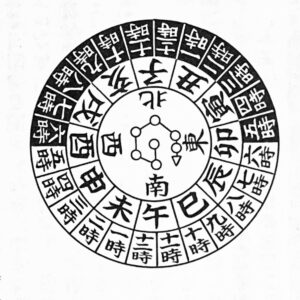
Ko-zu, 甲図, shell-picture: diagram of the cycle of Asian calendar related to the ju-ni-shi, 十二支, ten-branch, the twelve animal signs, and their time in a twenty-four day, the four cardinal directions, Tō, 東, Zai, 西 Nan, 南 Boku, 北. In standard Kanji and pronunciation these are: Higashi, 東, East; Nishi, 西, West; Minami 南, South; Kita, 北, North. In the center is a configuration of circles and a triangle that represent the seven stars Shichi-sei of the Big Dipper. This motif may be identified with the hiragana character of no, の, which unites the universe. It is a final gesture when drawing の preparing a bowl of tea.
The kozu serves as a two dimensional diagram of celestial configurations and their spatial orientation. Within the historical tapestry of Japan, the essential essence of this zodiacal framework is anchored in the union of the Ji-kkan, 十干, Ten-Heavenly-Stems, and the Jū-ni-shi, 十二支, Twelve-Earthly-Branches.
Jūnishi, representing the twelve animal signs of the Japanese zodiac, functions as a lexicon of symbols utilized for both directional navigation and the curation of the almanac. E-to, 干支, constitutes a sixty year cycle that emerged from the primordial lineages of ancient China. This sixty-year progression, originally established for the recording of temporal transitions, consists of two distinct and yet interconnected calculations that govern the domains of time and cardinal direction.
The primary component is designated as the Jikkan. The Jikkan manifests by connecting the Five Elements with In and Yō, resulting in ten distinct formations.
Within the traditions of Eastern natural philosophy, it is believed that five distinct elements—moku, 木, wood; ka, 火, fire; do, 土, earth; gon, 金, metal; and sui, 水, water—manifest through a cycle of generative and overcoming interactions. Collectively known as the Go-gyō, 五行, Five-transitions (phases), this theory suggests that every phenomenon within the cosmos, whether visible or hidden, can be decoded through these interactions.
Jikkan serves as a syncretic blending of the Five Phases with the philosophy of In, 陰, receptive, and Yō, 陽, positive. This culminates in ten characters that represent a combination of the Five Elements (Wu Xing) and the dual forces of In an Yō.
This foundational dualism suggests that the universe exists as a state of balance between contrasting aspects, such as the flickering of light and the stillness of shadow, or the radiance of day and the mystery of night, with the Big Dipper at the center of the turning of the wheel of the Cosmos.
For further study, see also: Anatomy of Japanese Tea Ceremony: Animals and Guardians, Chasen and Tea, and Ro: November Opening