Nijō and Small Tearooms
Chanoyu can be prepared at any time and any place. Japanese people have prepared Tea in rooms that once had bare wooden flooring that was later covered by straw and grass mats called go-za, 御座, hon.-seat, that were folded up and stored when not being used. This is called tatamu, 畳, fold up, stow, etc. In time, the goza mats covered thick, rigid, rectangular panels that covered much of the floor, and were called tatami. The tatami were placed where needed and removed when not being used. Some tatami remained on the floor, and were used to determine the size of the room. Because people like to be creative, they experimented with the number and size of tatami and arranged them in many different ways, even by adding wooden boards to alter the size of both the tatami as well as the size of the room. People tried to be different by having unique arrangements and sizes. What is the smallest place to make tea, for example. Sen no Rikyū designed a room that was the size of one maru, 丸, full, tatami that measures 3×6 shaku. As there are many different sizes of tatami, the size of the room also varies. A three-quarter tatami is, at times, called a han-jõ, 半畳, half-tatami, regardless of the tatami size.
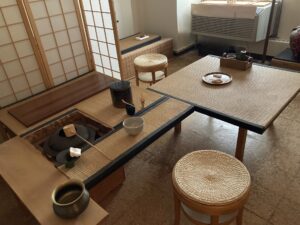
Cha-shitsu, 茶筌, tea-room, with one and three-quarter mats. The ro is located in the corner of the tatami and is called a sumi-ro, 隅炉, corner-hearth.
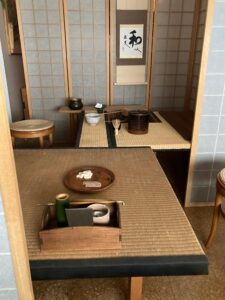
Arrangement of utensils in preparation of usu-cha, 薄茶, thin-tea. The scroll may be displayed almost anywhere in the Tearoom at any time. Different schools of Chanoyu have their own rules. However, an individual person may choose their own way in expressing their personal aesthetic. Rules are learned but should not be an impediment to one’s own creativity. Rikyū said that if a person had but one kama, one could still make the best tea. Sen no Rikyū was constantly experimenting within the tenets of Chanoyu.
I-kkyaku i-ttei, 一客一亭 , one-guest one-host, is a Tea gathering with just one guest. A room suitable for two persons is two daime tatami. Sen no Rikyū created a one and a daime tatami tearoom that was destroyed in the great fire of 1788 and was rebuilt as a nijō, 二畳, two tatami, with a daime, and the space is named ‘Fu-shin-an’, 不審菴, No-judgement-hut, Rikyū’s Buddhist name, Fushin. This room is located at Omotesenke in Kyōto.
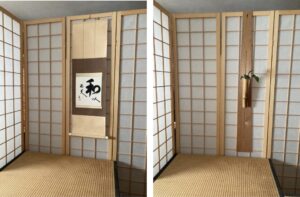
Shoji, 障子, can be used to create various size areas for making Tea. The origin of some yojōhan cha-shitsu, 四畳半茶室, four-tatami-half tea-room, Tea spaces were created in eighteen mat rooms with byō-bu, 屏風,, wall-wind. This is called kakoi, 囲い. Left: improvised tokonoma for sho-za, 初座, first-seating, when a meal is served with only the kakemono is displayed. Right: improvised tokonoma for go-za, 後座, latter-seating, when tea is presented with only the cha-bana, 茶花, tea-flower, is displayed.
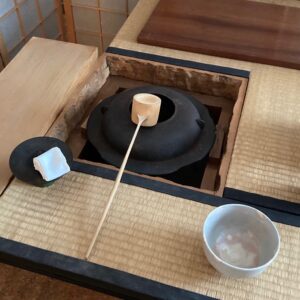
The ro, 炉, hearth, with suki-gi gama, 透木釜, pass through-wood kettle, tetsu, 鉄, iron, with lid of Kara-kane, 唐銅, Tang-copper, bronze, resting on sukigi, wooden blocks, placed on the copper ro-dan, 炉壇, hearth-foundation, by Taka-hashi Kei-ten, 高橋敬典, High-bridge Respect-celebrate, Nin-gen Koku-hō, 人間国宝, Person-interval National-treasure. The bamboo hi-shaku, 柄杓, handle-ladle, rests on the open kama. The folded, hemp cha-kin, 茶巾, tea-cloth, is placed on the kama no futa, 釜の蓋, kettle’s lid.
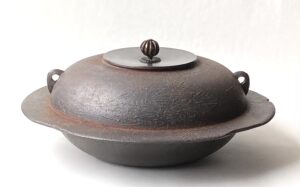
The kama is patinated tetsu, 鉄, iron, with a wide flaring hane, 羽, wing, with overall pattern of shiki matsu-ba, 敷松葉, spread pine-leaves (needles). The diameter of the body of the kama is 8.5 sun kane-jaku, and the diameter of the hane is 8.5 sun kujira-jaku.
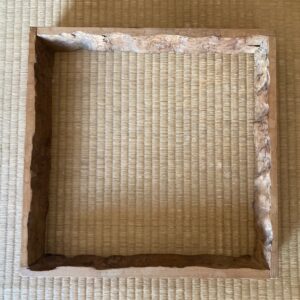
Ro-buchi, 炉縁, hearth-frame, sugi, 杉, cedar, retaining abraded exterior of the aged wood. Inscribed in pencil on the exterior: Tai-shō Jū-san-nen, 大正十三年十月, Great-rectitude 13 year 10 month. Kyō-to Go-sho, 京都御所, Capital-city Hon.-place (Imperial Palace). Partial inscription includes the words, me-ryō, 馬寮, horse-bureau, and cha-seki, 茶席, tea-seat. In the imperial court there were two groups, sa-u-me-ryō, 左右馬寮, left-right-horse-bureaus, that were headed by the Ashi-kaga, 足利, Foot-advantage, and later the Toku-gawa, 徳川, Virtue-river, Shō-gun, 将軍, Commander-army, who were given the title of Go-kan, 御監, Hon.-commander. Note that a robuchi frame with a width less than one sun kane-jaku is used only with an i-mae, 位前, be-fore, at soto-zumi, 外角, out-corner.
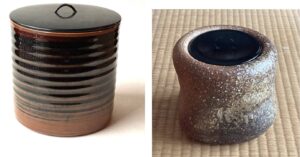
Left: mizu-sashi, 水指, water-indicate, hitoe-guchi, 単口, one layer-opening, porcelain vessel with black to brown glaze, Se-to-yaki, 瀬戸焼, Rapids-gate-fired, signed Izumi gama, 泉窯, Spring-kiln; H. 5 sun kane-jaku, with a black nuri-buta, 塗蓋, lacquer-lid, which acts like a mirror. The arch handle, tsumami, 摘み, pinch, reflected in the lid forms a circle, which is a symbol of water, and is a manifestation of In and Yō, 陰 陽, Yin and Yang, negative and positive.
Right: mizu-sashi, Shigaraki-yaki, 信楽焼, Truth-pleasure-fired, ash-glaze. Such water vessels were made without a self-lid, as the origins were filled with water used by potters when working with clay. Others were used as saya, 鞘, sheaths, that protected objects from the fire and ash buildup when being fired in kilns.
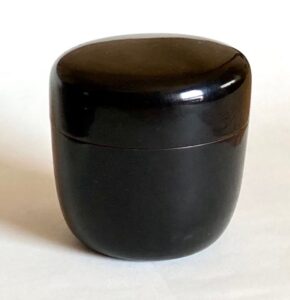
Rikyū gata chū-natsume, 形中棗, style middle-jujube. Sen no Rikyū mastered the way of Chanoyu, and used the walnut shell as the measure for filling a tea container. The measure has evolved into the cha-gō, 茶合, tea-measure, yet the tea container preferred by Rikyū has remained the same. In Urasenke Chanoyu, the preferred tea container is the Rikyū gata chū-natsume, 形中棗, style middle-jujube. It is a relatively small, covered, ovoid container made of turned wood and coated with shin-nuri, 真塗, true-lacquer, a mirror-finish, black lacquer. The Rikyū-gata chū-natsume is of such importance that it is used for preparing both koicha and usucha.
The natsume, 棗, jujube, is a small deciduous tree of the buckthorn family, with fruit that is at times called a Chinese date. There are many varieties, but the preferred fruit is a large, ripe, ovoid with shiny black skin. The name, jujube, derives from its scientific name: Ziziphus jujuba. The Japanese name, natsume, comes from the fact that buds, me, 芽, appear in summer, natsu, 夏. ‘Natsume’ could be written with the Kanji, natsu-me, 夏芽, summer-bud.
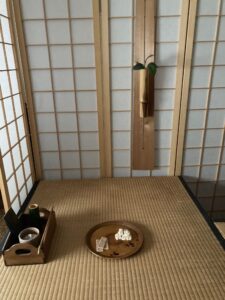
Bamboo kake hana-ire, 掛花入, hang flower-receptacle, by Nishi-kawa Bai-gen, 西川楳玄, West-river Prunus-mystery, Kyōto.
Maru-bon, 丸盆, round-tray, wood with lacquered design of tsuta, 蔦, vine, with two kinds of hi-ga-shi, 干菓子, dry-sweet-of, uchi-mono, 打物, struck-thing, molded sugar in the form of ‘Shichi-fuku-jin’, 七福神, Seven-fortune-gods, and soba-ita, 蕎麦板, buckwheat-boards, by Owari-ya, Kyōto.
Rectangular wooden tabako bon, 煙草盆, smoke-plant tray, wet with hi-ire, 火入, fire-receptacle, hai-fuki, 灰吹, ash-blow, reed and brass kiseru pipe, and paper envelope, tabako-ire, 煙草入, smoke-plant-receptacle. Smoking paraphernalia are for the relaxation and pleasure of the guests. Handling fire in the pipe allows the guest to be in control of fire, which is the priority of the master of the house.
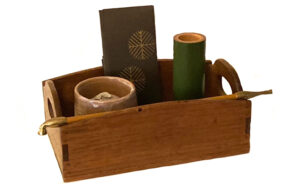
Tabako bon, 煙草盆, smoke-plant tray, sugi, 杉, cedar, set with various smoking articles: hi-ire, 火入,fire-into, beni-Shi-no yaki, 紅志野焼, red-Aspire-field fired, set with a piece of burning charcoal, kō-ta-don, 香炭団, incense-charcoal-circle; black paper envelope tabako-ire, 煙草入, smoke-plant-into. The design on the black paper tabako-ire is Kara-matsu, 唐松, Tang-pine, larch, which alludes to matsukaze. The gilt motif of the Karamatsu is the choice of Tantansai, XIV, Iemoto, Urasenke. Tobacco is a kind of incense. Although the smoking articles are functional, they allow the guest to handle fire, which elevates their stature, and they become the masters of fire. The hiire should be passed among the guests so that one can feel the ‘warmth’ of the spirit of the host.
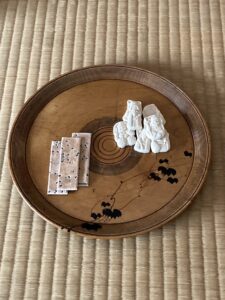
During usucha the sweets ideally contain a shin, 真, true, offering of pressed sugar higashi, which in Shintō is called shin-sen, 神饌, god-food offering. In this instance, the pressed sugar offering is in the form of the seven lucky gods, called the Shichi Fuku-jin, 七福神, Seven Fortune-gods. The shin offering is placed in the upper right hand corner of the tray, and the other dry sweet is placed in the lower left corner. The shin sweet is preferred, and the second sweet offering can be a variety of options based on the host’s choice and the theme of the gathering.
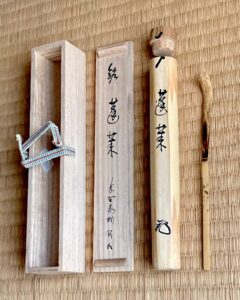
Tea scoop, cha-shaku, 茶杓, tea-scoop; bamboo naka-bushi, 中節, middle-node, crafted by Kage-bayashi Sō-toku, 影林宗篤, Shadow-grove Sect-kind; L. 6 sun kane-jaku; named ‘Hōrai’, 蓬莱, Mugwort-goosefoot, by Matsu-naga Gō-zan, 松長剛山, Pine-long Strong-mountain, abbot of Kō-tō-in, 高桐院, High-paulownia-sub temple, Dai-toku-ji, 大徳寺, Great-virtue-temple, Kyōto. The mythical island of Hōrai is where the Shichi Fukujin live.
Tomo-zutsu, 共筒, self-tube, bamboo, inscribed Hō-rai, 蓬莱, Mugwort-goosefoot, with the abbot’s ka-ō, 花押, flower-seal, a stylized number of his generation as abbot.
Box lid inscribed from the top; mei, 銘, inscription, Hō-rai, 蓬莱, Mugwort-goosefoot, Murasaki-no, 紫野, Purple-field (area of Daitokuji), Kō-tō, 高桐, High-paulownia, Gō-zan, 剛山, Strong-mountain.
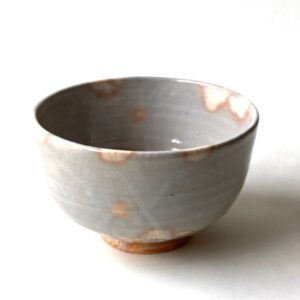
Cha-wan, 茶碗; tea-bowl; gray and pink glazed ceramic, O-suna yaki, お砂焼, Hon.-sand fired, by Kawa–hara Tō–sai, 川原陶斎, River-field Ceramic-abstain, Miya-jima–guchi, 宮島口, Palace-island-mouth. Made for Itsuku-shima Jin-ja, 厳島神社, Strick-island God-shrine.
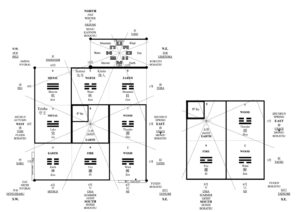
Left: diagram of the yojōhan showing the location of the ro. Right: diagram of a nijō incorporating the location of the ro as in the yojōhan. This is the plan of Rikyū’s nijō chashitsu ‘Tai-an’, 待庵, Wait-hut, with its sumi-ro, 隅炉, corner-hearth.
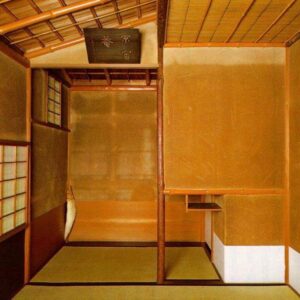
Rikyū’s nijō chashitsu ‘Tai-an’, 待庵, Wait-hut, at Myokian, 妙喜庵, Wondrous-joy-hut, with tatami set for presenting tea with a furo.
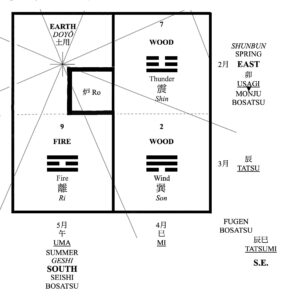
Diagram of a nijō, as in Sōtan’s Konnichian, with the ro moved from the corner to muko-giri, 向切, opposite-cut. The area in the diagram above that is identified with Earth and Doyō is covered with wood flooring, ita-datami, 板畳, board-‘tatami’. The board resembles the baseboard, ji-ita, 地板, earth-board, of the dai-su, 台子, support-of, however, according to tradition, no utensil is placed on the board.
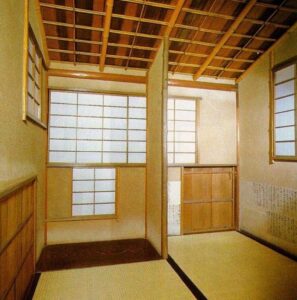
Kon-nichi-an, 今日庵, This-day-hut, is the name of the tea room built in 1646 by Sen no Sō-tan, 千宗旦, Thousand ’s Sect. This image shows Konnichian with tatami suitable for serving tea with a furo. Sōtan invited various abbots to join him for Tea in his newly constructed room that was the size of two tatami, ni-jō, 二畳. Sōtan had invited Sei-gan O-shō, 清巌和尚, Pure-cliff Harmony-esteem, the abbot of Dai-toku-ji, 大徳寺, Great-virtue-temple, the head temple of the Rinzai Zen Sect. When Seigan did not arrive, Sōtan left a note for him to come another day. Seigan arrived late and found Sōtan’s note, who, in turn, left a note which read “Ke-tai no biku asu wo kisezu”, 懈怠比丘不期明日, Lazy monk does not expect tomorrow. It is from this note that Sōtan named the hut Konnichian. Perhaps Sōtan chose ni-jō, 二畳, two-tatami, because of wordplay with the Buddhist ni-jō, 二乗, wo-power.
In Buddhism, “ni-jō” , 二乗, two-power, refers to two practitioners striving for their own enlightenment and liberation.This refers to the Shravakayana (hearing the Buddha’s teachings) and the Pratyekabuddhayana (attaining enlightenment alone). In Mahayana Buddhism, such as the Lotus Sutra, it was considered a self-centered form of practice that did not involve altruistic acts, but later, attaining Buddhahood was recognized.
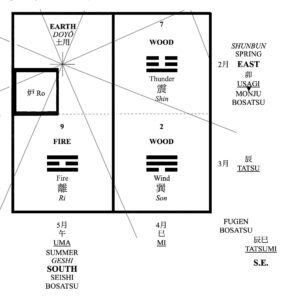
Diagram of a nijō, with sumiro positioned as pictured in Garandō above. As with Konnichian, the area in the diagram above that is identified with Earth and Doyō is covered with wood flooring, ita-datami, 板畳, board-‘tatami’. The board resembles the baseboard, ji-ita, 地板, earth-board, he dai-su, 台子, support-of, however, however, according to tradition, no utensil is placed on the board.
While the ro is preferred in the cold half of the year, from November through April, the furo can be used in any Tearoom throughout the year if a sunken hearth is not available.
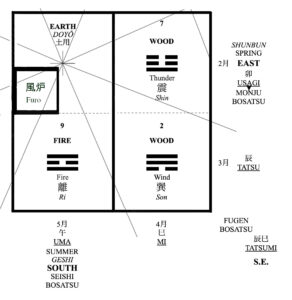
Diagram of a nijō, with fu-ro, 風炉, wind-hearth, placed directly over where the the sunken ro would be.
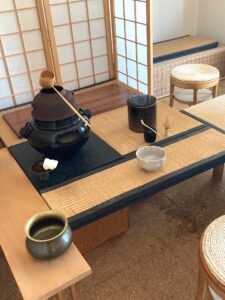
Ki-men bu-ro, 鬼面風炉, demon-face wind-hearth, placed on an ō-ita, 大板, large-board, on a dai-me tatami, 台目畳子, support-space tatami. The portable furo is placed directly over the permanently situated sunken ro, 炉, hearth.
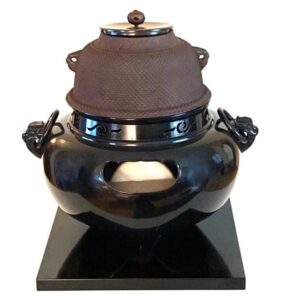
Ki-men bu-ro, 鬼面風炉, demon-mask wind-hearth, kiri-kake bu-ro, 切掛風炉, cut-hang wind-hearth, Kara-kane, 唐銅, Tang-copper, bronze. by Kana-mori Jō-ei, 金森浄栄, Gold-woods Pure-splendor. Attached rings are upright when there is a fire within the furo.
Kama, 釜, kettle, tetsu, 鉄, iron, arare, 霰, hailstone, pattern.
Shiki-ita, 敷板, spread-board, shin-nuri, 真塗, true-lacquer, protects the tatami.
Furo full height with kama: 9 sun kujira-jaku, with a diameter of 8 sun kujira-jaku (with kimen – 9 sun kujira-jaku).
Height of furo only, 5.8 sun kujira–jaku, or 7.25 sun kane-jaku.
Kama height with lid, 4.3 sun kujira-jaku, or 5.3 sun kane-jaku; height without lid 3.8 sun kujira-kane, diam. without hane 6 sun kane-jaku.
Furo opening diam. 5.5 sun kujira-jaku, or 6.9 sun kane-jaku.
Kama opening diam. 2.75 sun kujira-jaku, or 3.5 sun kane-jaku.
Furo height 5.8 sun kujira-jaku.
Kama no lid height 3.8 with lid 4.3 sun kujira-jaku.
The diameter of the kama is 6 sun kane-jaku, and the diameter of the furo is 8 sun kujira-jaku.
The number 6 is symbolic of Infinity in Time and emblematic of Water, and the number 8 is symbolic of Infinity in Space. The kama and furo together manifest the two means of measuring utensils used in Chanoyu.
The utensils used with the furo may be the same as those utensils used with the ro, with few exceptions: sumi, 炭, charcoal, take bi-shaku, 竹柄杓, bamboo handle-ladle, and take futa-oki, 竹蓋置, bamboo lid-place. The principal difference between the utensils for furo and ro, is that the charcoal, sumi, 炭, and related paraphernalia for ro is larger than that for furo. In general, the utensils for furo are measured with the kane-jaku, 曲尺, bend-measure, and those for ro are measured with the larger kujira–jaku, 鯨尺, whale-measure.
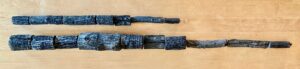
Top sumi and incense for furo, bottom sumi and incense for ro.
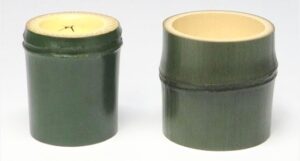
Left: ao-dake moto-bushi futa-oki, 青竹元節蓋置, green-bamboo origin-node lid-place, for furo. Right: ao-dake naka-bushi futaoki, 青竹中節蓋置, green-bamboo middle-node lid-place, for ro. The height of the bamboo futaoki is 1.8 sun kane-jaku.
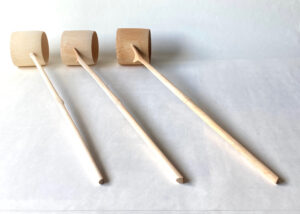
Hi-shaku, 柄杓, handle-ladle, take, 竹, bamboo; length 14 sun kane-jaku.
From left: kazari bi-shaku, 飾り柄杓, display handle-ladle, also called sashi-tōshi hi-shaku, 差し通し柄杓, pass through handle-ladle, is used with both furo and ro. Middle; handle end has flesh cut away for furo; Right: handle end has skin cut away for ro.
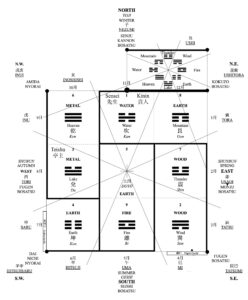
Changing from the ro to the furo involves many activities including emptying the ro, storing the ash, covering the opening of the ro, and replacing the tatami. There are instances where the ro has the wooden flooring replaced over the ro opening, and a small square of tatami is fitted over the ro. Some people simply change the tatami. The hanjō usually is the tatami that has the ro cut in it, and when changing to the furo, the hanjō is placed at the host’s entrance, which is called cha-do guchi, 茶道口, tea-way opening, as well as fumi-komi tatami, 踏込畳, step-in tatami. A full tatami is moved to be parallel with the guests’ tatami this is called maru tatami,丸畳, round-tatami, and it is a full tatami.
Traditionally, the ro is opened around November, the 11th month which is the month of the I, 亥, Wild boar. Also the opening of the ro corresponds with the first I no Hi, 猪の日, Wild Boar’s Day. The first use of the furo has no specific custom. However, the furo is first used around the time of Cha-tsumi, 茶摘み, Tea-picking. Tea is picked over a period of the twenty-one days, with the middle day called hachi-jū-hachi-ya, 八十八夜, eight-ten-eight-night – it is the 88th day after Ri-sshun, 立春, Start-spring. This number, 88, is the source of the term ‘mukashi’, 昔, past, because the Kanji for mukashi is composed of numbers that total twenty-one.
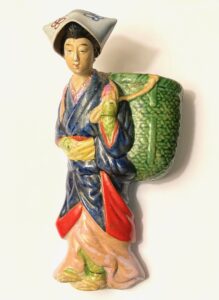
Ceramic figure of a tea-picker, Ban-ko-yaki, 萬古焼, Ten thousand-old-fired; H. 7.5 sun kane-jaku. Stamped Made in Japan, – made for the western market.
The start of May marks 88 days from the start of Risshun and marks the start of tea picking in the Kyōto area. The day is known as hachi-jū-hachi, 八十八, eight-ten-eight, 88, which can also be written as the Kanji for kome, 米, rice, which represents infinity in all directions. Adding the radical for kusa, 艹, grass, creates the Kanji for cha, 茶, tea: Tea is omnipresent.
For further study, see also: Tea in April, April Collection, and May Days of Chanoyu