Sanshoku: Three Colors
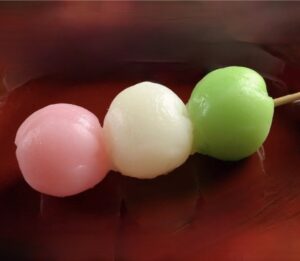
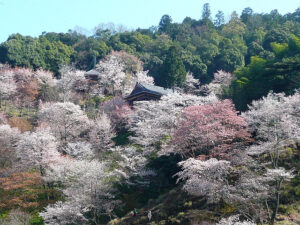
San-shoku dan-go, 三色団子, three-colors round-of, are known by different names depending on times and local traditions. For example, Hana-mi dango, 花見団子, flower-see dango, are often enjoyed for cherry blossom viewing.
A variation on the neame is ‘mochi-bana’, 餅花, mochi-flower, and it is made of a pink, a white, and a green ball of mochi, placed on a yō-ji, 柳枝, willow-branch, or skewer of dogwood, mizu-ki, 水木, water-wood (Cornus controversa) rather than using the common bamboo skewer.
The tradition of flower viewing dates back to the Nara and Heian periods, and sanshoku dango was popular among the imperial court ceremonies to celebrate the seasons. The specific custom of enjoying the three color mochi with tea became popularized in 1598 during a grand cherry blossom viewing banquet hosted by Toyotomi Hideyoshi.
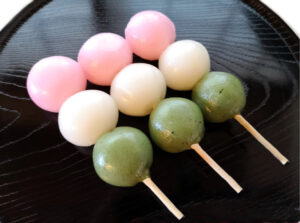
The colors of the sanshoku mochi are described as having various attributes. Some see the progression of pink, white, and green as a direct representation of the cherry tree itself, which begins with pink buds that become white flowers with green leaves that emerge as the blossoms fade.
Others see more than the direct expression of the colors as they appear in the natural growth of the tree. There can be other values applied to the colors.
For some, pink represents the seasonal change into spring, a season of new life and warmer days, an increase in joy, and emotional an/or spiritual renewal, and it may also represent protection to ward off evil spirits.
The white mochi may represent the last of the snow or frost and the ending of the winter season, white often represents starting anew and spiritual purity, as well as being a representation of honoring the ancestors and embracing inner peace.
The green mochi may represent the renewal of nature as the green returns to the environment. It can signify health and longevity, vitality and prosperity and signifies a deep connection with nature inherent in many of the core values of Japanese culture.
Many kake-jiku, 掛軸, hang-scroll, seen in the tea room have nature related themes.
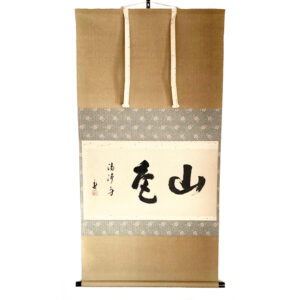
San-shoku, 三色, three-colors, is a homonym for san-shoku, 山色, mountain color/form. It is part of the Zen expression, ‘San-shoku Shō-jō-shin’, 山色清浄心, Mountain-color Pure-pure-body. Calligraphy by Hō-un-sai, 鵬雲斎, ‘Phoenix’-cloud-abstain, written prior to 1976. The text likens the landscape to the body of the Buddha.
An extension of the two character Kanji is the short phrase kei-sei san-shoku, 谿声山色, valley-voice-mountain-body (or color), which is a paraphrase from the Song dynasty Chinese poet Su Shi (蘇軾) also known as Su Tung-po (蘇東坡). Su Shi wrote a poem recorded in the book Record of the Transmission of the Lamp and it is also part of a case within The Blue Cliff Records.
While traveling near Mount Lushanand the Donglin Temple area Su Shi experienced the sound of the valley stream as the teachings of the dharma and the mountain as the body of the Buddha. The poem is often titled ‘On the Stream at Mount Lu’.
Traditional Chinese:
溪聲盡是廣長舌,
山色無非清淨身。
夜來八萬四千偈,
他日如何舉似人。
Modern translation:
The sounds of the valley stream are the (Buddha’s) long broad tongue,
the forms of the mountain are his Pure Body.
In the night, I heard the myriad sutras uttered.
How can I relate what they mean?
Although the phrase consists of only four Chinese characters, 谿声山色, they have been translated into English in many different ways. While the third character (山) is always translated as ‘mountain’, the other three characters have more diverse or nuanced interpretations. The second character (声) indicates either ‘sound’ or ‘voice’, while the final character can mean ‘form’ or ‘color’.
From Shō-bō-gen-zō, 正法眼蔵, lit. Correct-method-eye-storehouse, usually translated in English as the True Dharma Eye Treasury, a book written by the Japanese Zen master Dōgen, is a related phrase ‘Kei-sei-sunawachi kore Kō-chō-zetsu’, 渓声便是広長舌, Valley-voice namely is Wide-long-tongue, are likened to attributes of the Buddha, and is often broken down into the following translation:
- Kei-sei, 渓声, is the sound of the valley stream (representing the sounds of nature, the environment, or reality just as it is).
- Sunawachi kore, 便是, or 即ちこれ, is ‘precisely’, nothing other than.
- Kō-chō zetsu, 広長舌, is ‘the Wide and long tongue’ This refers to one of the 32 physical marks of a Buddha, symbolizing the ability to expound the true Dharma (reality) perfectly and extensively.
The Kanji for san, yama, 山, and san, mitsu, 三, three, are not only homonyms, they have striking visual similarities. Primarily, they contain three straight lines. In the kanji 山, mountain, the lines are oriented horizontally. In the Kanji ,三, three, the lines are oriented horizontally. In some ways, the three vertical lines of the mountain can be seen to be containers or doorways, while the three horizontal lines can be seen to support. It is important to remember that as can bee seen in the trigrams of the Eki-kyō,易経, Change-sutra and on the hakke-bon, 八卦盆, eight-sign tray, used in some tea presentations, the trigram of three horizontal lines represents the principle of Heaven.

Ha-kke bon, 八卦盆, eight-sign tray, black-lacquered wood with shell inlay of the eight trigrams of the Eki-kyō, 易経, Change-sutra. 8.8 sun kujira-jaku. The hakke bon trigrams, 三卦, three-sign, shown in the picture above from 12:00 clockwise are: Kan, 坎, Water, Gon, 艮, Mountain, Shin, 震, Thunder, Son, 巽, Wind, Ri, 離, Fire, Kon, 坤, Earth, Da, 兌, Lake, Ken, 乾, Heaven.
Also related to the concept of the three lines is an excerpt from the Tao De Ching 42:
The Tao begot one.
One begot two.
Two begot three.
And three begot the myriads of things.
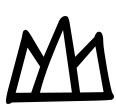
Drawing of an early form of the of Kanji for yama, 山, mountain, with peaks that can imply gateways.
In Buddhism there is a concept called the ‘Three Gates’, which are entry points for an individual to enter liberation from the san-bō-in, 三法印, three-principle-mark, the three marks of existence which are in Sanskrit Japanese and English respectively, anatta, mu-ga, 無我, nothing-ego, no self; annica, mu-jō, 無常, nothing- continually, impermanence ; dukkha, ku,苦, suffering, unsatisfactory-ness or aimlessness. The Three Gates which are in listed Sanskrit, Japanese, and English respectively, are shunyata, 空, void, or emptiness, sometimes referred to as ‘no self’; ānimitta, in Japanese mu-sō, 無相, nothing-aspect, or formlessness, sometimes referred to as signlessness; an apranihita, in Japanaese, mu-negai無願, unsatisfactory-ness or aimlessness. These three marks, as taught by the Buddha, are the basic description of reality for humans, for which there are the Three Gates of Liberation, or realization.
Regarding the gate of ‘Emptiness’ or ‘No Self’, when we look closely everything is connected. While we feel a separate existence as individuals, we all share the same earth. When we see a glass of water and then drink the water the glass is empty of water and yet full of air. The glass does not cease to exist because the water is gone. As an example from a simple scientific perspective, due to interdependent forces of the cosmos’ effect on earth’s gravity, air rarely leaves the atmosphere, we breathe relatively the same air as all beings who have come before us, just as those who come after us will also breathe the same air. Emptiness does not mean non-existence, it could be re-framed as pure potentiality. There is no real separation between anything, and when we realize this interconnection with all ‘things’ we can release egoic concerns and live with joy and ease.
Regarding the gate of ‘Formlessness’ or ‘Impermanence’ the forms of things, or their outer appearance is in a constant state of change. A cloud appears, it becomes rain, the rain falls on the plants, which helps them grow food, which we cook and enjoy. When we are no longer attached to temporary labels or perceive forms as concretized, we transcend birth and death and enjoy the wonderful, ever-changing journey of life.
Regarding the gate of ‘Unsatisfactory-ness’ or ‘Aimlessness’ this is the letting go of chasing after the latest new object of desire and relinquishing the pursuit of endlessly running after something we must attain, because we already have everything we need to end our self created afflictions and become liberated.
Many non-religious and/or non-spiritual people, as well as seasoned practitioners alike, intuitively utilize the teachings of the Three Gates of Liberation to attain freedom from attachment, aversion, and ignorance, regardless of whether they follow Buddhist teachings.
When practicing forms of Buddhism related to teh Three Gates of Liberation, people may turn to any number of deities for support. One of the groupings of deities to which many Buddhist practitioners look is called the Shaka San-zon, 釈迦三尊, Explain-(sound) Three-lords. The Shaka Sanzon depicts the Buddha as the central figure Shaka-Nyorai, 釈迦如来, Explain-like-become, the historical Buddha, with his attendants, Fu-gen Bo-satsu, 普賢菩薩, Universal-wisdom Grass-buddha and Mon-ju Bo-satsu, 文殊菩薩, Literary-exceptional Grass-buddha.
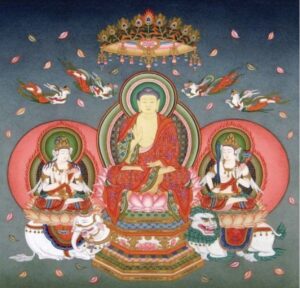
In this image the Buddha is the central figure with a white or golden glow emanating from his body. On the Buddha’s left is Monju, seated on a green lion. Monju symbolizes wisdom, and is usually associated with the color green. On the Buddha’s right is Fugen, seated on a white elephant. Fugen symbolizes meditation and action and is often associated with the color red.
Many other practitioners find great motivation from the deity known as the Mother of Liberation, Tara. Specifically in Vajrayana practices, she is considered to be a Buddha, and the ‘Tārā Tantra’ describes her as a “mother who gives birth to the buddhas of the three times”, who is also “beyond saṃsāra and nirvāṇa”. Like many deities, Tara is capable of taking many forms, three are outlined below.
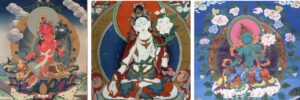
Red Tara, 赤多羅菩薩 , Red Tara Bodhisattva, is associated with the red-colored “fire of transformation”, embodying the magnetizing activity of enlightened compassion. She is revered for transforming desire into wisdom.
White Tara, 白多羅菩薩, White Tara Bodhisattva, is seen as compassionate, mother-like nurturing, promoting longevity, healing, and purified wisdom.
Green Tara, 緑多羅菩薩, Green Tara Bodhisattva, represents active compassion, swift protection, and enlightened activity.
In many ways the activities associated with these deities are related to qualities that can be evoked through the three colors of the sanshoku dango mentioned above.
The three colors can also be seen in simple aspects of a Tea presentation:
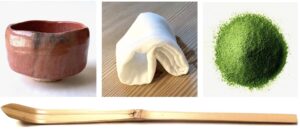
From Left: aka raku cha-wan, 赤楽茶碗, red pleasure tea-bowl, cream-colored ceramic with a clear glaze over mottled red slip glaze; diam. 4 x 2.7 sun kane-jaku, made by Yoshi-mura Sō-raku, 吉村宗楽, Luck-town Sect-pleasure, for Gin-kaku-ji, 銀閣寺, Silver-pavilion-temple, Kyōto.
Center: cha-kin, 茶巾, tea-cloth, fabric made of asa, 麻, hemp, thread.
Right: ma-tcha, 抹茶, ground-tea.
Bottom: cha-shaku, 茶杓, tea-scoop.
While both symbolic and delicious, sanshoku dango or hanami dango can be implied during a Tea presentation simply by choosing a bowl that approximates a pink or red tone.
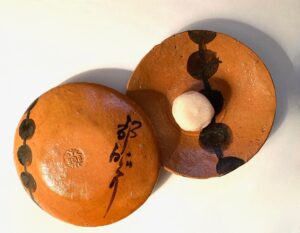
Two mei-mei zara, 銘々皿, name-name plate, terracotta dish made by Ei-raku, 永楽, Ever-pleasure, for the Miyako Odori, 京おどり, Capital-dance, in Kyōto. Diam. 4 sun kane-jaku. A different plate is made each year to serve sweets at a Tea held in the theater. The design in black glaze is of dango, an emblem of the group of geisha dance and the arts. The back has the dango design and calligraphy, ‘Miyako odori’. The mochi sweet on the dish is made of white an, 餡, modeled after the dango.
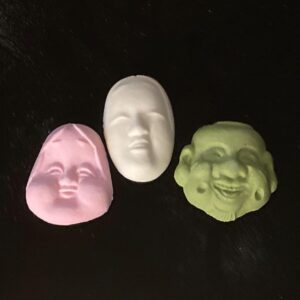
Three hi-ga-shi, 干菓子, dry-sweet-of, molded sugar and rice flour, in the images of Nō masks called Hana Omote, 花面, Flower-mask, by Chō-kyū-dō, 長久堂, Long- -hall. From the left = pink – Otafuku, white – young woman, and E-bi-su, 恵比寿, Joy-as-longevity.
Chanoyu embraces many aspects of Japanese Culture – and at it’s roots, in many ways, Chanoyu is Zen.
Sen no Rikyū was the son of a dried-fish merchant in Sakai. As a youth, he became interested in Chanoyu, and after studying with Tea masters, devoted his life to Tea. Among these teachers were Buddhist priests, and as such, his Tea was greatly influenced by Buddhism.
One of his early names was Hō-sen-sai, 抛筌斎, Discard-weir-abstain. Later, he took the name Sō-eki, 宗易, Sect-change, which is based aspects of Taoism, Dō-kyō, 道教, Way-belief, such as the I Ching, Eki-kyō, 易経, Change-sutra. As a Japanese person he followed Shin-tō, 神道, God-way.
Sen no Rikyu’s early name Hōsensai is reference to the Taoist teachings of Zhuangzi or Chang-zu, 荘子, Dignified-child, a great Taoist master of the Warring States period (476–221 BC). It is also a reference to the Zen interpretation of the teaching of ‘forgetting the weir’, in kanji, 忘筌. In the Taoist interpretation, once the fish has been caught, the weir is no longer necessary. In Zen, this has been interpreted through the story of a man having crossed a river using a raft, he continues to drag the raft along with him, though it is no longer needed.
Put in a way that Sen no Rikyu espoused through his wabi and Zen inspired approach to Tea: the implements, acquisition of tools, and documents of authority in Tea, are not what we are to hold most precious. The practice cannot be defined or found in objects and rules alone. Though we must learn the rules and use the tools, attachments to material and intellectual acquisitions act as barriers to the practice, the art, and the way of Tea. Ultimately we are to look only to the heart of ourselves, and to the heart of Tea.
For further study, see also: Hishi Mochi and Hanamatsuri and Gotoku: Trivet in Tea and Beyond