
Salt in Chanoyu and Chaji
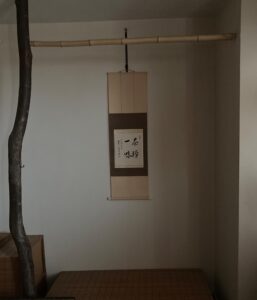
Ga-ran-dō, 伽蘭洞, Attend-orchid-cave, toko-no-ma, 床の間, floor-’s-room, as it would be during the sho-za, 初座, first-seating of a Cha-ji, 茶事, Tea-matter, when the meal, kai-seki, 懐石, heart-stone, meal is served.
The hanging scroll has a shiki-shi, 色紙, color-paper, pasteboard with calligraphy, ‘Cha Zen ichi mi’, 茶禅一味, Tea Zen One Taste, written by Yama–guchi En-dō, 山口円道, Mountain-opening Circle-way, abbot of Man-shu-in, 曼殊院, Wide-especially-temple, Kyōto. This imperial retreat was changed into a Buddhist temple, and has an important tea hut named, Ha-ssō-ken, 八窓軒, Eight-window-eave. Signed: Ha-ssō Cha-shitsu, Eight-window Tea-room, Man-shu Mon-shu En-dō, 曼殊門主円道, Wide-especially Gate-master Circle-way. With red ink stamps for the temple and author.
While the phrase ‘Tea and Zen are one Taste’ is familiar, the expression may also be applied to the meal that is traditionally served prior to the tea presentation. There are a variety of flavors and colors present in the meal, and it is important to note that the vast majority of the dishes contain the ingredient salt.
People in Japan historically have harvested salt, shio, 塩, from the ocean, umi, 海. The etymology of ‘umi’ is obscure, however, the Kanji, 海, includes the Kanji, 水, for ‘water’ and ‘mother’, 母, and implies vastness. The word ‘umi’ may be divided into ‘u’ and ‘mi’, which could be an ancient Japanese form of ‘vast-body’. Salt is essential for human existence, and, paradoxically, too much salt has the power to kill.
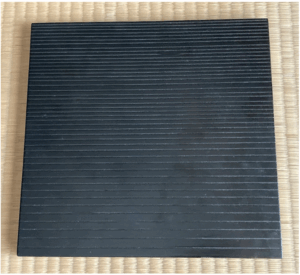
Ara-me ita, 洗目板, rough (surf)-eye board a style of shiki-ita, 敷板, spread-board, which supports the fu-ro, 風炉, wind-hearth, to protect the tatami from the heat of the fire.
One way of seeing the importance of the ocean in tea culture is through the arame ita style of a shiki ita. The arame ita has scored lines that graduate from wide at the front and narrow at the back. This subtle motif implies the waves of the sea. The ridged surfaces of tatami in tearooms could be imagined as evenly oscillating waves on the ocean. Spills on tatami may be cleaned by sprinkling damp sea salt on the stain, and brushing it away when dry.
Shio, 塩, salt, is a prime ingredient in Chanoyu, especially in the meal served in a Cha-ji, 茶事, Tea-matter. Kai-seki ryo-ri, 懐石料理, heart-stone materials-arrangement, is essential in the preparation of foods. The simplest, yet profound, meal is comprised of:
Go-han, 御飯, most-hon.-food
Ichi-ju, 一汁, one-soup salt in the dashi
San-sai, 三菜, one-soup three vegetables (side dishes) salt in the dashi
Su-no-mono, 酢の物, vinegar-thing salt use in making seasoned vinegar
Sake, ni-mono, 煮物, steeped-thing salt in the mold used for fermenting
Ni-mono, 煮物, simmered-thing salt in the dashi
Yaki-mono, 焼物, grilled-thing salt to season
Hashi-arai, 箸洗, sticks-rinse salt used in making umeboshi
Ha-ssun, 八寸, eight-‘inches’: comprised of the following:
Yama-no-mono, 山の物, mountain-’s-thing salt to season
Umi-no-mono, 海の物, sea-’s-thing salt in kelp and other foods from the sea
Kō-no-mono, 香の物, fragrance-’s-thing salt used in pickling
Yu-no-ko, 湯の子, hot water-’s-thing salt in hot water
Omo-ga-shi, 主菓子, main-sweet-of, salt may be used in ingredients, such as miso
Koi-cha, 濃茶, thick-tea
Hi-ga-shi, 干菓子, dry-sweet-of salt may be used in ingredients
Usu-cha, 薄茶, thin-tea
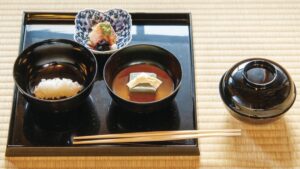
O-shiki, 折敷, fold-spread, square, black-lacquered tray with raised gallery, set with yotsu-wan, 四つ椀, four-bowls: meshi-wan, 飯碗, rice-bowl on the left, shiru-wan, 汁椀, soup-bowl on the right, lids at the left of the tray, and with mukō-zuke, 向付け, opposite-attach, ceramic bowl at the back. With dampened, cedar ryō-boso, 両細, both-narrow, hashi resting on the tray rim.
The most formal Chaji meal is based on Buddhist, vegetarian shō-jin ryō-ri, 精進料理, refined-progress materials-arrangement. In shōjin ryōri each serving utensil is red, a color that is believed to ward off illness. Whereas a typical Chanoyu Chaji has utensils that are black, which is a traditional color of joy and happiness. The following foods are based on a suggested vegetarian diet.
There are several Buddhist traditions and rules, one of the four restrictions is to avoid eating garlic and onions, as the smell might interfere with Zen contemplation. In the preparation of Chanoyu kaiseki foods oils and fats should be avoided.
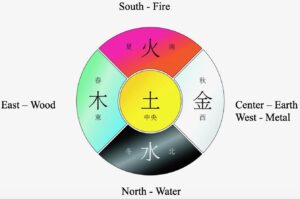
The selection of various foods in Japanese cuisine includes the prime go-shiki, 五色, five-colors: yellow, white, red, black and green. The color black is manifest in some foods as well as in the in yotsu-wan, 四つ椀, four-bowls, and the individual o-shiki, 折敷, fold-tray, for each guest.
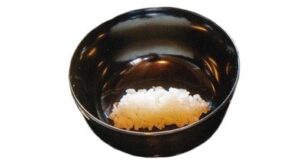
Go-han, 御飯, Most hon.-food; cooked white rice in a lidded bowl. In the shape of ichi-mon-ji, 一文字, one-letter-character.
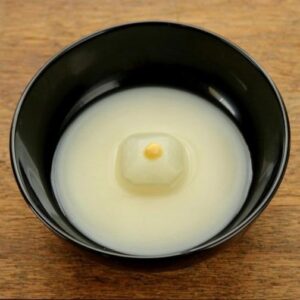
Mi-so shiru, 味噌汁, flavor-enhance soup. The dashi basic soup stock is made of steeped kon-bu, 昆布, ancestor-cloth, dried shii-take, 椎茸, oak-mushroom, and for non-vegetarian soup, katsuo-bushi, 鰹節, bonito-joint. A familiar ingredient in miso soup is simmered dai-kon, 大根, large-root, with a dab of Wa-gara-shi, 和芥子, harmony (Japan)-mustard-of, which is made of na-tane, 菜種, rape-seed, (Brassica napus). Many varieties of miso are made by fermenting soybeans, dai-zu, 大豆. large-bean soy bean (Glycine max), with shio, 塩, salt, and kōji-kin, 麹菌, yeast-fungus, (Aspergillus oryzae).
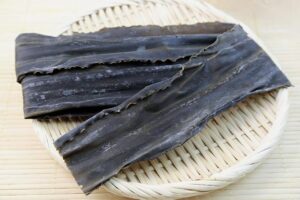
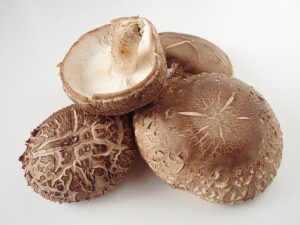
Left: kon-bu, 昆布, ancestor-cloth, the basic ingredient of dashi, 出し, extract, for soup and other dishes. Right: shii-take, 椎茸, oak-mushroom, (Lentinula edodes). The fissures on the mushroom resemble the shell of the tortoise, which is believed to live for ten thousand years. Cooks score and cut away parts of the cap to mimic the tortoise, and to make the mushroom more easily absorb the flavor of the dashi stock.
Ho-shi shii-take, 干し椎茸, dried oak-mushroom, have an intensly concentrated, earthy quality. They contain a mix of flavors including savory, woody, and slightly smoky. Once rehydrated, they are known for the umami flavor they impart to a variety of dishes. The flavor is more potent than that of fresh shiitake. The water used in rehydrating can be used in dashi as well as an addition for simmered dishes and the mushrooms themselves are consumed in a variety of ways.
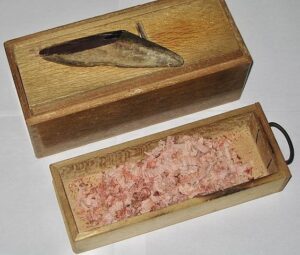
Katsuo bushi, 鰹節, bonito-joint, and box plane for making katsuo flakes. The katsuo is not used in shōjin ryōri.
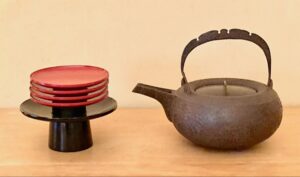
Hiki-hai, 引盃, move-cup, red lacquered saucers, on a black lacquered hai-dai, 杯台, cup-support, with a kan-nabe, 燗鍋, warm (sake)-pot. Left: hikihai, lacquered wood, supported on black-lacquered wooden haidai. Right: kannabe, iron vessel with V-spout and steel bridge handle with a scalloped edge likened to a snowflake, and black lacquered wooden lid.
Sake cups and pitcher commonly used during a Cha-ji, 茶事, Tea-matter. The host pours sake from each of the guests. Two more servings of sake are offered later in the Chaji. In some circumstances, the host presents another sake bottle, azuke-do-kkuri, 預け徳利, entrust-virtue-advantage, and sakazuki, 杯, sake cups, which the guests may pour for themselves or each other. The person who pours sake assumes a higher status, like a Shintō priest, Gū-ji, 宮司, Palace-official, pouring o-mi-ki, お神酒, hon-sacred-sake. The guests also have an opportunity to pour sake for the host.
After tasting the rice and soup, sake is served. Then the su-no-mono, 酢物, vinegar-’s-thing, is eaten from the mukō-zuke, 向付け, opposite-attach. The salad course is regarded as sakana, which commonly contains seafood.
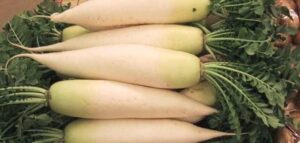

Left: dai-kon, 大根, large-root, giant radish, (Raphanus sativus L.) belonging to the mustard family (Brassicaceae); much favored a staple in the radish is eaten raw, simmered, roasted, pickled, etc.
Right: field of flowering mustard – Wa-gara-shi, 和芥子, harmony (Japan)-mustard-of, is made of na-tane, 菜種, rape-seed, (Brassica napus). The sunomono sauce is based on the proportions of ingredients named san-bai-zu, 三杯酢, three-cup-vinegar:
Su, 酢, vinegar 3Tbs
Sa-tō, 砂糖, sand-sugar, granulated white sugar 2Tbs
Shō-yu, 醤油, ‘soy’-oil 1Tbs
Shō-yu, 醤油, ‘soy’-oil; can be a sauce or a paste similar to miso and the ingredients for the fermentation process are made from kōji mold and salt water. Similarly, salt is used in the fermentation process of making seasoned vinegars.
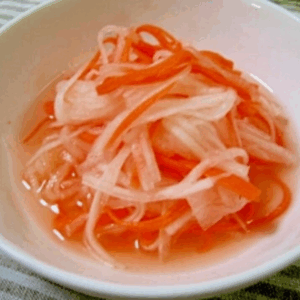
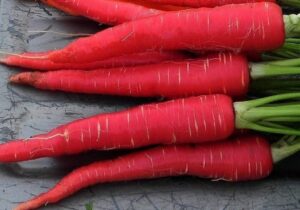
Namasu, 膾, ‘salad’, also called Kō-haku namasu, 紅白膾, Red-white-‘salad’, which is part of the New Year’s o-sechi ryō-ri, 御節料理, most hon.-season, consisting of ‘matchstick’ cut daikon and nin-jin, 人参, person-going, carrot (Daucus carota), pickled in vinegar, sugar, and salt. Namasu is offered to guests when first attending a Tea gathering. The word salad is derived from the Latin word sal, and in kaiseki, the ‘salad’ is often presented as salt mixed with bitter greens.
Right: red carrot from Kyōto creates a more accurate version of Kō-haku namasu, 紅白膾, Red-white-‘salad’.
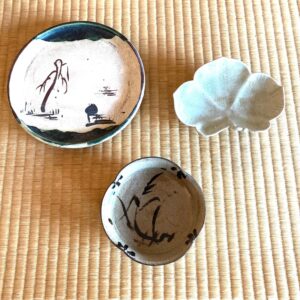
Ceramic serving pieces other than lacquered wooden utensils that may be used for mukō-zuke, 向付け, opposite-attach, in the kaiseki meal.
Lower center – shallow bowl in the form of kaki-no heta, 柿の蔕, persimmon-’s-sepal, (good for the throat) with an image of ashi, 葦, phragmites, that grow along waters edge, Kara-tsu yaki, 唐津焼, Tang-port fired.
Upper left: plate with an image of a bridge, willow tree, and figure in a boat, with green patches, Ori-be yaki, 織部焼, Weave-guild fired. Used to serve yaki-no-mono, 焼の物, fired-thing. Originally intended for a lamp to catch oil drips; abura-zara, 油皿, oil-dish.
Upper right; chestnut leaf-shaped dish with three feet, Se-to yaki, 瀬戸焼, Rapids-door fired, used to serve kō-no-mono, 香の物, fragrant’s-thing, pickled vegetables.
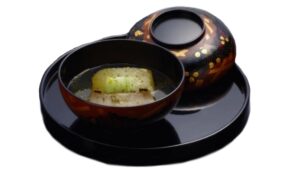
Ni-mono, 煮物, boiled-thing; salt is present in stock and cooking foods. Kyū-ji bon, 給仕盆, grant-serve tray, black-laquered round tray with low gallery: diam. 8 sun kane-jaku. Used by the host to serve individual guests. The nimono is the most important food course of the meal, and should be prepared by the host, whereas the host may have assistants identified as han-tō, 半東, half-east, provide help with the other courses.
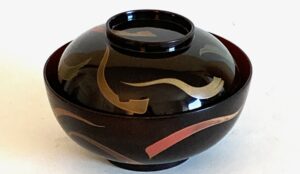
Ni-mono wan, 煮物椀, simmered-thing bowl, lacquered wooden bowl with lid, and adorned with colorful ribbons of dried awabi, 蚫, abalone, to be used in creating dashi. Dried awabi is offered to deity, and is the source of the auspicious motif called noshi gami, 熨斗紙, flattened-measure, stretched dried abalone as an substitute for an offering envelope for money, and gifts.
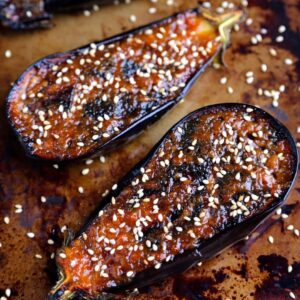
Yaki-mono, 焼物, grilled-thing: nasu den-gaku, 茄田楽, eggplant field-pleasure. Depicted above is grilled eggplant with miso and go-ma, 胡麻, foreign-flax, sesame seeds cooking, in preparation for slicing and serving. The eggplant may be salted in its preparation – shio-yaki, 塩焼, salt-fired. Brining eggplant in salt before grilling is a highly recommended technique to remove excess water, eliminate bitterness, and prevent the slices from becoming mushy.
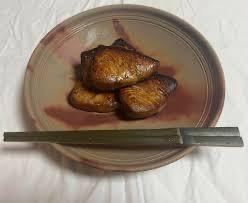
Azuke-bachi, 預け鉢, entrust-bowl, various morsels of the food to accompany sake contained in an azuke do-kkuri, 預け徳利, entrust virtue-advantage, and drunk from gui-nomi,ぐい呑み, gulp-drink.
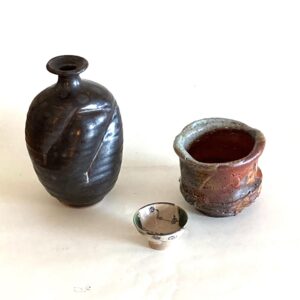
Sake azuke to-kkuri, 預徳利, entruse virtue-advantage, black glazed ceramic bottle by Makoto Yabe; H. 5 sun kane-jaku. Large ceramic cup of rugged form and glaze – and a small sakazuki, 盃, sake cup, Oribe yaki. Above depiction shows the range of sizes of sake cups. The guests may serve themselves and each other.
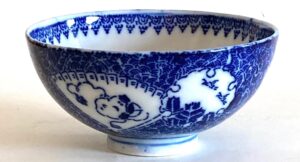
Azuke bachi, 預鉢, entrust bowl, porcelain some-tsuke, 染付, dye-attach, with auspicious designs including a mask of O-ta-fuku, お多福, O-much-fortune: diam. 3.5 sun kane-jaku. As a special treat for the guests, the host may offer additional sake and foods called azuke tokuri, 預徳利, entrust-virtue-advantage, and azuke bachi, to which they may help themselves. For some Tea masters, the additional sake and foods lay outside the parameters of Buddhist restraint of eating to ward off hunger during meditation.
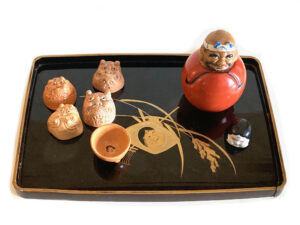
Sake bottle and sake cups for Setsu-bun, 節分, Season-divide, February 1, 2026. The sake bottle, porcelain tokku-ri, 徳利, virtue-advantage, in the form of Daruma, his limbs hidden, his head is the cup for sake, as is the smaller head of Otafuku. Sakazuki, 盃, sake cups, in the form of oni men, 鬼面, demon masks, with tiny fuku-mame, 福豆, fortune-bean, mask of Otafuku inside each. The utensils are arranged on a bon, 盆, tray, rectangular, black-lacquered, with a gilt design of an Otafuku men, 面, mask, in a bamboo basket, mi, 箕, winnow, rice plant, and a kuma-de, 熊手, bear-paw, rake.
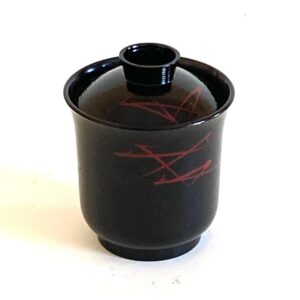
Hashi-arai, 箸洗, chopstick-rinse; flavored hot water called kō-sui-mono, 香水物, fragrant-water-thing, to rinse hashi, 箸, chopsticks; H. 3.2 sun kane-jaku. The hot water can be flavored with a variety of ingredients such as ume-boshi, konbu, etc.
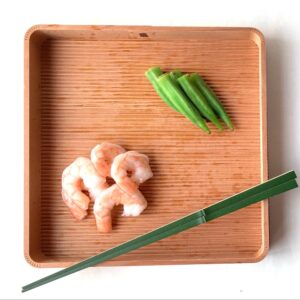
Ha-ssun, 八寸, eight-‘inches’, yama-no-mono, represented by oka-ren-kon, 陸蓮根, okra, (Abelmoschus esculentus) umi-no-mono, represented by ebi, 海老, shrimp, as a bid to Ebisu. Ao-dake naka-bushi hashi, 青竹中節箸, green-bamboo middle-node sticks, how ever the foods are dry enough so the guests can use their fingers to eat them: and can be called tsumami, 摘み, pinch. Each morsel is placed on the lid of the kōsuimono cup, while the guest is drinking the sake. The measurement of 8 sun is the size of the tray, which is part of Shintō offerings originally at Kasuga Tai-sha, 春日大社, Spring-day Great-shrine, in Nara.
One of the catch phrases of Chaji is “sake sakana”, 酒肴, sake (food with) seafood.
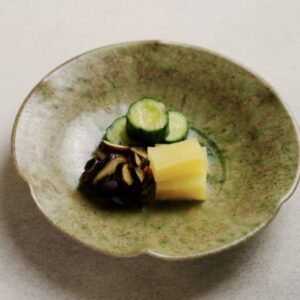
Kō-no-mono, 香の物, fragrance-’s-thing; in yutō course, salt-cured tsuke-mono, 漬物, pickled-thing. The tsuke-mono must include pickled daikon called ‘Taku-an’, 沢庵, Swamp-hut, named after a renowned Buddhist priest who created them. Each pair of Takuan is modeled on the hyō-shi gi, 拍子木, clap-of wood, two blocks of wood that are clapped together to make a sound to call attention to an event such as the beginning of a play or sumo meet. Other choices for pickled vegetables include eggplant, cucumber, mustard greens, etc.
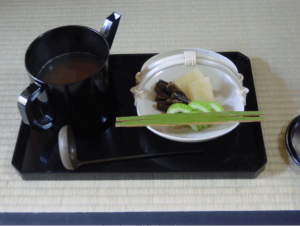
Yu-to, 湯斗, hot water-amount, with a yu-no-ko sukui, 湯の子掬い, hot water-no-of dipper, and with kō-no-mono, 香の物, fragrance-thing, various pickled vegetables in a bowl carried on a black-lacquered waki-biki bon, 脇取盆, side-take tray, is used to transport several utensils at one time. The pickled, aged konomono are complimentary to the fresh raw ingredients of the sunomono served at the beginning of the meal.
The yuto often contains the leftover slightly crisp brown rice and lightly seasoned hot water. This presentation is meant for the guest to use broth and the pickled vegetables as a way of cleaning the bowls on their individual oshiki, beginning with the soup bowl then pouring liquid into the rice bowl to enjoy as a type of ochazuke. This finishes up any leftover rice, while also ensuring the cleanliness of the bowl. Once finished, the lids are replaced on the bowls. And finally, the hashi are dropped by the guests, in unison onto the, tray – which signals the completion of the meal.
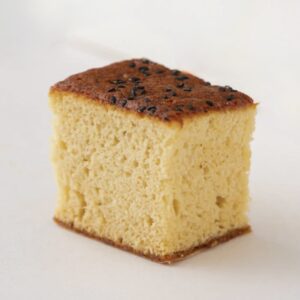
Miso-matsu-kaze, 味噌 松風, pine-wind, is a possible omo-ga-shi, 主菓子, main-sweet-of.
The original sweet was made with miso and Dai-toku-ji nattō, 大徳寺納豆, Great-virtue-temple fermented soy beans, which are made at Oda Nobunaga’s mortuary temple of Sō-ken-in, 総見院, All-see-sub-temple. Unlike familiar mucilaginous nattō, Daitokuji nattō are the quintessence of miso-like saltiness.
The history of matsu-kaze sweet includes ‘the barrenness of the seashore’. It was originally created by the head priest of Daitoku-ji for a neighboring temple, Ishiyama Hongan-ji, which was facing an extreme food shortage during a campaign conducted by Oda Nobunaga. Later, during the Edo period, the sweet was often presented at the Imperial court and was considered to be auspicious.
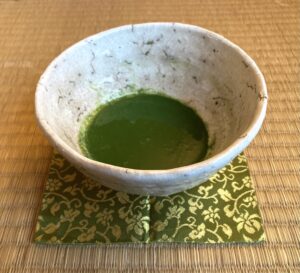
Cha-wan, 茶碗, tea-bowl, Hagi-yaki, 萩焼, Bush clover–fired, partially filled with green ma-tcha, 抹茶, powdered-tea, supported on a silk ko-buku-sa, 古帛紗, old-cloth-gauze, placed on tatami, 畳, grass mat.
The deep green color of koicha, for some, may evoke the Zen phrase, ‘ Sei-zan ryoku sui’, 青山緑水, Azure-mountain green-water. This is from a comment on Picture 9 of the 10 Ox Pictures, on the pursuit of a Zen mind. Things are as they appear.